
What we have seen in ecommerce content production is this: most teams have a writing process, but very few have a publishing system that protects quality, SEO intent, and lead generation at the same time.
If you want a production model tailored to your Shopify stack and team size, Contact StoreBuilt.
Table of contents
- Keyword decision and research inputs
- What a production system must solve
- 7-stage Shopify content workflow
- QA table before publishing
- Governance cadence for UK teams
- StoreBuilt example
- Final StoreBuilt point of view
Keyword decision and research inputs
Primary keyword: shopify content production system for uk ecommerce teams
Secondary keywords:
- ecommerce content workflow UK
- shopify SEO content operations
- content QA checklist ecommerce
- shopify blog process for lead generation
Search intent: operational framework for implementation.
Funnel stage: middle.
Page type: playbook and checklist.
Why StoreBuilt can win this topic:
- We run delivery programmes where SEO content must align with Shopify implementation and conversion priorities.
- We use strict briefing and QA frameworks to reduce duplicate output and weak intent matching.
- We connect publishing outputs to commercial pathways, not vanity reporting.
Research inputs used:
- UK SERP analysis for content workflow and Shopify SEO process queries.
- Competitor article-library review from leading UK Shopify agencies.
- Keyword cluster and modifier mapping around production systems, editorial QA, and ecommerce outcomes.
What a production system must solve
A useful system solves five recurring problems:
- inconsistent intent targeting,
- duplicate or overlapping topics,
- weak internal-link architecture,
- variable quality between contributors,
- no commercial handoff from content to enquiry.
If your current process does not control these, publishing more will only scale the problem.
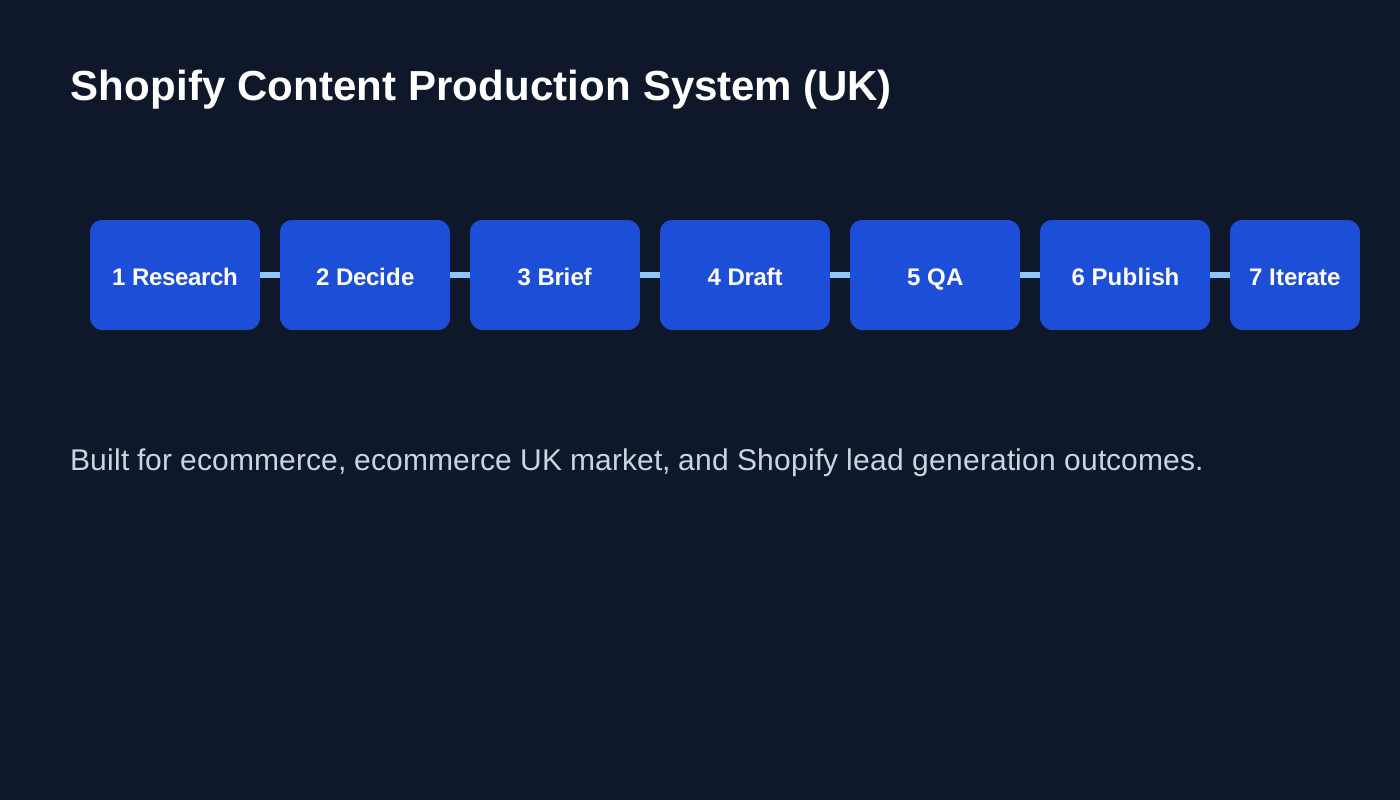
7-stage Shopify content workflow
- Research: verify intent, competitor patterns, and keyword cluster fit.
- Decision: set primary keyword, secondary terms, funnel stage, and page role.
- Brief: define headings, proof points, internal links, CTA placements, and taboo claims.
- Draft: produce full article with practical implementation detail.
- QA: check factual accuracy, SEO quality, duplication risk, and crawlability basics.
- Publish: add visuals, metadata, and CMS-level checks.
- Iterate: monitor rankings, CTR, and assisted conversion signals; refresh quarterly.
This workflow should be visible to every stakeholder, including commercial and development teams.
If you need a done-with-you implementation, StoreBuilt can help.
QA table before publishing
| QA layer | Check | Pass criteria |
|---|---|---|
| Intent | Does article match search intent? | Heading and examples align to query purpose |
| Duplicate risk | Is this too close to existing posts? | Distinct angle and unique practical value |
| Internal links | Are there useful next-step routes? | Links to relevant service/category pages |
| CTA clarity | Is conversion path obvious? | At least 2 contextual Contact StoreBuilt CTAs |
| Accuracy | Are claims defensible? | No invented metrics, no unverifiable assertions |
| Indexability support | Title/meta/slug quality? | Keyword-led, clear, and non-duplicative |
Governance cadence for UK teams
| Cadence | Activity | Owner |
|---|---|---|
| Weekly | Topic review and brief approvals | SEO lead + ecommerce manager |
| Bi-weekly | Production and QA checkpoint | Content + SEO + developer |
| Monthly | Performance and pipeline review | Leadership + channel owners |
| Quarterly | Cluster refresh and consolidation | SEO strategy owner |
This cadence prevents drift and keeps content tied to commercial goals.
StoreBuilt example
A UK Shopify team produced articles regularly but had uneven quality and unclear ownership. We introduced a shared brief template, pre-publish QA gate, and monthly performance review tied to commercial intent.
The process reduced rework, improved consistency, and gave stakeholders a clearer view of what content was actually contributing to enquiries.
Team operating roles
| Role | Core responsibility |
|---|---|
| SEO strategist | Owns keyword decisions, intent fit, and cluster roadmap |
| Content lead | Manages briefs, drafting schedule, and editorial quality |
| Shopify specialist | Validates technical constraints, templates, and UX implications |
| Commercial owner | Confirms CTA relevance and lead-quality expectations |
| Analyst | Tracks rankings, CTR, and assisted-conversion contribution |
When roles are explicit, publishing velocity can increase without lowering quality. When roles are blurred, QA gets skipped and intent drift accelerates.
High-intent AI search implementation layer
The AI-search version of this topic is not just “write more content”. A useful answer engine result needs a page that gives a direct answer, proves the claim, and shows the next operational step inside Shopify.
| Area | StoreBuilt implementation check |
|---|---|
| Primary intent | The page should map to content operations and one clear buyer or operator problem, not a vague traffic topic. |
| Shopify surface | Identify whether the work belongs on a collection, product page, theme section, checkout step, app workflow, email flow, or support process. |
| Proof | Add first-hand observations, product/category examples, screenshots, policy notes, review signals, or trustworthy external sources where they make the advice safer. |
| Internal route | Link the reader to the service most likely to solve the issue: Shopify SEO and AI search readiness. |
| Measurement | Check Search Console, analytics, assisted conversions, enquiry quality, and AI-response mentions after the update rather than judging success by pageviews alone. |
For this article, the useful research inputs are: Google Search Central guidance, Shopify platform documentation, Ahrefs AI Responses/Brand Radar patterns, and StoreBuilt Shopify audit observations. StoreBuilt would prioritise technical SEO, collection architecture, Product schema, answer-first content, GEO, and Search Console monitoring before expanding into broader supporting content.
If this topic maps to a live store problem, review the related StoreBuilt service or Contact StoreBuilt with the store URL and the issue you want fixed.
Final StoreBuilt point of view
In 2026, Shopify content is an operations discipline. In the ecommerce UK market, teams that document and enforce production standards outperform teams that rely on individual writing talent alone.