
What we have seen in checkout diagnostics is this: conversion drop is often explained as a traffic issue when the real blocker is trust clarity and payment confidence in the final steps.
If your checkout completion rate is inconsistent by device or payment method, Contact StoreBuilt.
Table of contents
- Keyword decision and research inputs
- What matters most in UK checkout behaviour
- Checkout trust architecture model
- Payment UX and policy clarity framework
- Agency and competitor signal perspective
- StoreBuilt example
- Final StoreBuilt point of view
Keyword decision and research inputs
Primary keyword: shopify checkout conversion uk
Secondary keywords:
- ecommerce uk market checkout ux
- shopify payment ux optimisation
- checkout trust signals shopify
- shopify checkout cro
- uk ecommerce payment conversion
Search intent: implementation-focused CRO guidance.
Funnel stage: middle to bottom.
Page type: actionable optimisation guide.
Why StoreBuilt can win this topic:
- We troubleshoot checkout quality with operational and UX context.
- We connect trust design and payment flow choices to commercial outcomes.
- We implement improvements inside Shopify-native constraints.
Research inputs used in angle selection:
- SERP intent pass for checkout conversion and payment UX query clusters.
- UK competitor content pattern review on checkout and CRO topics.
- Keyword-style mapping of payment confidence, trust signals, and delivery-policy intent.
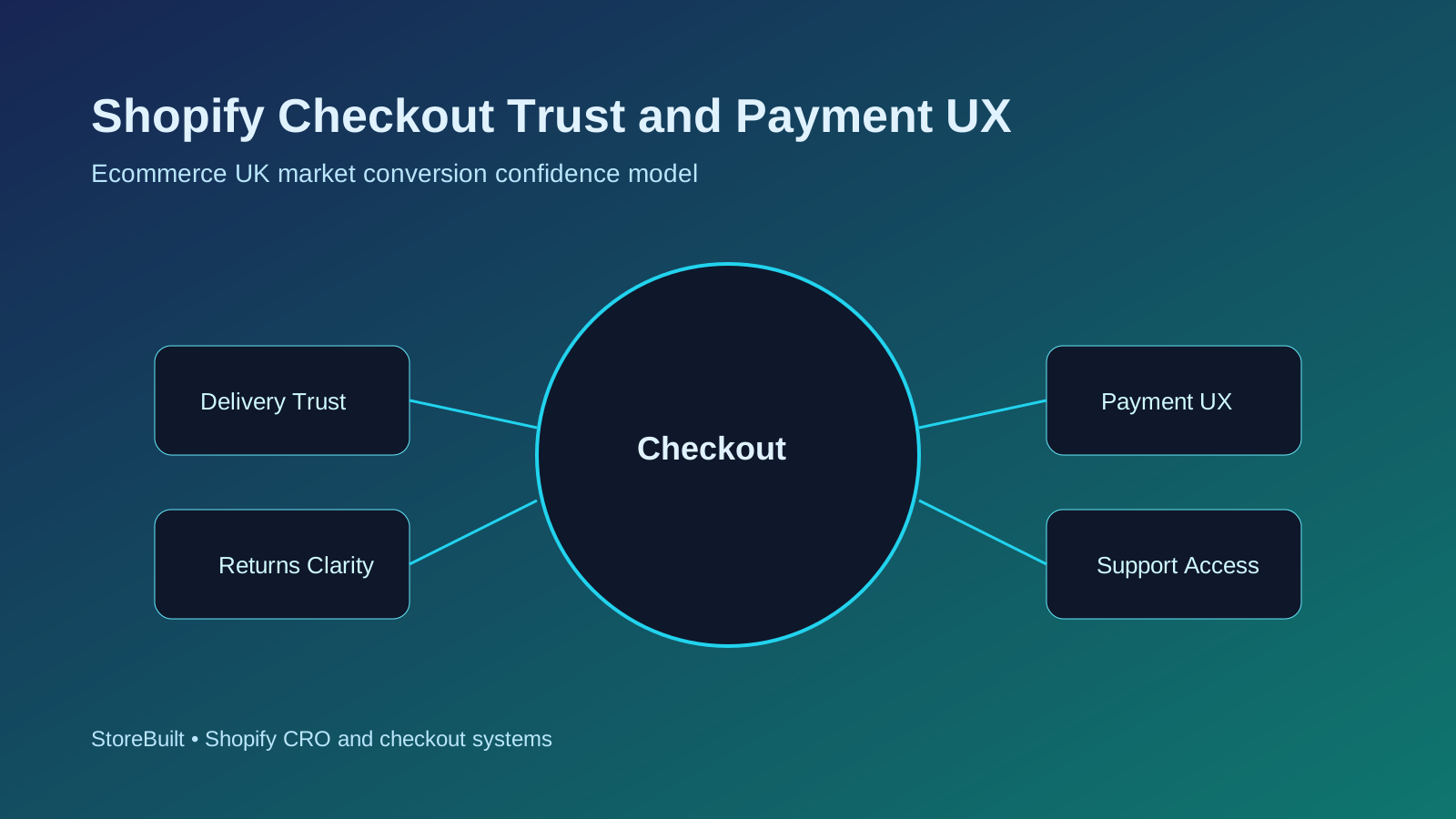
What matters most in UK checkout behaviour
UK checkout behaviour tends to be highly trust-sensitive. Users frequently compare:
- delivery timing confidence
- return and refund clarity
- payment method familiarity and error handling
- total cost visibility before payment submission
When these signals are weak, teams see:
- higher mobile checkout abandonment
- increased support tickets about delivery and returns
- lower conversion from paid acquisition sessions
- higher post-purchase complaint rates
Checkout trust architecture model
| Trust layer | User question | Implementation priority |
|---|---|---|
| Delivery confidence | “Will this arrive when promised?” | Clear delivery dates, cutoff messaging, and service-level detail |
| Returns confidence | “What if this is wrong?” | Concise returns summary and linked full policy |
| Payment confidence | “Can I pay the way I trust?” | Visible method support and robust error-state handling |
| Brand confidence | “Is this store reliable?” | Social proof, support contact access, and policy consistency |
Do not bury these signals in long policy blocks. Surface the summary where purchase decisions happen.
Payment UX and policy clarity framework
| Area | Common issue | Fix pattern |
|---|---|---|
| Payment method hierarchy | Preferred methods buried or inconsistent by device | Reorder and simplify method display logic |
| Error state messaging | Generic decline messages create uncertainty | Add clear next-step guidance for failed attempts |
| VAT and total-cost understanding | Surprises at final step | Improve tax/shipping communication earlier in flow |
| Policy discoverability | Users leave checkout to find policy details | Add concise in-context policy summaries |
| Support pathway | No fast route for pre-purchase questions | Add lightweight support access without leaving checkout |
If checkout is underperforming, start with decision clarity, not feature volume.
For teams that need design and technical implementation together, StoreBuilt can support the rollout.
Agency and competitor signal perspective
Many UK agency articles discuss checkout at a tactic level. The bigger opportunity is operating model quality.
| Signal from competitor content | What to learn | What to improve in your own execution |
|---|---|---|
| Tactical CRO tips | Good for quick wins | Build system-level governance and measurement |
| Platform feature explainers | Useful for implementation awareness | Tie feature choices to margin and support metrics |
| Payment trend articles | Helpful context | Create category-specific checkout tests |
Charle and other UK Shopify agencies publish useful commercial content. The practical advantage comes when insights are converted into a rigorous testing roadmap.
StoreBuilt example
A UK retailer had healthy product interest but unstable checkout conversion, especially on mobile. Initial diagnosis focused on traffic quality. Deeper review showed inconsistent delivery clarity and weak payment-error guidance.
The team introduced structured checkout trust messaging, improved payment fallback states, and aligned policy summaries with customer support language. Conversion stability improved because uncertainty dropped at the exact decision moment.
If your checkout issues are recurring and hard to isolate, Contact StoreBuilt.
High-intent AI search implementation layer
The AI-search version of this topic is not just “write more content”. A useful answer engine result needs a page that gives a direct answer, proves the claim, and shows the next operational step inside Shopify.
| Area | StoreBuilt implementation check |
|---|---|
| Primary intent | The page should map to shopify checkout and one clear buyer or operator problem, not a vague traffic topic. |
| Shopify surface | Identify whether the work belongs on a collection, product page, theme section, checkout step, app workflow, email flow, or support process. |
| Proof | Add first-hand observations, product/category examples, screenshots, policy notes, review signals, or trustworthy external sources where they make the advice safer. |
| Internal route | Link the reader to the service most likely to solve the issue: CRO and UX optimisation. |
| Measurement | Check Search Console, analytics, assisted conversions, enquiry quality, and AI-response mentions after the update rather than judging success by pageviews alone. |
For this article, the useful research inputs are: StoreBuilt CRO audit patterns, analytics QA checks, Shopify theme constraints, and buyer-intent SERP patterns. StoreBuilt would prioritise PDP hierarchy, cart friction, mobile merchandising, testing policy, analytics QA, and measured releases before expanding into broader supporting content.
If this topic maps to a live store problem, review the related StoreBuilt service or Contact StoreBuilt with the store URL and the issue you want fixed.
Final StoreBuilt point of view
In the ecommerce UK market, checkout performance is less about design polish and more about confidence architecture. Shopify brands that make payment, delivery, and returns decisions unambiguous at checkout consistently capture more value from existing demand.
Before adding a mandatory contact field, review when Shopify checkout should require a phone number and test the shipping-address boundary.