
What we have seen in checkout projects is this: teams often approach Checkout Extensibility as a chance to customise everything, when the better commercial question is much narrower. What should actually change at checkout to reduce risk, improve trust, or support a real buying workflow?
If your Shopify checkout roadmap is drifting toward complexity without clear conversion logic, Contact StoreBuilt.
Table of contents
- Keyword decision and research inputs
- What Checkout Extensibility actually changes
- The checkout customisations most UK brands should prioritise
- What teams should stop trying to force into checkout
- Checkout extensibility prioritisation table
- StoreBuilt example
- A safer rollout sequence
- Final StoreBuilt point of view
Keyword decision and research inputs
Primary keyword: shopify checkout extensibility
Secondary keywords:
- Shopify checkout customisation
- checkout extensions Shopify Plus
- Shopify checkout UX
- ecommerce UK market checkout
- Shopify Plus checkout optimisation
Search intent: implementation-focused and commercial. The reader is usually planning checkout changes, migrating away from older customisation patterns, or deciding whether a specific extension belongs in checkout at all.
Funnel stage: middle to bottom.
Page type: implementation and prioritisation guide.
Why StoreBuilt can realistically win this topic:
- We frame checkout customisation through conversion, trust, and support-risk tradeoffs rather than feature novelty.
- UK brands often need help deciding what should sit in checkout versus product page, cart, or post-purchase.
- The topic sits between CRO, technical execution, and rollout governance, which is where many teams need practical guidance.
Research inputs used on June 18, 2026:
- Current SERP pattern review for
shopify checkout extensibility,shopify checkout customisation, and checkout-extension queries. - Competitor content review from Underwaterpistol, Flux, Charle, and adjacent Shopify agencies covering checkout customisation and conversion guidance.
- Official Shopify Help Center documentation on the checkout and accounts editor, payment and delivery customisation, and upgrade guidance for legacy checkout customisations.
What Checkout Extensibility actually changes
Checkout Extensibility matters because it moves checkout work into a more controlled and supportable model.
That is the technical story.
The commercial story is simpler: it gives ecommerce teams a safer way to improve checkout without relying on brittle workarounds that age badly.
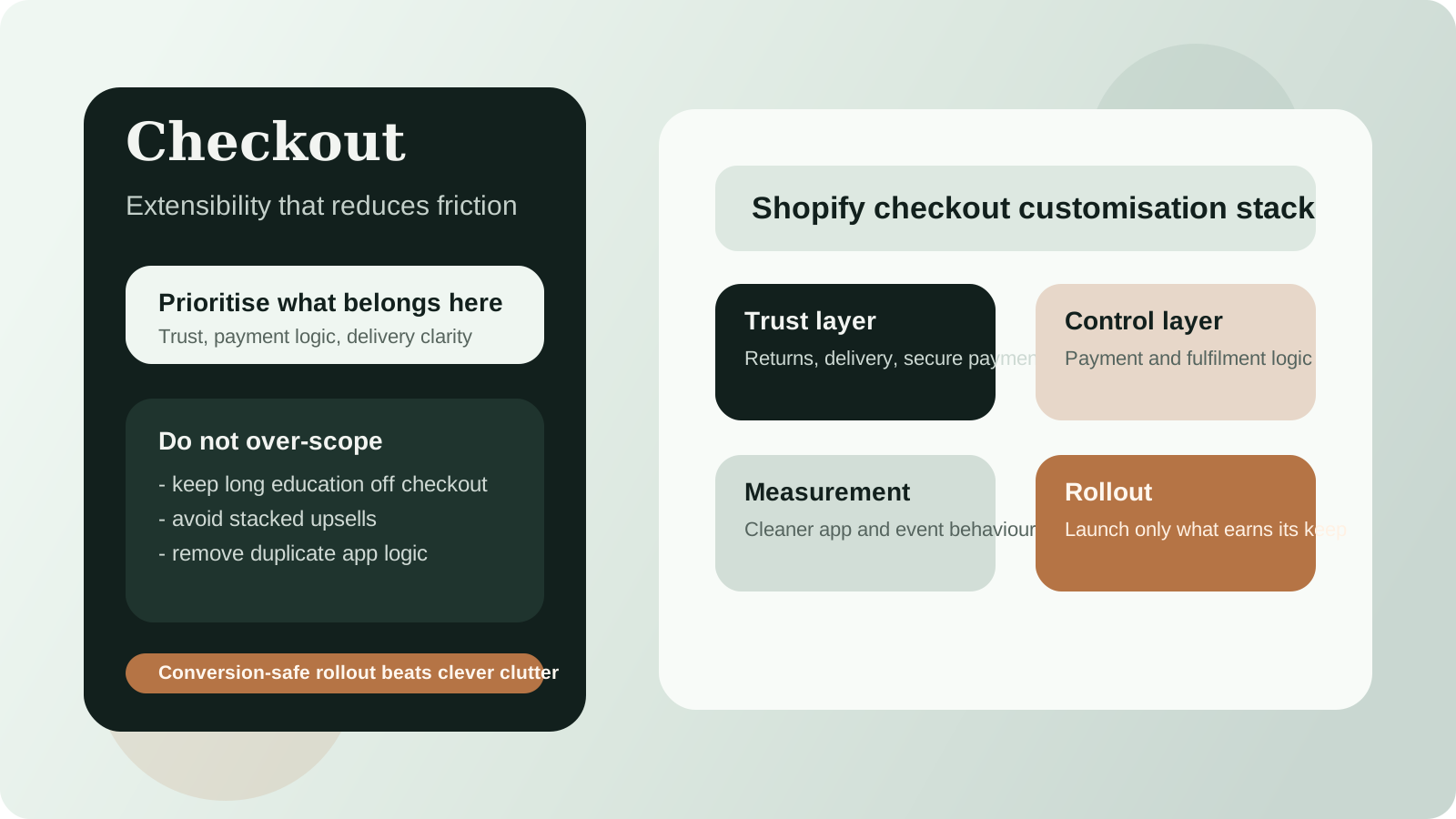
For UK ecommerce brands, the most useful opportunities usually sit in a few areas:
- clearer payment and delivery messaging
- controlled trust and policy reinforcement
- selective field or content customisation
- cleaner event and app behaviour around the checkout journey
This is why current official Shopify guidance matters. Shopify now emphasises the checkout and accounts editor, app-based blocks, and supported configuration paths rather than the older mindset of improvising fragile checkout code. That affects scope, timeline, and maintenance cost.
The checkout customisations most UK brands should prioritise
1. Delivery clarity where hesitation peaks
If delivery speed, shipping thresholds, or collection logic drive conversion quality, checkout needs to reflect that clearly. Many teams try to fix shipping anxiety on the product page only. That is not enough.
2. Payment-method order and naming logic
Shopify now supports more deliberate payment-method customisation. That matters because the order and wording of options can influence confidence more than teams expect, especially on mobile.
3. Supportive trust blocks, not decorative clutter
The best checkout content additions are short and specific:
- return reassurance
- secure payment confidence
- market-specific delivery context
- tax or duty clarity when relevant
The worst ones try to turn checkout into a sales page.
4. Account and post-order continuity
Checkout does not stand alone anymore. Teams should think about how checkout, thank-you, order-status, and customer-account pages work together. Shopify’s current tooling supports this more directly, which means the buying journey should be planned as one system.
5. App discipline and event hygiene
One of the least glamorous but most valuable benefits of a disciplined checkout setup is cleaner instrumentation and fewer conflicting behaviours from apps. That is commercially important because broken tracking and overlapping scripts create false learning.
If your checkout work needs both UX and implementation discipline, StoreBuilt CRO and UX optimisation is the most relevant service path.
What teams should stop trying to force into checkout
Not every persuasive idea belongs in checkout.
The most common over-scoping mistakes are:
- long-form promotional messaging
- too many upsell modules
- educational content that should have been solved earlier
- policy explanations that compensate for weak PDP or cart copy
- multiple competing app widgets
If a checkout extension is trying to solve a product-page, merchandising, or customer-service problem, the problem usually sits too high in the funnel to be fixed there safely.
That is where some competitor content can mislead. Public agency examples often show what is possible. They are less useful at showing what should be left alone.
Checkout extensibility prioritisation table
| Customisation area | Usually high value | Usually low value | Why |
|---|---|---|---|
| payment method logic | yes | no | affects confidence and completion directly |
| delivery and fulfilment messaging | yes | no | reduces last-minute uncertainty |
| trust and policy reinforcement | yes, if concise | no, if oversized | useful when specific and well placed |
| promotional content | sometimes | often | can distract from completion |
| heavy cross-sell layers | rarely | usually | better handled before checkout or post-purchase |
| analytics and app cleanup | yes | no | improves data quality and operational reliability |
StoreBuilt example
One UK brand approached checkout customisation with a long wish list shaped by several teams at once. Ecommerce wanted threshold reinforcement, marketing wanted promotion visibility, support wanted policy reminders, and operations wanted delivery context.
None of those requests were unreasonable on their own. The problem was that together they would have turned checkout into a crowded decision surface.
The better approach was to rank the interventions by commercial value and timing. Delivery clarity and payment confidence stayed. Short trust language stayed. Several promotional ideas moved back to cart or PDP. The resulting checkout felt lighter, but it actually did more useful work because each element had a clear reason to exist.
A safer rollout sequence
Use this sequence when planning checkout extensibility work:
- Audit the current checkout, thank-you page, and order-status flow.
- Identify which customer doubts still appear at checkout rather than earlier.
- Classify each requested change as trust, operations, measurement, or persuasion.
- Kill anything that tries to solve an earlier-funnel problem too late.
- Launch changes in a controlled sequence with event validation and mobile QA.
This matters more now because Shopify’s official upgrade and customisation path is more structured than older checkout models. The gain is stability. The tradeoff is that teams need better prioritisation rather than more improvisation.
For a broader delivery review that ties checkout, cart, and post-purchase together, use the StoreBuilt free Shopify audit.
High-intent AI search implementation layer
The AI-search version of this topic is not just “write more content”. A useful answer engine result needs a page that gives a direct answer, proves the claim, and shows the next operational step inside Shopify.
| Area | StoreBuilt implementation check |
|---|---|
| Primary intent | The page should map to shopify checkout extensibility and one clear buyer or operator problem, not a vague traffic topic. |
| Shopify surface | Identify whether the work belongs on a collection, product page, theme section, checkout step, app workflow, email flow, or support process. |
| Proof | Add first-hand observations, product/category examples, screenshots, policy notes, review signals, or trustworthy external sources where they make the advice safer. |
| Internal route | Link the reader to the service most likely to solve the issue: CRO and UX optimisation. |
| Measurement | Check Search Console, analytics, assisted conversions, enquiry quality, and AI-response mentions after the update rather than judging success by pageviews alone. |
For this article, the useful research inputs are: StoreBuilt CRO audit patterns, analytics QA checks, Shopify theme constraints, and buyer-intent SERP patterns. StoreBuilt would prioritise PDP hierarchy, cart friction, mobile merchandising, testing policy, analytics QA, and measured releases before expanding into broader supporting content.
If this topic maps to a live store problem, review the related StoreBuilt service or Contact StoreBuilt with the store URL and the issue you want fixed.
Final StoreBuilt point of view
Shopify Checkout Extensibility is valuable when it makes checkout clearer, safer, and easier to maintain.
For UK ecommerce brands, the win is not “more checkout customisation.” The win is fewer, better customisations tied to trust, fulfilment clarity, and clean completion behaviour. Teams that over-scope checkout usually add noise. Teams that prioritise rigorously usually add revenue protection.