
What we have seen repeatedly is this: ecommerce teams often increase paid traffic while their Shopify basket and checkout journey still carries obvious trust gaps, payment hesitation, and preventable friction that quietly suppresses conversion.
If you want a senior view on where checkout leakage is really happening, Contact StoreBuilt.
Table of contents
- Keyword decision and research inputs
- Why checkout optimisation matters more than another traffic push
- The four friction layers that matter most in the UK
- Checkout priority table
- What strong Shopify checkout optimisation looks like
- StoreBuilt example
- The next 30-day checkout plan
- Final StoreBuilt point of view
Keyword decision and research inputs
Primary keyword: shopify checkout optimisation uk
Secondary keywords:
- shopify checkout conversion uk
- ecommerce checkout optimisation
- shopify basket abandonment uk
- shopify payment ux uk
Search intent: commercial and problem-solving.
Funnel stage: middle to bottom.
Page type: optimisation guide.
Why StoreBuilt can win this topic:
- Checkout issues usually sit at the intersection of UX, trust, payment logic, and implementation detail.
- We assess checkout in the full buying-journey context rather than as an isolated platform screen.
- We can turn audit findings into practical Shopify workstreams quickly.
Research inputs used:
- Current SERP review around checkout optimisation, Shopify checkout, and UK payment-intent modifiers.
- Competitor content scan across UK Shopify agency blogs, especially payment, CRO, and checkout-related guides.
- Internal StoreBuilt overlap check against current conversion and payment content.
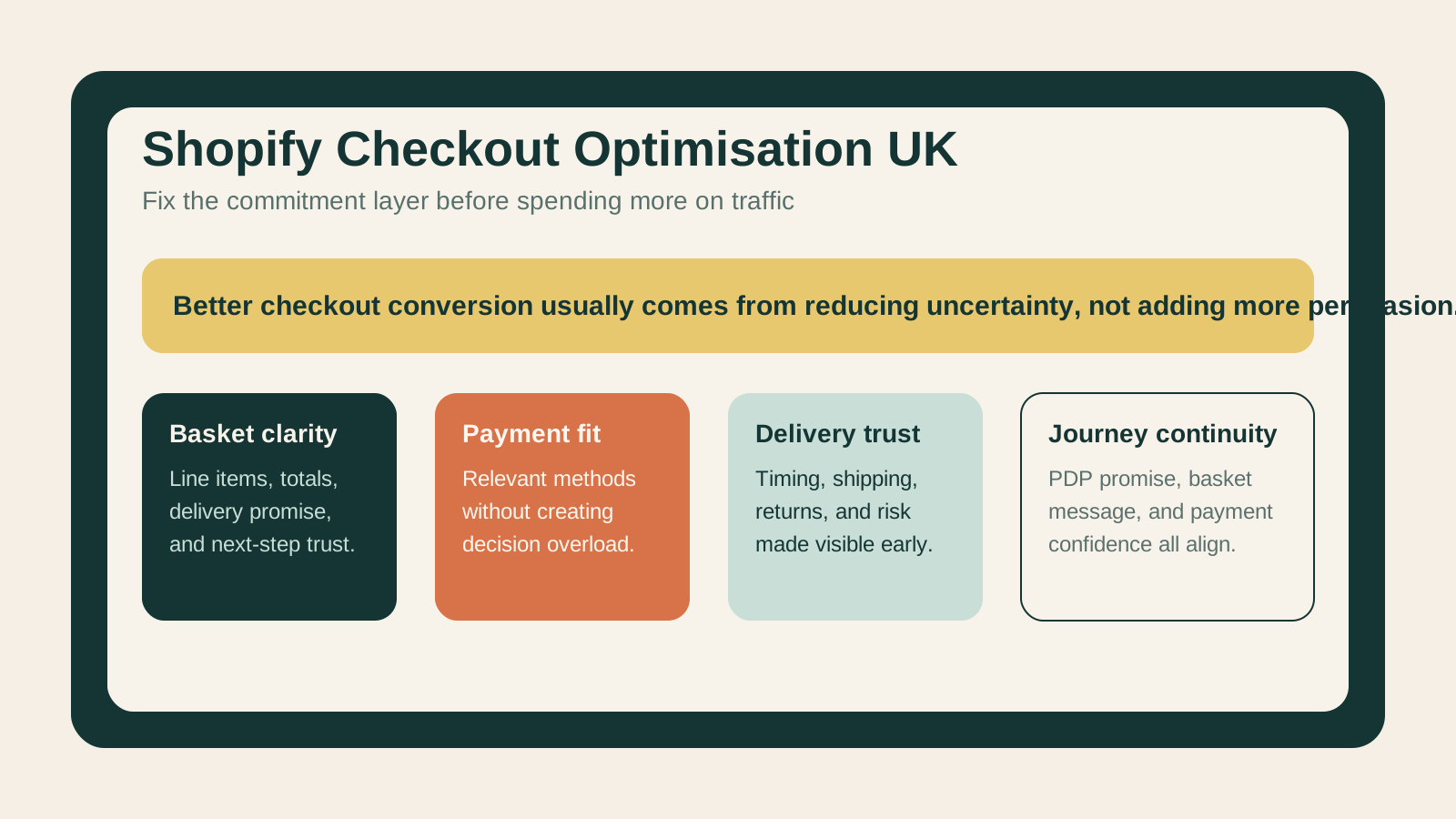
Why checkout optimisation matters more than another traffic push
Checkout optimisation is often less glamorous than campaign planning, but it is one of the fastest places to recover wasted demand.
When teams say conversion is weak, the real problem is not always product-market fit or media efficiency. Sometimes the issue is simpler:
- the basket introduces new uncertainty
- payment options do not match customer expectation
- delivery and returns information appears too late
- trust cues are generic or badly placed
That matters in the UK market because shoppers are already comparison-heavy and mobile-heavy. Any extra ambiguity near payment can trigger abandonment fast.
The four friction layers that matter most in the UK
1. Basket clarity before checkout
By the time a shopper reaches basket, they should understand:
- what they are buying
- what it costs
- when it will arrive
- what happens if they need to return it
If those answers are incomplete, checkout intent weakens before the first form field appears.
2. Payment confidence
Payment mix should reflect both customer expectation and the brand’s economics. The right answer depends on category, average order value, and repeat purchase behaviour, but the principle is stable: choice should create confidence, not cognitive load.
3. Delivery and returns reassurance
Many UK brands still hide important fulfilment context until too late. That is especially risky in categories where timing, freshness, fit, or gifting expectation matters.
4. Journey continuity from PDP to payment
Weak checkout optimisation often starts earlier than checkout. If PDP messaging creates one expectation and basket or checkout creates another, confidence drops quickly.
Checkout priority table
| Area | Good signal | Risk signal | Priority |
|---|---|---|---|
| Basket summary | Clear line items, totals, and next-step confidence | Ambiguous charges or weak delivery cues | High |
| Payment mix | Relevant methods with clear trust framing | Too few or too many poorly explained options | High |
| Delivery messaging | Promise is visible before commitment | Delivery details delayed until late stages | High |
| Returns reassurance | Relevant for product risk profile | Generic or hidden policy signals | Medium |
| Mobile flow | Fast, obvious, low-scroll completion path | Dense screens and distracting modules | High |
| Tracking continuity | Checkout performance is measurable | Attribution uncertainty around drop-off | Medium |
If you want StoreBuilt to turn this into a live audit against your current store, StoreBuilt can help.
What strong Shopify checkout optimisation looks like
Strong checkout optimisation usually means simplifying the decision path rather than adding persuasion everywhere.
Practical improvements often include:
- clearer basket messaging before the checkout handoff
- better payment-method framing for customer confidence
- less distraction around the transition into payment
- stronger alignment between PDP promises and basket or checkout reality
- clearer support signals when the category carries risk or urgency
The point is not to stuff reassurance into every screen. The point is to remove the specific uncertainty most likely to stop commitment.
StoreBuilt example
In one StoreBuilt review for a UK brand, acquisition demand was healthy but the commercial team felt checkout conversion should have been stronger. The issue was not one dramatic failure. It was a stack of smaller frictions: late delivery clarity, weak continuity from PDP to basket, and payment reassurance that appeared too generically.
Once those points were reframed and prioritised, the team had a clearer plan. Instead of pushing more acquisition spend into the same funnel, they improved the commitment layer first.
That is a useful discipline for most Shopify brands. The cheaper next sale is often hidden in journey clarity, not in a new media test.
The next 30-day checkout plan
- Review basket and checkout messaging on mobile first.
- Check whether shipping, returns, and payment reassurance appear before commitment moments.
- Validate that your payment mix reflects both shopper expectation and commercial logic.
- Compare PDP promise, basket message, and checkout confidence cues for consistency.
- Prioritise the three friction points most likely to suppress commitment before increasing traffic investment.
If your current funnel still feels more expensive than it should, Contact StoreBuilt.
High-intent AI search implementation layer
The AI-search version of this topic is not just “write more content”. A useful answer engine result needs a page that gives a direct answer, proves the claim, and shows the next operational step inside Shopify.
| Area | StoreBuilt implementation check |
|---|---|
| Primary intent | The page should map to shopify checkout optimisation uk and one clear buyer or operator problem, not a vague traffic topic. |
| Shopify surface | Identify whether the work belongs on a collection, product page, theme section, checkout step, app workflow, email flow, or support process. |
| Proof | Add first-hand observations, product/category examples, screenshots, policy notes, review signals, or trustworthy external sources where they make the advice safer. |
| Internal route | Link the reader to the service most likely to solve the issue: CRO and UX optimisation. |
| Measurement | Check Search Console, analytics, assisted conversions, enquiry quality, and AI-response mentions after the update rather than judging success by pageviews alone. |
For this article, the useful research inputs are: StoreBuilt CRO audit patterns, analytics QA checks, Shopify theme constraints, and buyer-intent SERP patterns. StoreBuilt would prioritise PDP hierarchy, cart friction, mobile merchandising, testing policy, analytics QA, and measured releases before expanding into broader supporting content.
If this topic maps to a live store problem, review the related StoreBuilt service or Contact StoreBuilt with the store URL and the issue you want fixed.
Final StoreBuilt point of view
For UK ecommerce brands on Shopify, checkout optimisation should not be treated as a late-stage polish task. It is one of the highest-leverage commercial systems in the store. Before buying more traffic, fix the parts of the basket and checkout journey that make qualified shoppers hesitate. That is usually the cleaner and cheaper growth move.