
What we have seen in delivery reviews is this: shipping software often gets bought to solve an operational problem that was never clearly named. A brand says it needs a better shipping app when the real issue is promise clarity, warehouse logic, returns confusion, or tracking ownership.
If delivery friction is showing up in checkout abandonment or support tickets, Contact StoreBuilt.
Table of contents
- Keyword decision and research inputs
- Quick answer: what a shipping app should really do
- The shipping jobs Shopify teams actually need help with
- A practical shipping app shortlist for UK teams
- When a simple shipping setup is better
- StoreBuilt example
- 90-day delivery stack plan
- Final StoreBuilt point of view
Keyword decision and research inputs
Primary keyword: shipping apps for shopify
Secondary keywords:
- best shipping apps for Shopify UK
- Shopify shipping UK
- Shopify delivery apps
- Shopify tracking app
- ecommerce shipping software UK
Search intent: commercial investigation with operational implementation intent.
Funnel stage: middle to bottom.
Page type: shortlist guide with operational commentary.
Why StoreBuilt can realistically win this topic:
- Shipping choices directly affect checkout conversion, support load, and margin, which maps well to StoreBuilt delivery work.
- UK ecommerce brands often need help separating checkout promise design from fulfilment-tool complexity.
- Competitor listicles frequently catalogue apps but skip operational fit and tradeoffs.
Research inputs used in angle selection:
- Current SERP review around
shipping apps for Shopify,Shopify shipping UK, and delivery-tool comparison intent. - UK competitor patterns, including Charle’s shipping-app content style and adjacent Shopify app list structures.
- Public delivery-stack research covering tracking, carrier management, returns, and post-purchase communication.
Quick answer: what a shipping app should really do
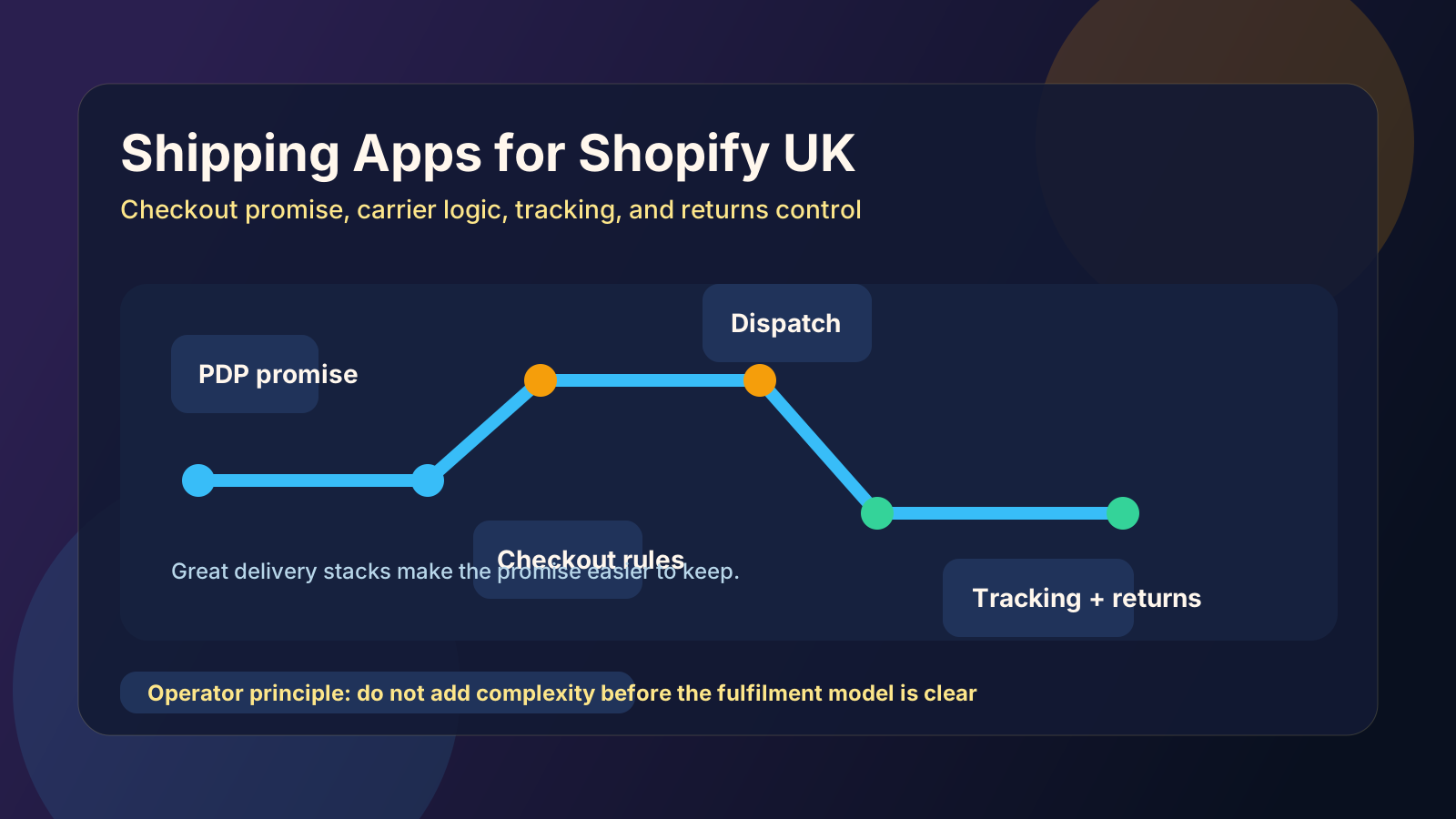
The best shipping app is not the one with the most carriers. It is the one that makes the delivery promise easier to keep.
For UK Shopify teams, a good shipping stack should support:
- clear checkout messaging
- reliable carrier logic
- visible tracking and exception handling
- a manageable returns or exchanges workflow
- lower support dependency after dispatch
If an app adds operational steps without improving those outcomes, it may be complexity disguised as infrastructure.
The shipping jobs Shopify teams actually need help with
Before comparing tools, define the delivery job.
| Shipping job | Typical need | Common mistake |
|---|---|---|
| Rate and service logic | different carriers, zones, or service levels | overengineering rules before volume justifies them |
| Tracking and post-purchase comms | fewer WISMO tickets and more trust | adding notifications without fixing service clarity |
| Returns and exchanges | lower support burden and cleaner reverse logistics | treating returns as separate from CX and margin |
| Multi-warehouse or 3PL coordination | operational reliability as scale grows | layering apps without clean ownership |
| Premium delivery promise | better conversion for time-sensitive orders | advertising delivery confidence the ops model cannot support |
Most stores do not need an advanced delivery stack on day one. But stores with rising order complexity do need shipping logic that can scale cleanly.
A practical shipping app shortlist for UK teams
UK brands usually evaluate a mix of these categories in 2026:
| Tool type or example category | Strong fit when | Main watch-out |
|---|---|---|
| Carrier and label management layer | the team ships meaningful volume and needs operational consistency | can add process overhead if order volume is still low |
| Tracking and branded post-purchase layer | support load is rising and delivery confidence matters commercially | cosmetic tracking upgrades do not fix poor fulfilment performance |
| Returns and exchanges platform | returns volume has become a margin and service issue | strict automation can frustrate customers if policy design is weak |
| Delivery-date or promise layer | gifting, premium, or time-sensitive categories depend on confidence | promise tools are risky if warehouse data is weak |
| Multi-location routing layer | stock is split across sites or partners | exception management becomes harder if rules are poorly documented |
Notice that none of those categories says “best for everyone.” Shipping software is highly sensitive to business model and fulfilment maturity.
Checkout and delivery-promise tools
These matter most when:
- shipping speed influences conversion
- premium delivery or gifting matters
- operational constraints vary by SKU or region
What teams often miss is that promise clarity must be true at the point of dispatch, not just persuasive on the PDP.
Tracking and post-purchase visibility
Tracking tools can become high-value fast because they reduce uncertainty after checkout.
Look for improvement in:
- support-ticket volume
- repeat “where is my order?” questions
- perceived professionalism after dispatch
- exception handling during delays
This is often where UK ecommerce brands can improve customer confidence without redesigning the storefront.
Returns and exchanges
Shipping and returns should be planned together. Treating them as separate tool decisions usually creates friction.
| Returns question | Why it matters |
|---|---|
| Can customers self-serve cleanly? | reduces support load |
| Do policy rules reflect category economics? | protects margin |
| Are exchange paths stronger than refund-only flows? | supports revenue retention |
| Is warehouse handling realistic? | prevents software from outpacing operations |
Multi-location and complexity-led shipping
This is where app listicles often become too generic. Once inventory is split across warehouses, shops, or fulfilment partners, software choice becomes more about exception handling than features.
If the business has:
- multiple dispatch origins
- channel-based stock constraints
- product-specific fulfilment rules
- delivery windows that vary heavily by geography
then the shipping stack should be reviewed alongside apps, integrations, and automation ownership. In other words, it is usually not a one-app decision anymore.
For Shopify stores where shipping logic, apps, and operational automation need to work together, see StoreBuilt apps, integrations, and automation support.
When a simple shipping setup is better
Do not force a sophisticated shipping stack if:
- order volume is still modest
- one main carrier handles most orders reliably
- support pain is low
- delivery messaging is already clear
- the team lacks bandwidth to maintain exceptions
In those cases, simplicity can outperform optionality.
A cleaner checkout promise plus disciplined fulfilment can beat a complex shipping stack that nobody trusts.
StoreBuilt example
One UK Shopify team assumed it needed a more advanced shipping app because delivery complaints had increased during growth. The initial instinct was to add more logic and more customer messaging.
The audit showed a different issue. The store’s promise layer had become disconnected from actual warehouse handling. Customers were being shown shipping confidence the operation could not consistently support.
The immediate gain did not come from more tooling. It came from simplifying service logic, tightening promise language, and clarifying which exceptions the team could handle reliably. Only after that did a more capable post-purchase layer make sense.
That sequence matters. Good software amplifies a clear operation. It does not create one.
90-day delivery stack plan
| Timeline | Focus | Output |
|---|---|---|
| Weeks 1-2 | map current delivery flow from PDP to returns | delivery operations diagnostic |
| Weeks 3-5 | simplify checkout promises and service logic | lower ambiguity at purchase |
| Weeks 6-9 | tighten tracking, exceptions, and returns handling | fewer support escalations |
| Weeks 10-13 | add or refine tools only where the business case is clear | more resilient shipping stack |
Metrics worth reviewing:
- checkout abandonment on shipping step
- delivery-related support tickets
- dispatch SLA adherence
- return reasons and return cycle time
- failed or delayed tracking updates
If your delivery stack is harder to explain than your delivery promise, the setup is probably too complex.
For an outside review before peak trading, migration, or fulfilment change, use the StoreBuilt free Shopify audit.
High-intent AI search implementation layer
The AI-search version of this topic is not just “write more content”. A useful answer engine result needs a page that gives a direct answer, proves the claim, and shows the next operational step inside Shopify.
| Area | StoreBuilt implementation check |
|---|---|
| Primary intent | The page should map to shipping apps for shopify and one clear buyer or operator problem, not a vague traffic topic. |
| Shopify surface | Identify whether the work belongs on a collection, product page, theme section, checkout step, app workflow, email flow, or support process. |
| Proof | Add first-hand observations, product/category examples, screenshots, policy notes, review signals, or trustworthy external sources where they make the advice safer. |
| Internal route | Link the reader to the service most likely to solve the issue: Apps, integrations and automation. |
| Measurement | Check Search Console, analytics, assisted conversions, enquiry quality, and AI-response mentions after the update rather than judging success by pageviews alone. |
For this article, the useful research inputs are: StoreBuilt support-retainer reviews, Shopify operations documentation, fulfilment/app governance patterns, and UK ecommerce operator intent. StoreBuilt would prioritise app stack decisions, integration logic, automation, data flow QA, and operational reliability before expanding into broader supporting content.
If this topic maps to a live store problem, review the related StoreBuilt service or Contact StoreBuilt with the store URL and the issue you want fixed.
Final StoreBuilt point of view
The best shipping apps for Shopify UK brands are the ones that make delivery easier to trust and easier to operate. Great shipping software does not only connect carriers. It protects checkout confidence, support quality, and post-purchase control.
The stronger operating model is usually the simpler one. Add complexity only when the commercial need is real and the team can maintain it under trading pressure.