
What we have seen in ecommerce build scoping is this: cost problems usually start before the first quote arrives. Teams ask for a price before they have defined the trading model, content load, integrations, and post-launch support expectations that actually drive the budget.
If you want StoreBuilt to review your current website scope before you commit, Contact StoreBuilt.
Table of contents
- Keyword decision and research inputs
- The quick answer on ecommerce website cost in the UK
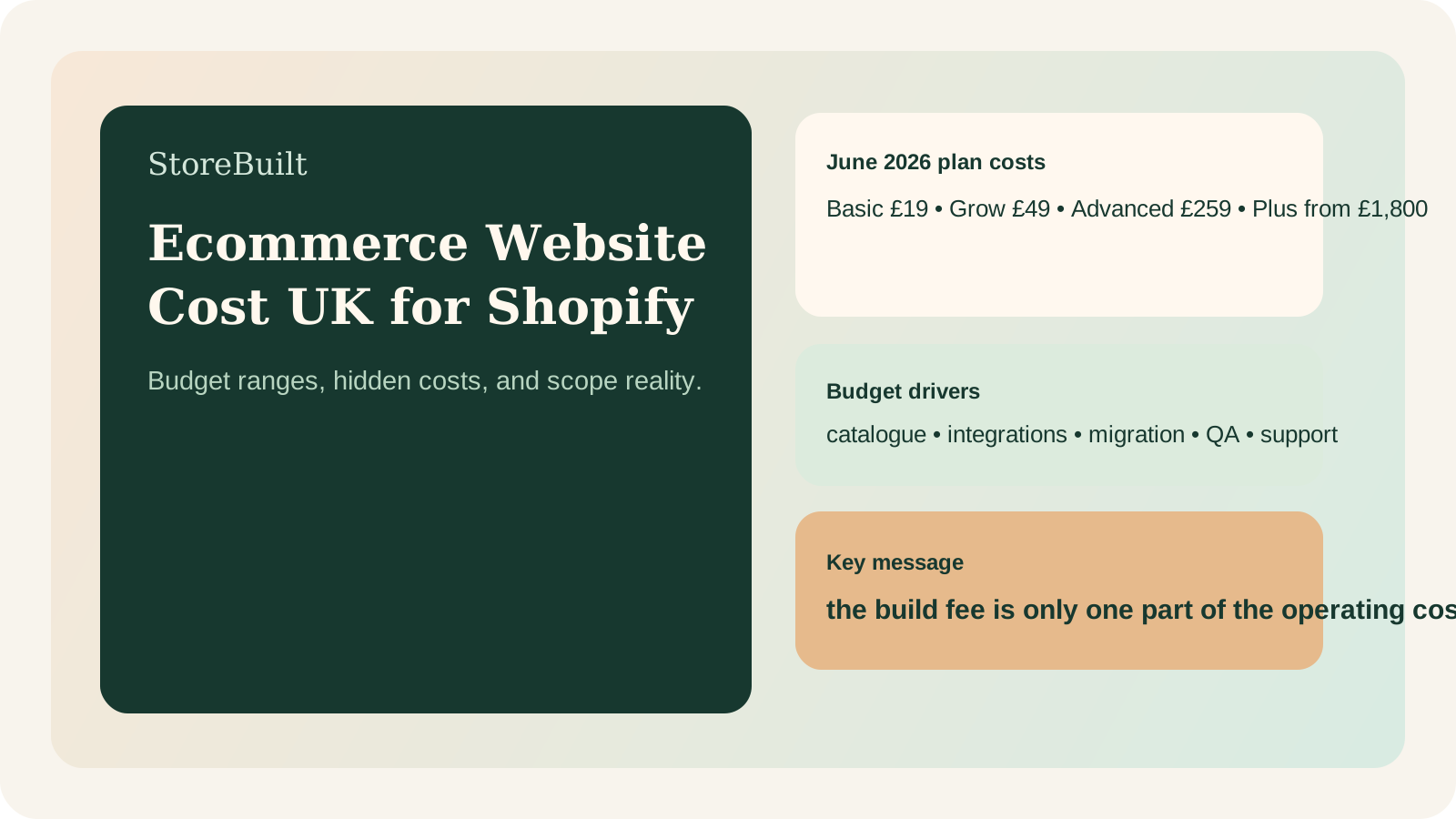
- What the Shopify platform itself costs in June 2026
- What actually changes the build budget
- A practical cost table for Shopify website projects
- The hidden monthly costs brands forget
- StoreBuilt example
- Final StoreBuilt point of view
Keyword decision and research inputs
Primary keyword: ecommerce website cost uk
Secondary keywords:
- shopify website cost uk
- ecommerce website pricing uk
- how much does a shopify website cost
- ecommerce website monthly costs
Search intent: commercial research from founders, ecommerce leads, and marketing teams validating quotes or planning a new Shopify budget.
Funnel stage: middle to bottom.
Page type: cost explainer with budget framework.
Why StoreBuilt can realistically win this topic:
- Searchers want practical budget ranges tied to real delivery decisions, not generic “from” prices.
- We can connect platform cost, build cost, and support cost into one clearer model.
- Many pricing articles oversimplify by ignoring integrations, content readiness, QA, and post-launch ownership.
Research inputs used on June 8, 2026:
- Current SERP review for
ecommerce website cost uk,shopify website cost uk, and related pricing modifiers. - Competitor pricing-content review including Charle-style long-form commercial explainers and current UK agency pricing pages.
- Official Shopify UK pricing and Shopify Help pricing references checked on June 8, 2026.
The quick answer on ecommerce website cost in the UK
For a Shopify-led ecommerce website in the UK, most projects land in one of three bands:
| Project type | Typical range | What it usually means |
|---|---|---|
| Lean launch | £6,000 to £15,000 | premium theme adaptation, essential app setup, limited custom sections |
| Mid-market custom build | £15,000 to £45,000 | stronger UX, more custom section architecture, app/integration planning, fuller QA |
| Complex build or replatform | £45,000 to £120,000+ | migration, deeper systems work, larger catalogue complexity, multi-market or B2B needs |
That does not mean a higher quote is always justified. It means the cost follows complexity more than aesthetics.
Many teams still think in homepage terms. The better way is to budget around operating demands:
- how complex the catalogue is
- how much content needs structuring
- how many systems need integrating
- how much control the merchant team needs after handover
- how much launch risk the business can tolerate
What the Shopify platform itself costs in June 2026
As of June 8, 2026, the official Shopify UK pricing page shows these annual-plan entry points:
| Shopify plan | Yearly billing entry price |
|---|---|
| Basic | £19/month |
| Grow | £49/month |
| Advanced | £259/month |
| Plus | from £1,800/month on a 3-year term |
The same page also shows higher monthly-billing prices, including:
| Shopify plan | Monthly billing entry price |
|---|---|
| Basic | £25/month |
| Grow | £65/month |
| Advanced | £344/month |
Those numbers matter, but only as one layer of the budget.
In practical scoping, the Shopify subscription is rarely the cost problem. The bigger questions are:
- what custom work is really needed
- what apps or integrations add recurring cost
- how much support and iteration the store needs after launch
What actually changes the build budget
The biggest cost drivers are usually not the ones brands notice first in the proposal.
1. Catalogue and merchandising complexity
A 40-product catalogue with simple filters is not the same build as a 4,000-SKU operation with variant complexity, bundle logic, or trade pricing requirements.
2. Content readiness
If product data, collection logic, PDP copy, and media are not ready, the project gets slower and more expensive. The agency either has to absorb ambiguity or wait for assets.
3. Integration depth
ERP, WMS, subscription tools, reviews, loyalty, search, personalisation, and analytics setups can all expand the budget materially.
4. Migration risk
Moving from WooCommerce, Magento, BigCommerce, or a fragile legacy Shopify setup adds redirect planning, QA, data validation, and launch-control cost.
5. Merchant flexibility after launch
A store that looks polished but is hard to manage is often a false economy. Better section architecture and merchant usability can increase initial cost slightly while reducing long-term dependency.
A practical cost table for Shopify website projects
Use this table to sanity-check quotes.
| Budget area | Lower-complexity build | Higher-complexity build |
|---|---|---|
| Discovery and scoping | shorter workshop and lighter documentation | deeper discovery, system mapping, stakeholder alignment |
| Design and UX | theme-led adaptation | bespoke UX and component planning |
| Theme development | moderate customisation | deeper custom build and QA burden |
| Apps and integrations | standard tools with light setup | custom flows, ERP/WMS/CRM integration, data sync risk |
| Migration and launch | limited redirect/data work | full migration, reconciliation, and release planning |
| Post-launch support | small retained fixes | structured support, roadmap ownership, optimisation |
The key buyer question is not “Why is this quote bigger?” It is “Which risks or capabilities is the higher quote actually covering?”
The hidden monthly costs brands forget
Many pricing guides stop at project cost. That is not enough.
Recurring costs commonly include:
| Monthly cost area | What brands often miss |
|---|---|
| Apps | overlapping tools, premium tiers, usage-based pricing |
| Support | who fixes issues after launch and how fast |
| CRO or growth work | iteration budget beyond the initial build |
| Email/SMS tooling | list growth raises the software cost |
| Search and merchandising tools | improved UX often adds recurring software spend |
This is why a low upfront build can become more expensive over 12 months if the underlying operating model is inefficient.
If the build needs stronger commercial scoping before quote comparison, StoreBuilt’s Shopify store design and development service is the right route.
Budget questions to ask before you request quotes
- Are we launching a simpler store or a more controlled operating system?
- What needs to be migrated, not just redesigned?
- How much flexibility does the internal team need after launch?
- Which integrations are genuinely essential in phase one?
- What support or optimisation do we need in the first 90 days after go-live?
Without those answers, price comparison becomes mostly theatre.
StoreBuilt example
A UK brand came into planning expecting a “design and build” budget conversation. Once discovery started, the real cost drivers were elsewhere: product-data inconsistency, app overlap, migration QA, and a strong internal requirement for merchant-friendly content control after launch.
The original budget expectation was shaped by visible design work. The real budget was shaped by operational reliability. Once that became clear, the scope changed for the better. Some features moved to phase two, a few unnecessary tools were cut, and the budget aligned more closely with actual trading priorities.
That is usually what better costing looks like. Not spending more by default, but paying for the parts that reduce real business risk.
If you are comparing agency quotes that still feel impossible to read, run a free Shopify audit and use it as a scope sanity check first.
High-intent AI search implementation layer
The AI-search version of this topic is not just “write more content”. A useful answer engine result needs a page that gives a direct answer, proves the claim, and shows the next operational step inside Shopify.
| Area | StoreBuilt implementation check |
|---|---|
| Primary intent | The page should map to ecommerce website cost uk and one clear buyer or operator problem, not a vague traffic topic. |
| Shopify surface | Identify whether the work belongs on a collection, product page, theme section, checkout step, app workflow, email flow, or support process. |
| Proof | Add first-hand observations, product/category examples, screenshots, policy notes, review signals, or trustworthy external sources where they make the advice safer. |
| Internal route | Link the reader to the service most likely to solve the issue: Shopify support, maintenance and audits. |
| Measurement | Check Search Console, analytics, assisted conversions, enquiry quality, and AI-response mentions after the update rather than judging success by pageviews alone. |
For this article, the useful research inputs are: Shopify Help documentation, StoreBuilt implementation patterns, UK ecommerce SERP intent, and common founder/operator questions. StoreBuilt would prioritise technical audits, roadmap priority, theme changes, app governance, reporting, and measured improvement before expanding into broader supporting content.
If this topic maps to a live store problem, review the related StoreBuilt service or Contact StoreBuilt with the store URL and the issue you want fixed.
Final StoreBuilt point of view
The real ecommerce website cost in the UK is not just a build fee plus a Shopify subscription. It is the combined cost of platform choice, implementation complexity, migration risk, and the operating model you inherit after launch.
For Shopify brands in 2026, the best budget is the one that protects trading reality, not the one that wins a quote-comparison spreadsheet on day one.