
What we have seen in multi-article Shopify programmes is this: the cluster is usually not the problem, prioritisation is. Teams pick topics by convenience instead of commercial sequence.
If you want your cluster plan rebuilt around buyer intent and revenue proximity, Contact StoreBuilt.
Table of contents
- Keyword decision and research inputs
- What competitor clusters reveal
- The StoreBuilt prioritisation model
- Cluster scoring table
- 12-week sequencing table
- StoreBuilt example
- Final StoreBuilt point of view
Keyword decision and research inputs
Primary keyword: ecommerce uk market shopify topic cluster strategy
Secondary keywords:
- shopify seo topic prioritisation
- ecommerce content cluster model uk
- shopify agency cluster planning
- commercial intent seo cluster
Search intent: strategic planning; teams deciding which topics should be published first.
Funnel stage: middle.
Page type: planning framework.
Why StoreBuilt can win this topic:
- We sequence Shopify content clusters by lead quality impact, not only search volume.
- We combine SEO intent mapping with commercial conversion pathways.
- We run duplicate-risk and cannibalisation checks before cluster execution.
Research inputs used:
- SERP review for Shopify topic cluster and ecommerce UK market content-planning queries.
- UK competitor cluster pattern scan including Charle and other agency resource hubs.
- Internal StoreBuilt recent-post overlap and title-pattern checks.
What competitor clusters reveal
The strongest UK competitor libraries are not random lists of good ideas. They function as ordered systems where decision-stage content appears consistently alongside educational coverage.
A common pattern:
- Awareness pieces attract broad category traffic.
- Mid-funnel framework content supports evaluation.
- Bottom-funnel commercial pages capture active buying demand.
Where many in-house teams slip is sequencing. They launch awareness-heavy clusters first, then delay decision-stage content. That slows revenue impact and can weaken stakeholder confidence in SEO investment.
The StoreBuilt prioritisation model
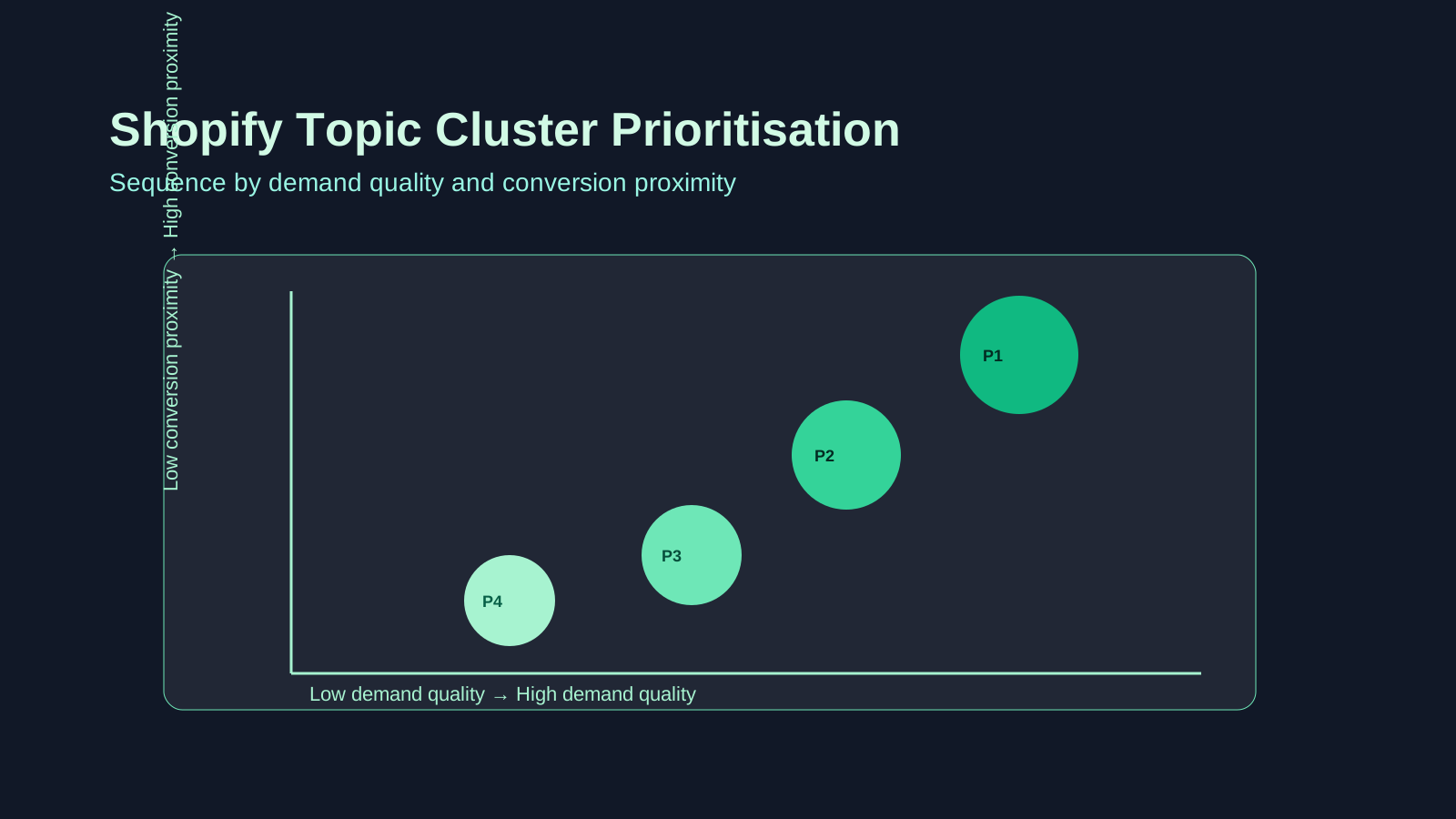
Score each candidate topic across five weighted factors:
- Demand quality (weight 30%): how close is query language to action?
- Commercial proximity (weight 25%): can this topic route to a service conversation?
- Differentiation (weight 20%): can we publish a meaningfully stronger angle?
- Delivery confidence (weight 15%): can we write from real implementation experience?
- Link leverage (weight 10%): does the topic strengthen strategic internal-link flow?
Then publish in score order, with one deliberate balancing rule: keep at least 30% of output in decision-stage or bottom-funnel intent.
This prevents the cluster from becoming an awareness-only content library.
Cluster scoring table
| Topic type | Typical score profile | Priority guidance |
|---|---|---|
| Cost and partner-choice pages | High demand quality + high commercial proximity | Publish early |
| Migration and governance frameworks | Mid-high demand + strong differentiation | Publish early-mid |
| Tactical implementation guides | Medium demand + high delivery confidence | Publish mid cycle |
| Broad trend explainers | Lower commercial proximity | Publish later or merge |
A practical filter: if a topic scores below 65/100, it should not enter the current quarter backlog unless it unlocks a critical internal-link or authority objective.
If you want this scoring model applied to your existing Shopify roadmap, StoreBuilt can help.
12-week sequencing table
| Weeks | Focus | Output |
|---|---|---|
| 1-2 | Topic scoring and cluster design | Prioritised cluster backlog |
| 3-4 | Briefing and structural templates | Approved outlines with CTA paths |
| 5-8 | Content production | 6 to 8 priority articles |
| 9-10 | Internal-link optimisation | Cluster-to-service link reinforcement |
| 11-12 | Review and re-sequencing | Next-quarter score updates |
This model is intentionally rigid because most content programmes fail due to weak sequencing discipline.
Practical safeguards against cluster drift
To protect the plan after launch, add three safeguards:
- Weekly check: confirm new briefs still match the original intent tiers.
- Monthly overlap pass: merge or redirect posts that are becoming too similar.
- Quarterly commercial review: compare assisted leads by topic type, then rebalance cluster weights.
Without safeguards, even a strong strategy drifts back toward easy awareness content. The operating model must be maintained, not just designed once.
StoreBuilt example
A UK ecommerce operator had a full-year cluster plan but low confidence from leadership after several quarters of weak commercial outcomes.
We rescored the backlog using demand quality and conversion proximity. Several broad awareness topics moved down; high-intent decision pages moved up. The resulting cluster produced fewer total articles but better enquiry relevance and clearer attribution.
The result was not a clever hack. It was prioritisation discipline.
High-intent AI search implementation layer
The AI-search version of this topic is not just “write more content”. A useful answer engine result needs a page that gives a direct answer, proves the claim, and shows the next operational step inside Shopify.
| Area | StoreBuilt implementation check |
|---|---|
| Primary intent | The page should map to topic clusters and one clear buyer or operator problem, not a vague traffic topic. |
| Shopify surface | Identify whether the work belongs on a collection, product page, theme section, checkout step, app workflow, email flow, or support process. |
| Proof | Add first-hand observations, product/category examples, screenshots, policy notes, review signals, or trustworthy external sources where they make the advice safer. |
| Internal route | Link the reader to the service most likely to solve the issue: Shopify SEO and AI search readiness. |
| Measurement | Check Search Console, analytics, assisted conversions, enquiry quality, and AI-response mentions after the update rather than judging success by pageviews alone. |
For this article, the useful research inputs are: Google Search Central guidance, Shopify platform documentation, Ahrefs AI Responses/Brand Radar patterns, and StoreBuilt Shopify audit observations. StoreBuilt would prioritise technical SEO, collection architecture, Product schema, answer-first content, GEO, and Search Console monitoring before expanding into broader supporting content.
If this topic maps to a live store problem, review the related StoreBuilt service or Contact StoreBuilt with the store URL and the issue you want fixed.
Final StoreBuilt point of view
For Shopify in the ecommerce UK market, cluster strategy is not about filling a calendar. It is about publishing in the order that supports buyer decisions. If you sequence topics by convenience, outcomes will be inconsistent. If you sequence by commercial intent, SEO becomes a growth system.