
What we have seen across UK Shopify audits is this: teams often create too many single-keyword posts, then wonder why rankings flatten. Cluster quality beats post count.
For help building a commercially useful cluster map, Contact StoreBuilt.
Table of contents
- Keyword decision and research inputs
- What a UK Shopify keyword cluster should include
- Cluster model table for ecommerce teams
- How competitor libraries expose opportunity
- Execution checklist
- StoreBuilt example
- Final StoreBuilt point of view
Keyword decision and research inputs
Primary keyword: ecommerce uk market keyword clusters for shopify brands
Secondary keywords:
- ecommerce keyword strategy UK
- shopify seo keyword clustering
- uk ecommerce content map
- shopify content cluster planning
Search intent: practical framework for SEO managers and ecommerce leads.
Funnel stage: middle.
Page type: strategic implementation guide.
Why StoreBuilt can win this topic:
- We build keyword clusters that align to Shopify information architecture and conversion journeys.
- We audit overlapping article libraries and resolve cannibalisation during growth and migration projects.
- We map clusters to commercial pages, not just informational rankings.
Research inputs used:
- Current UK SERP patterns for ecommerce/shopify keyword-cluster queries.
- Competitor content library review from UK Shopify agencies publishing frequently on SEO, migration, and growth.
- Query-modifier and related-term clustering from commercial and informational keyword sets.
What a UK Shopify keyword cluster should include
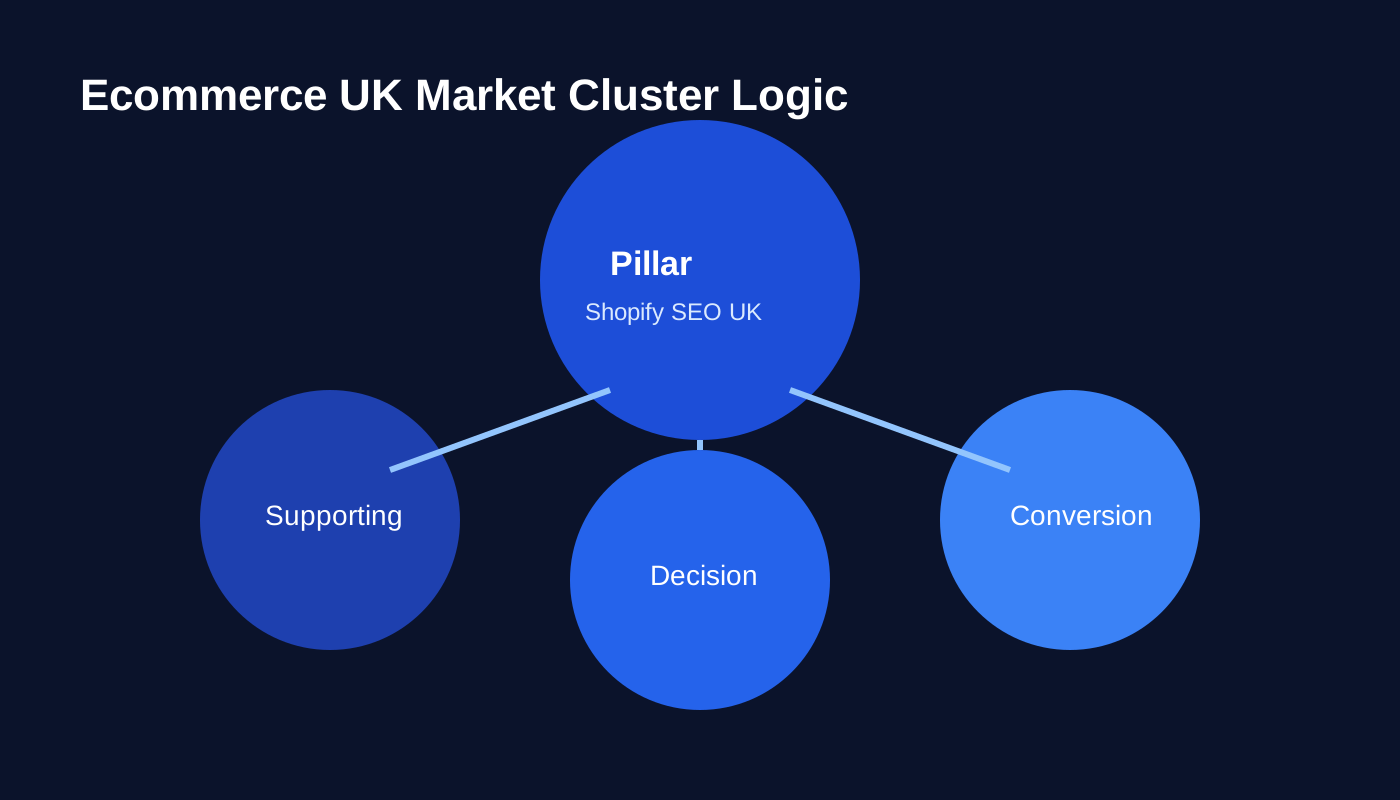
A useful cluster has clear hierarchy:
- Pillar query: broad strategic topic with high authority potential.
- Supporting evaluation queries: tools, comparisons, frameworks, and scenario pages.
- Transaction-adjacent queries: service-relevant problem statements that can lead to commercial pages.
Most cluster failures happen when these layers are mixed in one page or split across too many weak pages.
Cluster model table for ecommerce teams
| Cluster level | Query intent | Example topic | Destination link |
|---|---|---|---|
| Pillar | Strategic | Shopify SEO for UK ecommerce growth | In-depth guide page |
| Supporting | Evaluation | Shopify category SEO structure, technical checks, crawl control | Related article cluster |
| Decision | Commercial comparison | Shopify agency benchmark, migration support model | Service page and contact |
| Conversion | Action | Audit, migration, SEO implementation support | Contact and service CTAs |
Your content should guide users through these layers naturally. If your pillar has no decision layer, you are creating education with no lead path.
How competitor libraries expose opportunity
Competitor libraries are useful because they show concentration zones. When several agencies publish heavily on the same broad topic, you should avoid generic rephrasing and instead focus on gaps such as:
- industry-specific implementation guides,
- UK operational constraints (VAT, delivery, localisation),
- execution detail tied to real Shopify workflows,
- clearer commercial decision frameworks.
This is where StoreBuilt typically outperforms generic “top tips” content.
If you want a cluster that supports real revenue outcomes, see our Shopify SEO services.
Execution checklist
| Step | Question | Output |
|---|---|---|
| Intent mapping | Is this informational, evaluation, or decision intent? | Cluster placement |
| Page assignment | Should this be blog, service, or supporting page? | Correct page type |
| Internal linking | What is the next logical action for this reader? | CTA and service pathway |
| Consolidation | Are we duplicating an existing post? | Merge/refresh decision |
| Measurement | Which query and conversion signal will we track? | KPI plan |
StoreBuilt example
A UK ecommerce brand had dozens of Shopify posts with overlapping SEO themes and inconsistent results. We mapped every post to intent and page type, then merged weaker duplicates into stronger cluster assets.
The team reduced publishing waste, improved internal-link flow, and gave category and service pages stronger support from blog content. The total number of articles fell, but visibility quality and commercial relevance improved.
Common mistakes to avoid
Before publishing any new cluster page, run a quick risk check:
| Mistake | What happens | Fix |
|---|---|---|
| Creating a new post for every keyword variant | Thin overlap pages dilute authority | Group close variants under one stronger page |
| Linking only to other blog posts | User journey stalls before commercial step | Add links to relevant service and category pages |
| Ignoring search-intent shifts over time | Previously good pages lose fit and CTR | Refresh titles, intros, and headings quarterly |
| Measuring rankings only | Teams miss commercial quality signals | Track assisted enquiries and qualified sessions |
This is where cluster governance matters. The output is not just pages; it is a maintained demand-capture system for ecommerce growth.
High-intent AI search implementation layer
The AI-search version of this topic is not just “write more content”. A useful answer engine result needs a page that gives a direct answer, proves the claim, and shows the next operational step inside Shopify.
| Area | StoreBuilt implementation check |
|---|---|
| Primary intent | The page should map to keyword research and one clear buyer or operator problem, not a vague traffic topic. |
| Shopify surface | Identify whether the work belongs on a collection, product page, theme section, checkout step, app workflow, email flow, or support process. |
| Proof | Add first-hand observations, product/category examples, screenshots, policy notes, review signals, or trustworthy external sources where they make the advice safer. |
| Internal route | Link the reader to the service most likely to solve the issue: Shopify SEO and AI search readiness. |
| Measurement | Check Search Console, analytics, assisted conversions, enquiry quality, and AI-response mentions after the update rather than judging success by pageviews alone. |
For this article, the useful research inputs are: Google Search Central guidance, Shopify platform documentation, Ahrefs AI Responses/Brand Radar patterns, and StoreBuilt Shopify audit observations. StoreBuilt would prioritise technical SEO, collection architecture, Product schema, answer-first content, GEO, and Search Console monitoring before expanding into broader supporting content.
If this topic maps to a live store problem, review the related StoreBuilt service or Contact StoreBuilt with the store URL and the issue you want fixed.
Final StoreBuilt point of view
In ecommerce SEO, clustering is not a writing technique, it is an operating model. For Shopify brands in the UK market, keyword clusters should be built to serve both ranking coverage and buying progression.