
What we have seen in ecommerce optimisation work is this: merchandising is often treated like homepage styling when it should be treated like an operating system for demand, margin, and buyer confidence.
If your Shopify store gets traffic but still feels commercially messy, Contact StoreBuilt.
Table of contents
- Keyword decision and research inputs
- Why merchandising strategy drives more than aesthetics
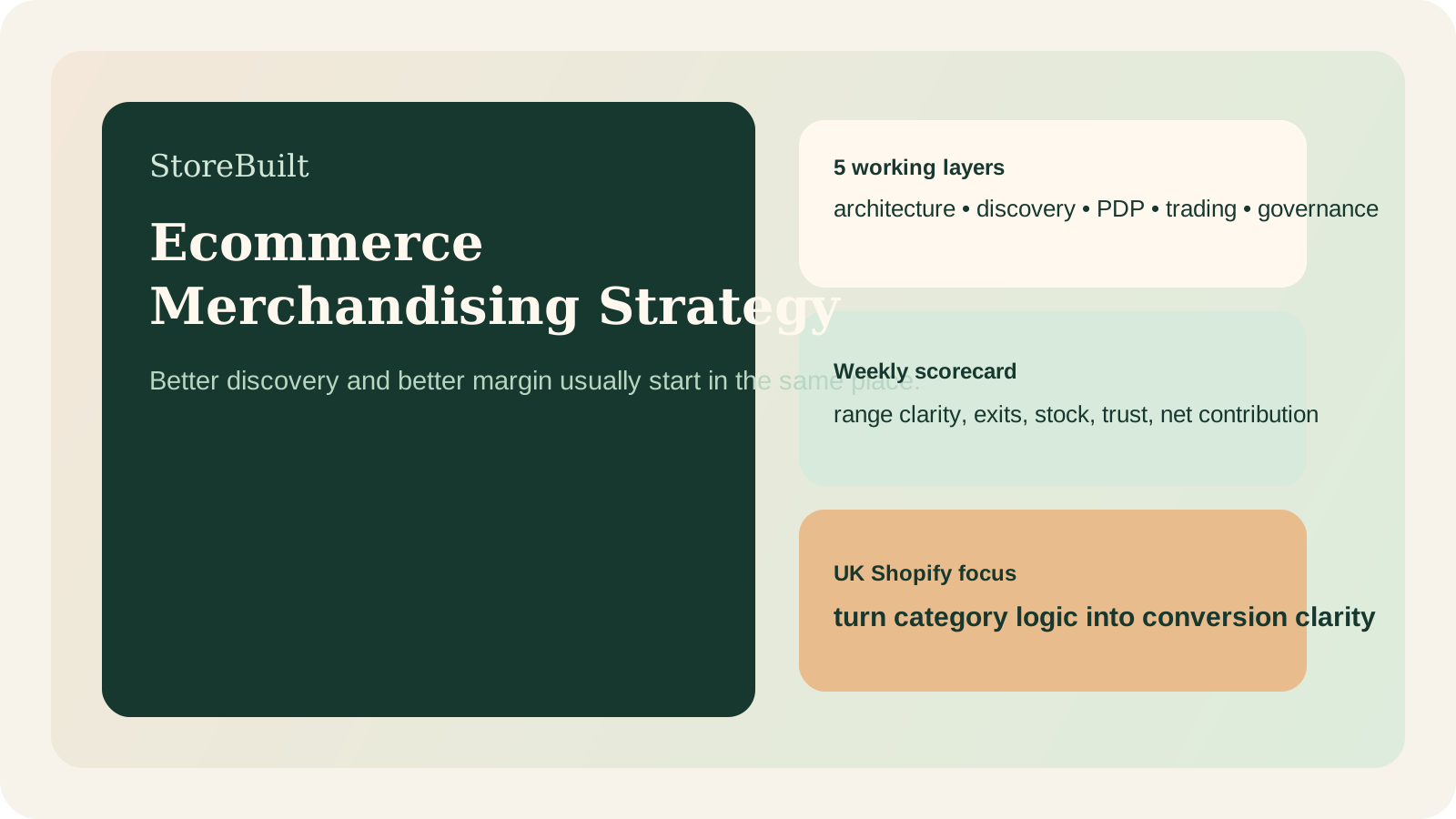
- The 5 layers of strong Shopify merchandising
- The weekly merchandising scorecard
- How to connect campaigns, stock, and onsite discovery
- StoreBuilt example
- Final StoreBuilt point of view
Keyword decision and research inputs
Primary keyword: ecommerce merchandising strategy
Secondary keywords:
- shopify merchandising strategy
- ecommerce merchandising for conversion
- onsite merchandising for shopify
- ecommerce UK market merchandising
Search intent: informational-commercial from teams improving conversion, catalogue discovery, and trading execution.
Funnel stage: middle of funnel.
Page type: long-form playbook.
Why StoreBuilt can win this topic:
- We see merchandising problems through both CRO and operations lenses.
- We connect category UX, stock logic, promotions, and onsite discovery.
- We know that better merchandising should improve margin quality, not just click activity.
Research inputs used:
- Current SERP review for
ecommerce merchandising strategy,shopify merchandising, and related conversion queries. - Competitor content pattern checks across UK Shopify agencies and practical CRO article libraries.
- StoreBuilt observations from category audits, launch planning, and onsite optimisation work.
Why merchandising strategy drives more than aesthetics
In the ecommerce UK market, merchandising quality affects far more than product presentation.
It shapes:
- what customers discover first
- how quickly they understand the range
- whether promotions feel helpful or desperate
- how much support load the store creates
- how well margin survives campaign pressure
That is why merchandising should not sit only with design or only with campaign teams. It needs shared ownership between trading, product, marketing, and the people maintaining the Shopify experience.
The stores that perform best usually make three things clear:
- what products matter most right now
- who each range is for
- what should happen next after the first click
If any of those are unclear, conversion often weakens before the analytics team can describe why.
The 5 layers of strong Shopify merchandising
Strong merchandising usually has five layers working together.
| Layer | What it controls | Common failure mode |
|---|---|---|
| Category architecture | Range logic, hierarchy, collection purpose | Too many overlapping collections with weak intent |
| Discovery UX | Search, filters, sort logic, recommendation paths | Shoppers cannot narrow the range with confidence |
| PDP support | Product proof, cross-sell, bundle logic, comparison help | Traffic reaches PDPs but hesitation stays high |
| Trading rules | Launches, promos, seasonal routing, stock priorities | Campaigns override long-term clarity |
| Governance | Ownership, QA, and reporting | Good ideas decay because no one maintains them |
Most Shopify stores do not fail equally across all five. They usually have one dominant weak layer.
For example:
- a beauty brand may need better cross-sell and regimen logic
- a furniture brand may need stronger category comparison and trust support
- a gifting brand may need seasonal routing and tighter stock communication
- a multi-market catalogue may need clearer collection ownership and localisation rules
That is why merchandising strategy should start with business model fit, not trend copying.
If your category or PDP experience needs deeper structural work, StoreBuilt’s CRO and UX optimisation service is usually the right route.
The weekly merchandising scorecard
Merchandising improves fastest when it becomes a weekly review habit.
| Question | Why it matters | Signal of weakness |
|---|---|---|
| Are top collections aligned with current demand? | Protects trading focus | Hero inventory buried or outdated |
| Are search and filter paths helping selection? | Improves discovery speed | High exits from collection pages |
| Are PDPs supporting confident purchase? | Reduces hesitation | Strong traffic, weak add-to-cart rate |
| Are promotions margin-aware? | Protects profitability | Conversion lifts with poor net contribution |
| Are stock messages helping rather than confusing? | Supports trust | Support tickets and abandoned sessions rise |
This scorecard does not need enterprise complexity. It just needs consistency. The point is to create a repeatable trading rhythm where product discovery and conversion quality are reviewed together.
One StoreBuilt rule of thumb: if merchandising reporting talks only about revenue, it is incomplete. You also need to look at exit behaviour, stock concentration, support friction, and net-margin implications.
How to connect campaigns, stock, and onsite discovery
This is where many teams lose control. Campaigns are launched quickly, but the onsite experience is not reset around them.
The result is familiar:
- paid ads point to weak collection landing pages
- hero products sell through while the site still pushes them aggressively
- sorting and filtering do not reflect the campaign narrative
- support teams answer questions that the store should already be answering
A cleaner model is:
- Define the trading priority.
- Confirm which categories, products, and messages support it.
- Update collection paths, recommendation blocks, and PDP support.
- Review stock, delivery, and support impact before scaling spend.
That model is less glamorous than talking about “brand storytelling,” but it produces a stronger customer journey and fewer downstream problems.
StoreBuilt example
A UK brand had healthy traffic around a key seasonal window but inconsistent conversion quality. The issue was not product demand. It was merchandising drift.
Collections had grown organically, promotional emphasis changed week to week, and product discovery paths no longer matched what the marketing team was buying traffic for. Support demand also rose because onsite messages around stock timing and options were too soft.
The fix was not a redesign. It was a merchandising reset:
- fewer overlapping collection paths
- clearer hero-product logic
- better campaign-to-collection continuity
- more deliberate PDP support for comparison and reassurance
The commercial win came from clarity, not novelty.
If your onsite journey feels overbuilt but under-curated, Contact StoreBuilt.
High-intent AI search implementation layer
The AI-search version of this topic is not just “write more content”. A useful answer engine result needs a page that gives a direct answer, proves the claim, and shows the next operational step inside Shopify.
| Area | StoreBuilt implementation check |
|---|---|
| Primary intent | The page should map to ecommerce merchandising and one clear buyer or operator problem, not a vague traffic topic. |
| Shopify surface | Identify whether the work belongs on a collection, product page, theme section, checkout step, app workflow, email flow, or support process. |
| Proof | Add first-hand observations, product/category examples, screenshots, policy notes, review signals, or trustworthy external sources where they make the advice safer. |
| Internal route | Link the reader to the service most likely to solve the issue: CRO and UX optimisation. |
| Measurement | Check Search Console, analytics, assisted conversions, enquiry quality, and AI-response mentions after the update rather than judging success by pageviews alone. |
For this article, the useful research inputs are: StoreBuilt CRO audit patterns, analytics QA checks, Shopify theme constraints, and buyer-intent SERP patterns. StoreBuilt would prioritise PDP hierarchy, cart friction, mobile merchandising, testing policy, analytics QA, and measured releases before expanding into broader supporting content.
If this topic maps to a live store problem, review the related StoreBuilt service or Contact StoreBuilt with the store URL and the issue you want fixed.
Final StoreBuilt point of view
Ecommerce merchandising strategy works when it is treated as commercial control, not decoration.
For Shopify brands in 2026, better merchandising usually means clearer range logic, stronger discovery, and tighter coordination between traffic, stock, and conversion. That is what turns a busy store into a useful one.