
What we have seen in support reviews is this: most Shopify customer-support pain is not really a ticket-volume problem. It is a context problem. Teams are answering the right customers with the wrong information, or too slowly, because systems are split across inboxes, order dashboards, chat tools, and informal workarounds.
If your support layer is dragging on retention, conversion, or internal capacity, Contact StoreBuilt.
Table of contents
- Keyword decision and research inputs
- Quick answer: what a support app should improve
- The support jobs Shopify teams need covered
- A practical support app shortlist for UK teams
- When a support platform will not fix the real issue
- StoreBuilt example
- 90-day support-system plan
- Final StoreBuilt point of view
Keyword decision and research inputs
Primary keyword: customer support apps for shopify
Secondary keywords:
- Shopify helpdesk apps
- Shopify support software
- customer service apps for ecommerce
- Shopify live chat support
- ecommerce support tools UK
Search intent: commercial investigation with implementation intent.
Funnel stage: middle to bottom.
Page type: shortlist guide with operational commentary.
Why StoreBuilt can realistically win this topic:
- Support systems influence conversion trust, retention, and post-purchase experience, not just ticket handling.
- UK Shopify brands often need a more commercial support lens than generic software roundups provide.
- StoreBuilt can connect helpdesk decisions to retained support, workflow ownership, and customer journey quality.
Research inputs used in angle selection:
- Current SERP review around
customer support apps for Shopify,Shopify helpdesk, and adjacent live-chat and support-system queries. - UK competitor publishing patterns, including Charle’s customer-support-app content style and surrounding helpdesk comparison topics.
- Public research around self-serve support, order-context visibility, AI-assisted triage, and post-purchase service expectations.
Quick answer: what a support app should improve
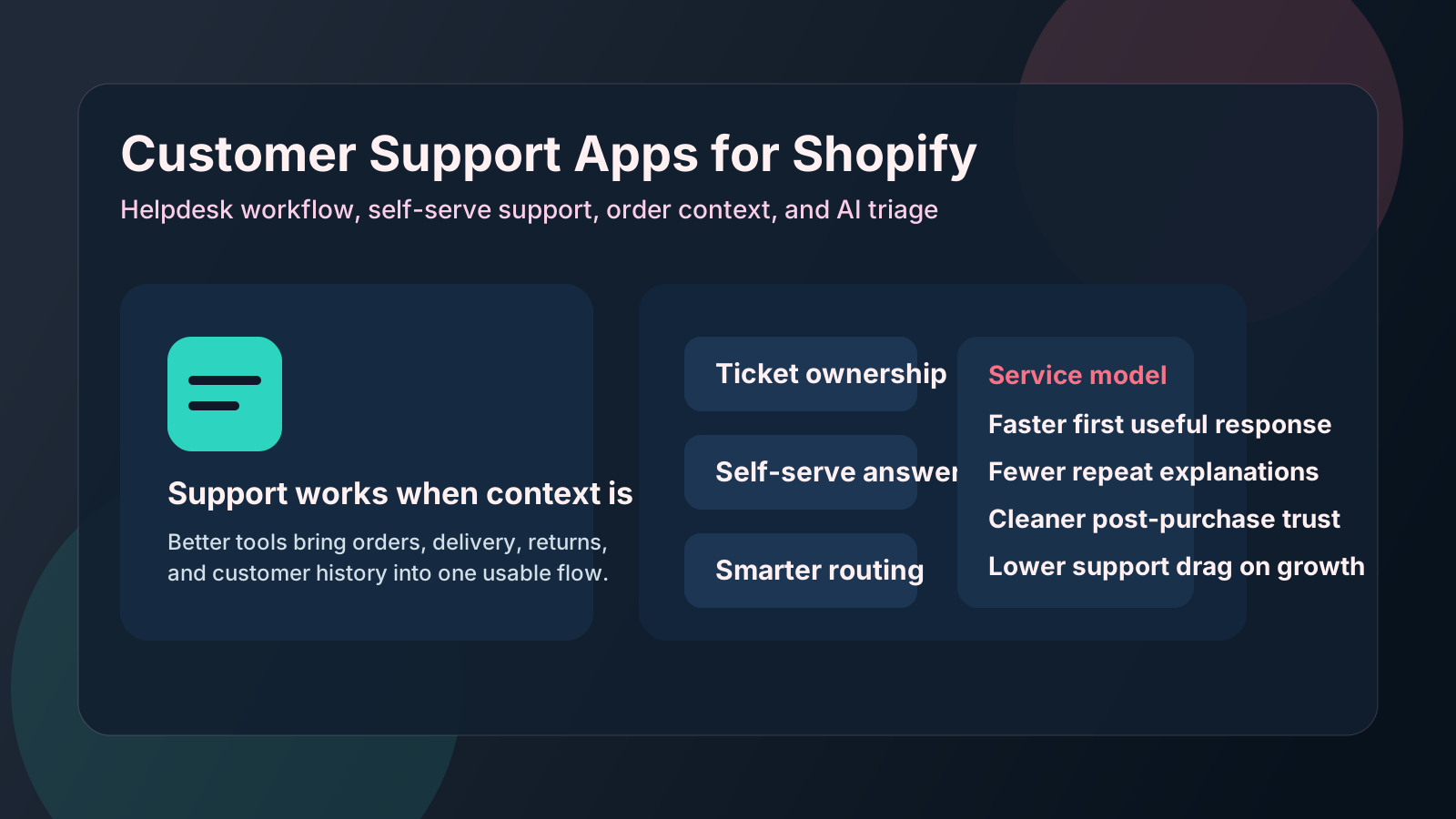
The best Shopify support app is the one that helps the team resolve customer issues with less friction and better context.
That usually means improving:
- visibility of the order behind the question
- speed of first useful response
- self-serve answers for simple issues
- escalation flow for complicated cases
- consistency across email, chat, and post-purchase requests
If a helpdesk tool does not materially improve those outcomes, it may simply reorganise the inbox without solving the service model.
The support jobs Shopify teams need covered
Support platforms tend to get compared on channels and features. That is not enough. Start with the job.
| Support job | Why it matters | Common mistake |
|---|---|---|
| Unified ticket handling | avoids fragmented replies across tools | centralising messages without fixing ownership |
| Order context inside support flow | speeds up answers and reduces back-and-forth | forcing agents to jump across tabs and systems |
| Self-serve support | lowers simple ticket volume | publishing a help centre nobody maintains |
| AI or rules-based triage | improves routing and response quality | automating poor answers at scale |
| Post-purchase exception handling | protects trust during delivery or return issues | treating support as separate from operations |
Most support-app decisions should be judged by how well they handle high-frequency, high-friction moments after purchase.
A practical support app shortlist for UK teams
The support-tool categories most UK Shopify brands commonly review in 2026 look like this:
| Tool type or example category | Strong fit when | Main watch-out |
|---|---|---|
| Ecommerce-native helpdesk layer | order context and ticket ownership need to sit together | does not solve broken support policy by itself |
| Enterprise support platform | teams need heavier workflow control or broader channel integration | can be oversized for lean ecommerce teams |
| Chat-first support layer | pre-purchase guidance and quick-service expectations matter | chat volume becomes costly without self-serve design |
| Self-serve knowledge and portal layer | repeat support queries cluster around known issues | outdated help content damages trust |
| AI-assisted triage layer | ticket routing and agent efficiency are under pressure | poor prompts or weak data create unreliable answers |
The right choice depends less on brand size than on process maturity and issue complexity.
Ecommerce-native helpdesk tools
These are usually the right first review for Shopify teams because they bring order context closer to customer communication.
Useful signs:
- agents need to see fulfilment or refund history quickly
- support volume is high enough to justify structured workflow
- the brand wants customer service and commerce data closer together
This is often where Shopify brands can create immediate operational value.
Enterprise-style platforms
These may make sense when the support operation spans:
- multiple brands
- complex channel mix
- deeper escalation rules
- broader business-service operations beyond the storefront
But for many ecommerce teams, enterprise platforms introduce process weight before the support operation is ready for it.
Chat, self-serve, and AI assistance
This category is growing fast, but it is easy to implement badly.
| Capability | High-value when | Risk |
|---|---|---|
| Live chat | pre-purchase questions strongly affect conversion | chat becomes a new queue without triage discipline |
| Help centre | recurring tickets are predictable and easy to answer | stale content frustrates customers |
| AI routing or draft replies | issue categories repeat and data is accessible | inaccurate answers damage confidence quickly |
| Customer portal | order edits, tracking, and returns can be self-served | portal quality depends on operations accuracy |
The commercial question is simple: does the support layer make the customer feel the brand is in control?
For brands that need support workflow tied to retained technical ownership, see StoreBuilt support, maintenance, and audits.
When a support platform will not fix the real issue
Do not assume a new support app will fix the problem if:
- fulfilment is inconsistent
- policy language is unclear
- refunds and exchanges are handled ad hoc
- there is no owner for service quality
- the help centre does not reflect live operations
In those cases, the support tool is downstream of the real issue.
Better software can still help, but only after the operating model becomes clearer.
StoreBuilt example
One UK Shopify merchant believed it had outgrown its support setup because ticket volumes were rising and response times were slipping. The team assumed it needed a more advanced helpdesk immediately.
The review showed the deeper issue was not only tooling. Customer questions were repeating because delivery updates, returns guidance, and account-service paths were inconsistent. The inbox had become the place where customers discovered operational ambiguity.
Once those service points were tightened, the new helpdesk choice became much easier. The business could then evaluate software based on real workflow needs instead of support frustration.
That pattern is common. Strong support systems sit on top of service clarity.
90-day support-system plan
| Timeline | Focus | Output |
|---|---|---|
| Weeks 1-2 | classify ticket types, channels, and friction sources | support diagnostic with issue clusters |
| Weeks 3-5 | tighten order-context visibility and ownership rules | cleaner service workflow |
| Weeks 6-9 | improve self-serve content and escalation paths | lower avoidable ticket load |
| Weeks 10-13 | add helpdesk or AI workflow changes where justified | more resilient support stack |
Metrics worth reviewing:
- first-response time
- resolution time
- repeat-contact rate
- delivery and returns ticket share
- self-serve deflection rate
- support-related customer satisfaction trend
If your team spends more time forwarding context than solving the problem, the support system is under-designed.
For an outside review before peak trading or a support-retainer rethink, use the StoreBuilt free Shopify audit.
High-intent AI search implementation layer
The AI-search version of this topic is not just “write more content”. A useful answer engine result needs a page that gives a direct answer, proves the claim, and shows the next operational step inside Shopify.
| Area | StoreBuilt implementation check |
|---|---|
| Primary intent | The page should map to customer support apps for shopify and one clear buyer or operator problem, not a vague traffic topic. |
| Shopify surface | Identify whether the work belongs on a collection, product page, theme section, checkout step, app workflow, email flow, or support process. |
| Proof | Add first-hand observations, product/category examples, screenshots, policy notes, review signals, or trustworthy external sources where they make the advice safer. |
| Internal route | Link the reader to the service most likely to solve the issue: Shopify support, maintenance and audits. |
| Measurement | Check Search Console, analytics, assisted conversions, enquiry quality, and AI-response mentions after the update rather than judging success by pageviews alone. |
For this article, the useful research inputs are: StoreBuilt Shopify audits, UK ecommerce SERP intent, Shopify platform documentation, and AI-search measurement patterns. StoreBuilt would prioritise technical audits, roadmap priority, theme changes, app governance, reporting, and measured improvement before expanding into broader supporting content.
If this topic maps to a live store problem, review the related StoreBuilt service or Contact StoreBuilt with the store URL and the issue you want fixed.
Final StoreBuilt point of view
The best customer support apps for Shopify are the ones that make service faster, clearer, and more commercially aligned with the rest of the ecommerce operation. Great support software should reduce friction for customers and reduce ambiguity for the team behind the scenes.
For UK ecommerce brands, that usually means fewer disconnected tools, stronger order context, and a cleaner path between customer question and operational answer.