
What we have seen in Shopify stack audits is this: most app problems are not caused by one bad tool. They come from teams adding software one campaign at a time until nobody can explain which app owns which job.
If your Shopify stack feels expensive, slow, or hard to change, Contact StoreBuilt.
Table of contents
- Keyword decision and research inputs
- Quick answer: what makes a Shopify app worth keeping
- The app categories that matter most for UK ecommerce teams
- A practical Shopify app shortlist for 2026
- When not to install another app
- StoreBuilt example
- 90-day app-stack cleanup plan
- Final StoreBuilt point of view
Keyword decision and research inputs
Primary keyword: best shopify apps
Secondary keywords:
- Shopify apps 2026
- ecommerce apps for Shopify
- Shopify app stack
- Shopify apps for UK ecommerce
- best Shopify tools for ecommerce brands
Search intent: commercial investigation with active implementation intent.
Funnel stage: middle to bottom.
Page type: shortlist guide with operator commentary.
Why StoreBuilt can realistically win this topic:
- The topic maps to real Shopify audit work rather than broad affiliate-style list publishing.
- UK ecommerce teams often need fewer apps with clearer ownership, not bigger software lists.
- We can connect app decisions to performance, QA, support load, and margin discipline.
Research inputs used in angle selection:
- Current SERP review around
best shopify apps,shopify apps 2026, and adjacent use-case modifiers. - UK competitor content patterns, especially Charle’s article library and other Shopify-agency list-style coverage.
- Public platform and app-category research around retention, support, reviews, subscriptions, merchandising, and operational tooling.
Quick answer: what makes a Shopify app worth keeping
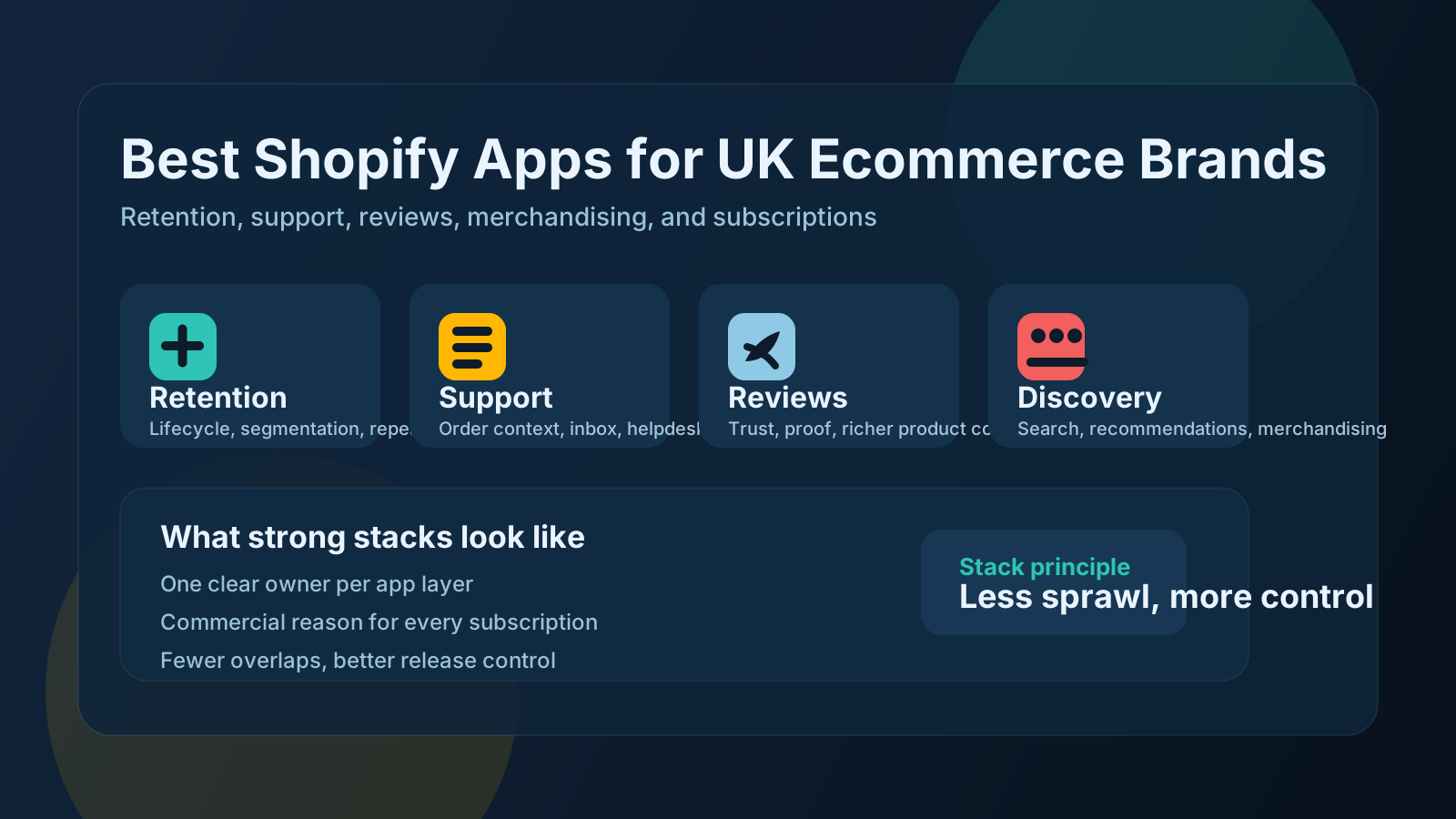
The best Shopify apps are not the ones with the most features. They are the ones that solve a specific commercial problem cleanly, fit the way your team works, and do not create hidden operational debt.
For UK ecommerce brands, a good app usually does at least three things:
- improves a revenue-critical workflow
- reduces manual work or support friction
- remains understandable after the original installer leaves
That third point matters more than many teams expect. A powerful app is still a bad decision if only one person knows how it is configured.
The app categories that matter most for UK ecommerce teams
If a team asks which apps matter first, we usually frame the answer around operating layers rather than software popularity.
| Layer | Why it matters | Typical signal that the stack is weak |
|---|---|---|
| Retention | email, SMS, repeat purchase, lifecycle ownership | campaign pressure rises but repeat revenue stays inconsistent |
| Support | faster answers, ticket context, post-purchase trust | inboxes feel reactive and resolution times drift |
| Reviews and trust | conversion proof and better product understanding | PDPs feel thin or shoppers need reassurance |
| Merchandising and personalisation | better product discovery and basket shaping | traffic lands but product-finding friction remains high |
| Subscriptions and recurring revenue | steadier reorder behaviour where the model fits | repeat purchase exists but lacks structured retention |
| Returns and post-purchase visibility | lower service load and stronger confidence | support tickets cluster around tracking and returns |
The winning stack is not always one app per layer. Some brands can keep the stack lean. Others need deeper capability. The question is whether the revenue model justifies the added complexity.
A practical Shopify app shortlist for 2026
The shortlist below is not a universal ranking. It is a decision aid for UK ecommerce teams reviewing common app categories in 2026.
| App or category example | Strong fit when | Main watch-out |
|---|---|---|
| Klaviyo | retention is a major growth lever and the team will actually use segmentation well | expensive if flows, list hygiene, and ownership are weak |
| Gorgias | support volume is meaningful and CX needs order context | process issues do not disappear just because the helpdesk looks cleaner |
| Judge.me or Okendo-style review layer | trust content and review capture can materially improve PDP quality | duplicated widgets and schema clutter can create UX and SEO noise |
| Rebuy-style merchandising layer | the business has enough traffic and AOV to justify more advanced product recommendations | personalisation apps can add cost and storefront weight quickly |
| Recharge-style subscription layer | the category genuinely benefits from repeat replenishment or membership behaviour | forcing subscription onto weak category fit can hurt first-order conversion |
| Loop or AfterShip-style post-purchase layer | returns, exchanges, and tracking generate significant support load | more automation still needs clear policy and ownership |
| Search and discovery layer | catalogue complexity is hurting product-finding speed | too many overlays can slow the store or fragment analytics |
The most useful way to read that table is not “which app is number one?” It is “which business problem is mature enough to deserve software investment?“
1. Retention and lifecycle
Many UK Shopify brands overestimate how much a retention app will fix by itself. Email and SMS tools become valuable only when the underlying operating model is ready:
- list capture is intentional
- flow triggers are documented
- campaign calendars exist
- reporting is tied to commercial outcomes
If those foundations are weak, the right move may be a stack cleanup before a new retention app purchase.
For teams building stronger lifecycle systems, see StoreBuilt retention services.
2. Support and post-purchase clarity
Support apps become high-value fast when a brand has:
- meaningful order volume
- more than one fulfilment or service exception path
- repeat queries around delivery, returns, or account issues
What teams often miss is that a support platform should improve decision quality, not just ticket handling speed. If the app cannot show order context, return status, and escalation routes clearly, it may simply formalise the chaos.
3. Trust, reviews, and PDP confidence
Review tools are rarely just review tools. They influence:
- conversion trust
- user-generated content
- structured trust signals
- product decision confidence
The wrong setup usually means duplicated review outputs, inconsistent styling, or review widgets that compete with more important PDP content.
4. Merchandising and product discovery
This is where many “best apps” lists become vague. Discovery apps should be judged by commercial effect, not feature theatre.
| Discovery problem | Better question to ask |
|---|---|
| Search results feel weak | Can shoppers find the right SKU faster without more support dependency? |
| Recommendation blocks underperform | Is the logic improving basket quality or just filling space? |
| Collection filters are messy | Does the app reduce friction or make navigation heavier? |
The answer is often more operational than technical. Merchandising logic fails when product data, naming, inventory status, and category structure are inconsistent.
5. Subscriptions, returns, and the second-order stack
Not every brand needs a subscription app, and not every store needs a complex returns layer. These tools matter when the business model has already earned them.
Common sign that the stack is growing in the wrong direction:
- the store has multiple post-purchase tools but weak product and checkout fundamentals
In that situation, a better theme, cleaner product pages, and stronger support ownership may outperform another software purchase.
When not to install another app
This is the section many competitor listicles skip.
Do not install another Shopify app yet if:
- the team cannot clearly name the owner of the current tool
- storefront performance is already suffering
- analytics attribution is fragmented
- the last three apps were added without a decommissioning plan
- the real problem is process, not missing functionality
In practical terms, app growth should follow capability gaps, not internal anxiety.
StoreBuilt example
One ecommerce team came into a StoreBuilt review believing they needed a stronger Shopify stack because a competitor had launched faster on-site experiences and more post-purchase automation.
The audit showed the opposite problem. Their store already had enough software. What they lacked was a clear ownership model. Review output came from two tools, support routing lived partly in email and partly in a helpdesk, and product recommendations were running without a clean merchandising brief.
The first win was subtraction. Once the stack became easier to understand, the team could see which capability gaps were real and which had been created by app overlap.
That is a common pattern. App quality matters, but stack coherence matters more.
90-day app-stack cleanup plan
| Timeline | Focus | Output |
|---|---|---|
| Weeks 1-2 | inventory all apps, cost, owner, and storefront impact | app register with keep/replace/remove status |
| Weeks 3-5 | remove overlap and define source-of-truth roles | cleaner operating model |
| Weeks 6-9 | tighten key layers such as retention, support, or reviews | improved execution in revenue-critical workflows |
| Weeks 10-13 | add only the next justified capability gap | controlled roadmap instead of app sprawl |
Metrics worth checking during the review:
- monthly app spend
- storefront speed impact
- support ticket categories
- repeat purchase trend
- average order value
- team time spent managing software exceptions
If your team cannot connect app cost to operational value, the stack is likely too loose.
For an independent stack review before your next hire or software commitment, use the StoreBuilt free Shopify audit.
High-intent AI search implementation layer
The AI-search version of this topic is not just “write more content”. A useful answer engine result needs a page that gives a direct answer, proves the claim, and shows the next operational step inside Shopify.
| Area | StoreBuilt implementation check |
|---|---|
| Primary intent | The page should map to best shopify apps and one clear buyer or operator problem, not a vague traffic topic. |
| Shopify surface | Identify whether the work belongs on a collection, product page, theme section, checkout step, app workflow, email flow, or support process. |
| Proof | Add first-hand observations, product/category examples, screenshots, policy notes, review signals, or trustworthy external sources where they make the advice safer. |
| Internal route | Link the reader to the service most likely to solve the issue: Apps, integrations and automation. |
| Measurement | Check Search Console, analytics, assisted conversions, enquiry quality, and AI-response mentions after the update rather than judging success by pageviews alone. |
For this article, the useful research inputs are: StoreBuilt Shopify audits, UK ecommerce SERP intent, Shopify platform documentation, and AI-search measurement patterns. StoreBuilt would prioritise app stack decisions, integration logic, automation, data flow QA, and operational reliability before expanding into broader supporting content.
If this topic maps to a live store problem, review the related StoreBuilt service or Contact StoreBuilt with the store URL and the issue you want fixed.
Final StoreBuilt point of view
The best Shopify apps for UK ecommerce brands are the ones that make the business easier to run, not just easier to buy software for. Strong stacks are opinionated, commercially justified, and simple enough to survive staff changes, redesigns, and agency handovers.
Most stores do not need more apps. They need a better stack design. That is the real operator advantage behind a high-performing Shopify build.