
What we have seen in agency selection cycles is this: many ecommerce teams evaluate Shopify agencies with vague goals and generic RFPs, then struggle with mismatched delivery later.
If you want StoreBuilt to pressure-test your agency brief before outreach, Contact StoreBuilt.
Table of contents
- Keyword decision and research inputs
- Why UK agency briefs fail
- Briefing document structure
- Scorecard table for shortlist decisions
- Questions to ask every Shopify agency
- StoreBuilt example
- Final StoreBuilt point of view
Keyword decision and research inputs
Primary keyword: uk shopify agency briefing doc for ecommerce leads
Secondary keywords:
- how to choose shopify agency uk
- ecommerce agency brief template
- shopify partner shortlist framework
- ecommerce UK market agency evaluation
Search intent: commercial evaluation and procurement planning.
Funnel stage: bottom.
Page type: decision framework guide.
Why StoreBuilt can win this topic:
- We participate in agency evaluation cycles with ecommerce leadership teams and see where brief quality drives outcomes.
- We combine strategy, SEO, and implementation delivery, so brief standards are grounded in real execution constraints.
- We understand how to avoid “good proposal, poor fit” outcomes.
Research inputs used:
- SERP review for Shopify agency selection and brief-template queries.
- UK agency content pattern review, including Charle and other major Shopify partners.
- Modifier analysis around pricing, capability, migration, SEO, CRO, and support models.
Why UK agency briefs fail
Most failed selections start with one of these:
- objectives are channel-level (“grow ecommerce”) instead of operational (“lift category conversion in top 3 categories”);
- no decision criteria weightings;
- unclear team capacity and approval dependencies;
- missing risk and governance requirements;
- unrealistic launch or migration timelines.
When the brief is unclear, responses are harder to compare and the team over-indexes on pitch quality.
Briefing document structure
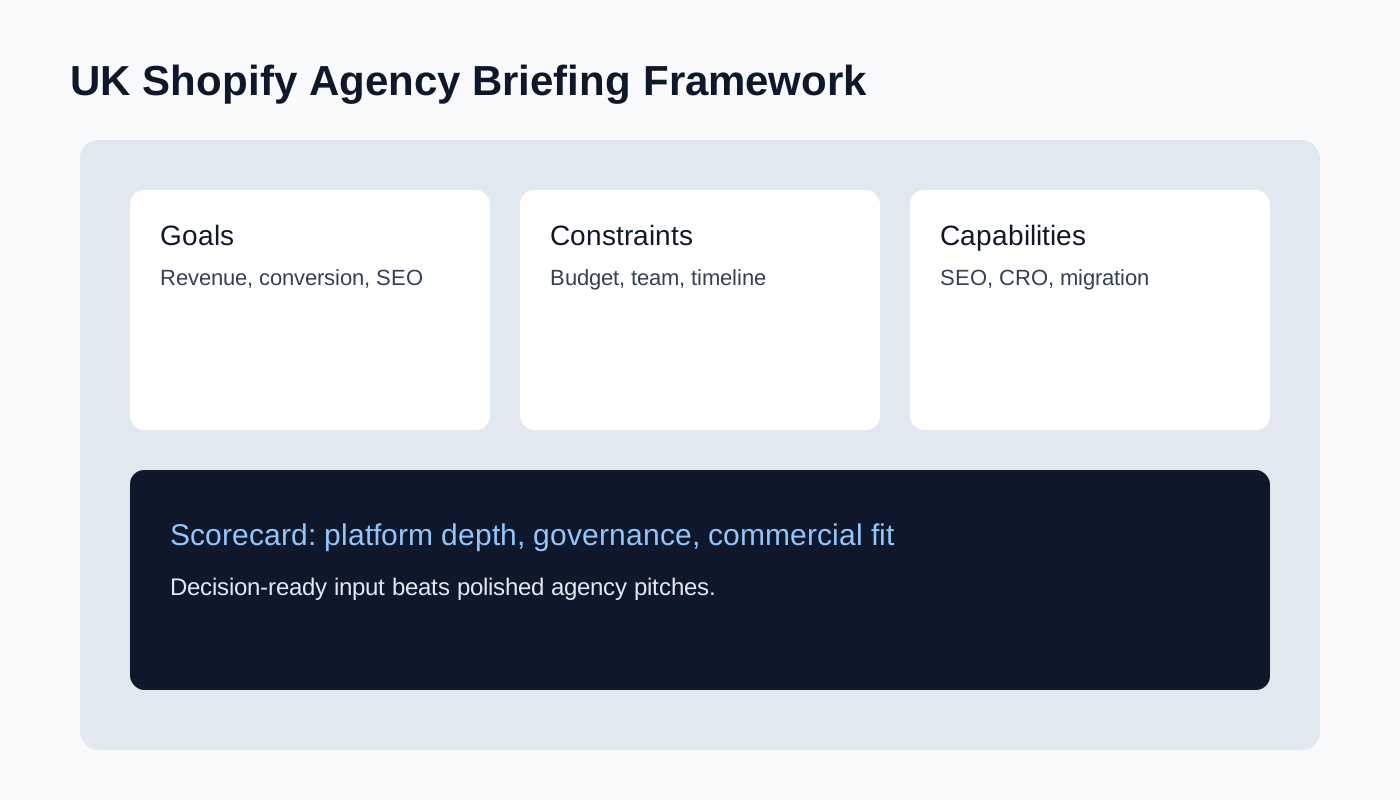
Your brief should include:
- Business goals and priority metrics.
- Current platform state and pain points.
- Scope split: build, migration, SEO, CRO, retention, support.
- Constraints: budget range, timeline, internal team availability, legal/compliance factors.
- Required ways of working: QA, reporting cadence, escalation model.
- Success criteria at 30, 90, and 180 days.
Include known tradeoffs up front. Strong agencies will challenge weak assumptions early, which protects delivery later.
Scorecard table for shortlist decisions
| Evaluation area | Weight | What good looks like | Red flag |
|---|---|---|---|
| Shopify platform depth | 25% | Clear examples of similar architecture and complexity | Generic capability claims |
| SEO and content execution | 20% | Proven method for category + content integration | SEO as add-on service |
| CRO and experimentation | 15% | Structured testing process and implementation ownership | “Best practice” only, no process |
| Delivery governance | 20% | Defined QA, sprint rhythm, and risk controls | Vague project management language |
| Commercial model fit | 20% | Transparent pricing and support terms | Hidden dependencies and scope ambiguity |
If you use this scorecard consistently, team alignment improves and procurement cycles shorten.
If you need support running this process, StoreBuilt can help with strategy and delivery planning.
Questions to ask every Shopify agency
| Question | Why it matters |
|---|---|
| How do you handle overlap between SEO, CRO, and development priorities? | Reveals operating model maturity |
| What do first 90 days look like in detail? | Shows whether they can execute beyond proposals |
| How do you de-risk launches and migrations? | Validates QA and rollback discipline |
| What internal team input do you need from us? | Exposes hidden client-side workload |
| How do you report commercial impact? | Confirms outcome accountability |
StoreBuilt example
A UK brand had strong agency proposals but low confidence in fit. We helped rebuild the brief with weighted criteria and clearer constraints. Two shortlisted partners were removed after deeper delivery questions, while one vendor demonstrated stronger operational fit despite a less polished pitch.
The project launched with clearer responsibilities, fewer surprises, and better executive alignment.
Briefing document handoff tips
To improve proposal quality and reduce rework:
- share current analytics context and known blockers with all shortlisted agencies;
- provide one clear decision deadline and a single question log for all participants;
- ask each agency to describe first-30-day execution in detail, not just strategy themes;
- request explicit assumptions on internal team availability and approval dependencies;
- require visibility on who actually does the work day to day.
These simple controls make responses more comparable and prevent procurement decisions driven only by presentation quality.
High-intent AI search implementation layer
The AI-search version of this topic is not just “write more content”. A useful answer engine result needs a page that gives a direct answer, proves the claim, and shows the next operational step inside Shopify.
| Area | StoreBuilt implementation check |
|---|---|
| Primary intent | The page should map to shopify agency and one clear buyer or operator problem, not a vague traffic topic. |
| Shopify surface | Identify whether the work belongs on a collection, product page, theme section, checkout step, app workflow, email flow, or support process. |
| Proof | Add first-hand observations, product/category examples, screenshots, policy notes, review signals, or trustworthy external sources where they make the advice safer. |
| Internal route | Link the reader to the service most likely to solve the issue: Shopify migrations and replatforming. |
| Measurement | Check Search Console, analytics, assisted conversions, enquiry quality, and AI-response mentions after the update rather than judging success by pageviews alone. |
For this article, the useful research inputs are: UK ecommerce platform SERPs, StoreBuilt platform-selection reviews, Shopify operating constraints, and cost/risk signals. StoreBuilt would prioritise platform selection, roadmap planning, migration risk, TCO, operating model, and implementation sequencing before expanding into broader supporting content.
If this topic maps to a live store problem, review the related StoreBuilt service or Contact StoreBuilt with the store URL and the issue you want fixed.
Final StoreBuilt point of view
In the ecommerce UK market, the quality of your Shopify agency brief determines the quality of your shortlist. Better inputs create better proposals, and better proposals lead to better execution.