
What we have seen with UK ecommerce brands is this: marketplace traction can prove demand, but it can also hide the absence of a durable owned-channel model.
Amazon, Etsy, TikTok Shop, and retail marketplaces can generate useful sales. They can also train teams to rely on rented demand, compressed margins, and limited customer ownership.
If your marketplace channel is working but your Shopify store feels secondary, Contact StoreBuilt.
Table of contents
- Keyword decision and research inputs
- Why marketplace-first brands hit a growth ceiling
- The owned-channel transition model
- Marketplace to Shopify decision table
- How to avoid a weak DTC launch
- Anonymous StoreBuilt example
- Final StoreBuilt point of view
Keyword decision and research inputs
Primary keyword: marketplace to Shopify growth plan UK
Secondary keywords:
- ecommerce UK market
- Shopify growth strategy UK
- Amazon to Shopify DTC
- Etsy to Shopify UK
- marketplace ecommerce strategy
Search intent: strategic and commercial. The reader has marketplace revenue or channel traction and is considering whether Shopify should become a stronger owned-channel base.
Funnel stage: middle funnel.
Page type: strategic implementation guide.
Why StoreBuilt can realistically win this topic:
- We can explain the operating model shift, not just the platform choice.
- Many marketplace-to-DTC guides focus on channel benefits but under-cover margins, fulfilment, data, retention, and content architecture.
- StoreBuilt can link the topic to Shopify build, SEO, retention, and support routes.
Research inputs used on June 19, 2026:
- Current competitor review of UK Shopify agency article libraries, including Charle articles around ecommerce growth, Shopify Plus, apps, SEO, and agency selection.
- Existing UK ecommerce SERP patterns where marketplace, DTC, and Shopify queries overlap.
- StoreBuilt audit patterns around brands that have demand but weak owned-store conversion and retention.
Why marketplace-first brands hit a growth ceiling
Marketplace channels are attractive because they shorten the route to demand. Customers are already browsing. Trust is borrowed from the platform. Discovery can happen before the brand has built meaningful authority.
The ceiling appears when the business needs more control:
- better margin visibility
- owned customer data
- repeat purchase journeys
- stronger brand storytelling
- deeper product education
- configurable bundles or subscriptions
- more reliable SEO demand capture
- less dependence on marketplace policy changes
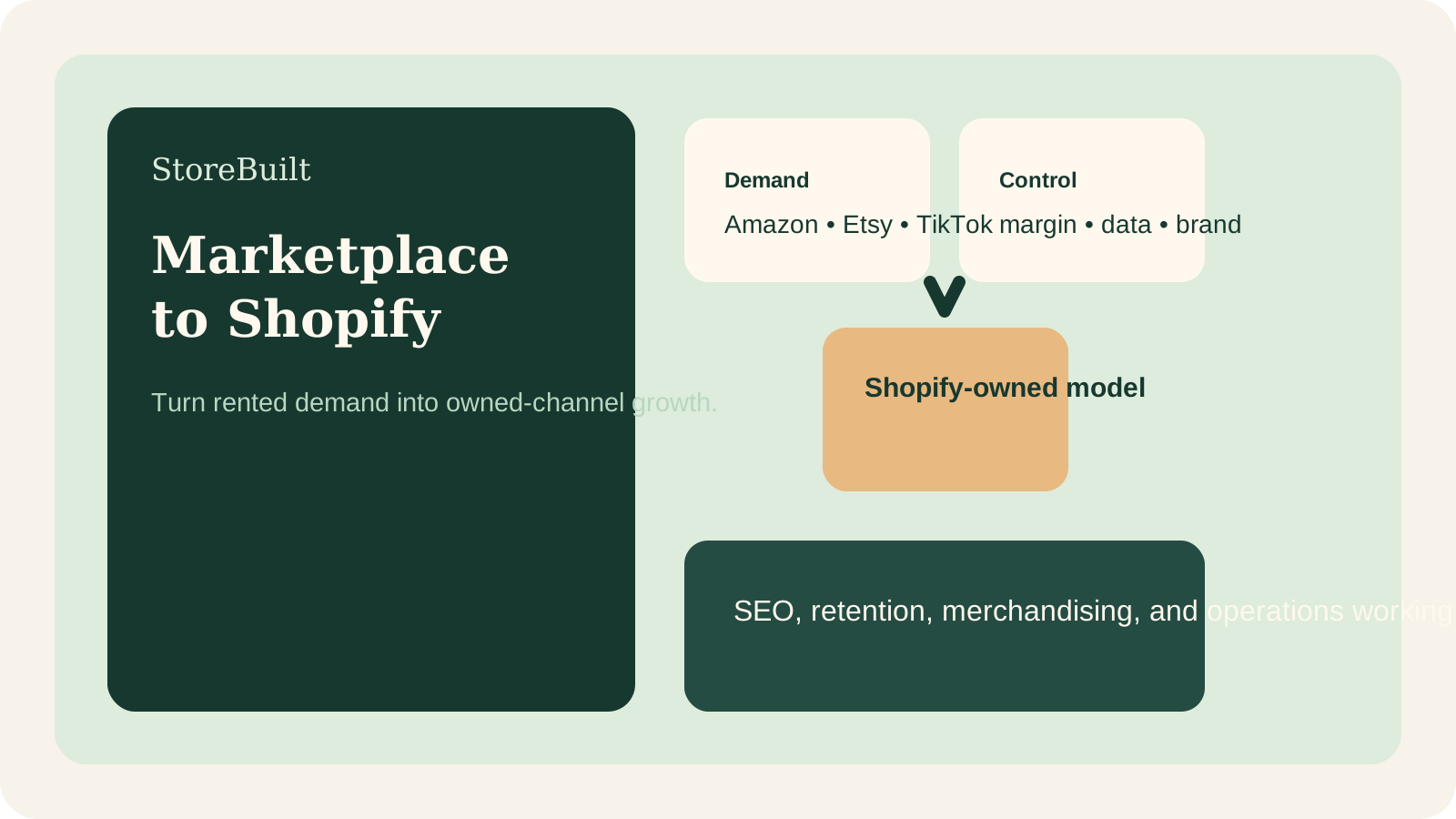
This is where Shopify becomes commercially useful. It is not just a website. It is the owned operating layer for merchandising, content, retention, data, and customer experience.
But launching a Shopify store does not automatically solve marketplace dependence. A weak owned store simply gives the brand another channel to maintain.
The owned-channel transition model
StoreBuilt usually separates the transition into four phases.
First, protect marketplace profit. Do not damage a working channel while building the owned model.
Second, define why customers should buy direct. That might include bundles, subscription flexibility, education, loyalty, early access, gift options, better support, or stronger content.
Third, build Shopify around those reasons. A DTC store should not copy the marketplace listing structure. It should add decision support, comparison, proof, and retention paths.
Fourth, measure owned-channel quality. Revenue matters, but early signs include email capture quality, repeat purchase movement, organic visibility, conversion by product type, and margin per order.
If Shopify is only treated as a catalogue, the owned-channel model will stay weak.
Marketplace to Shopify decision table
| Decision area | Marketplace-first risk | Shopify-owned opportunity |
|---|---|---|
| Customer ownership | Limited data and weak direct relationship | Email, SMS, accounts, loyalty, and lifecycle journeys |
| Margin control | Fees and promotional pressure compress contribution | Bundle logic, AOV strategy, controlled offers |
| Brand education | Listing pages limit depth | Guides, product pages, FAQs, comparison content |
| SEO growth | Marketplace pages may rank, but not for your owned site | Collection, product, and content clusters can compound |
| Retention | Repeat purchase often mediated by the platform | Post-purchase flows and replenishment journeys |
| Operational learning | Marketplace reports show channel output | Shopify plus analytics can reveal journey friction |
The point is not to abandon marketplaces. The point is to stop letting marketplaces define the whole growth model.
How to avoid a weak DTC launch
The biggest mistake is building a Shopify store that looks professional but gives customers no reason to change behaviour.
Before launch, answer these questions:
- Which products are most credible as direct-channel anchors?
- Which offers should exist only or primarily on the owned store?
- Which content helps customers choose better than marketplace listings can?
- Which email or SMS flows are ready from day one?
- Which collection pages need SEO structure, not just product grids?
- Which operational promises can the team keep without manual workarounds?
This is where Shopify store design and development, Shopify SEO and AI Search Readiness, and Klaviyo retention support should work together.
If your owned store is live but still behaves like a passive catalogue, Contact StoreBuilt.
The commercial sequence also matters. A brand should not push every marketplace customer toward the owned store immediately if the owned store cannot yet handle service quality, delivery clarity, or support volume. Start with the products and segments where the direct proposition is strongest. That might be bundles, replenishment, gifting, exclusive colours, education-heavy products, or categories where customers need more context than the marketplace listing can provide.
Build the direct channel around those strengths first. Then expand the range as the team proves it can operate the owned model without damaging customer confidence.
Anonymous StoreBuilt example
One UK brand had clear product-market signal through marketplace sales but low confidence in its owned store. The Shopify site existed, but most traffic went to the marketplace because the direct route did not offer a stronger experience.
The issue was not only design. The direct store lacked a clear merchandising argument. Product pages did not explain range differences, retention flows were shallow, and collection pages were not built around the search terms buyers used before purchase.
The plan focused on direct-channel reasons to buy: clearer bundles, improved PDP proof, stronger educational content, and post-purchase flows that marketplaces could not replicate. Shopify became a strategic channel rather than a brand brochure.
High-intent AI search implementation layer
The AI-search version of this topic is not just “write more content”. A useful answer engine result needs a page that gives a direct answer, proves the claim, and shows the next operational step inside Shopify.
| Area | StoreBuilt implementation check |
|---|---|
| Primary intent | The page should map to marketplace strategy and one clear buyer or operator problem, not a vague traffic topic. |
| Shopify surface | Identify whether the work belongs on a collection, product page, theme section, checkout step, app workflow, email flow, or support process. |
| Proof | Add first-hand observations, product/category examples, screenshots, policy notes, review signals, or trustworthy external sources where they make the advice safer. |
| Internal route | Link the reader to the service most likely to solve the issue: Apps, integrations and automation. |
| Measurement | Check Search Console, analytics, assisted conversions, enquiry quality, and AI-response mentions after the update rather than judging success by pageviews alone. |
For this article, the useful research inputs are: UK ecommerce platform SERPs, StoreBuilt platform-selection reviews, Shopify operating constraints, and cost/risk signals. StoreBuilt would prioritise app stack decisions, integration logic, automation, data flow QA, and operational reliability before expanding into broader supporting content.
If this topic maps to a live store problem, review the related StoreBuilt service or Contact StoreBuilt with the store URL and the issue you want fixed.
Final StoreBuilt point of view
For UK ecommerce brands, marketplaces are useful demand channels, not a complete operating model. Shopify becomes powerful when it gives customers a better reason to buy direct and gives the business better control over margin, retention, content, and customer insight.
The right move is not marketplace versus Shopify. It is marketplace plus a serious owned-channel system that can compound.