
What we have seen in strategy workshops is this: teams love Shopify statistics when they help justify a decision they already want to make. They are much less disciplined about asking which statistics actually change how the business should operate next. That is a problem because market-share slides and platform hype do not build a better ecommerce system by themselves.
If your team needs a clearer Shopify growth plan for the UK market, Contact StoreBuilt.
Table of contents
- Keyword decision and research inputs
- The Shopify statistics that matter most in 2026
- What the UK market numbers actually imply
- Decision table for ecommerce leaders
- How to use Shopify statistics without fooling yourself
- StoreBuilt example
- Final StoreBuilt point of view
Keyword decision and research inputs
Primary keyword: shopify statistics
Secondary keywords:
- Shopify statistics UK
- Shopify market share UK
- ecommerce UK market Shopify
- Shopify growth 2026
- Shopify platform data for ecommerce leaders
Search intent: informational with strategic intent. The reader wants current numbers, but also wants to know what those numbers should mean for planning.
Funnel stage: middle.
Page type: statistics interpretation guide.
Why StoreBuilt can realistically win this topic:
- We can translate statistics into practical implications for platform selection, content planning, and operating-model design.
- Competitor statistics pages often gather large number sets but do not always explain which figures matter more than others for real decisions.
- UK buyers researching Shopify scale and relevance often need strategic interpretation, not just a long list.
Research inputs used:
- Current Shopify investor and press-release reporting, including the May 5, 2026 Q1 2026 results announcement.
- Current Shopify Editions and product-update signals relevant to platform direction.
- Current UK competitor content, especially Charle’s Shopify statistics page and related market framing.
- StoreBuilt observations from UK Shopify brand planning and agency-side delivery work.
The Shopify statistics that matter most in 2026
Not every big number deserves equal attention.
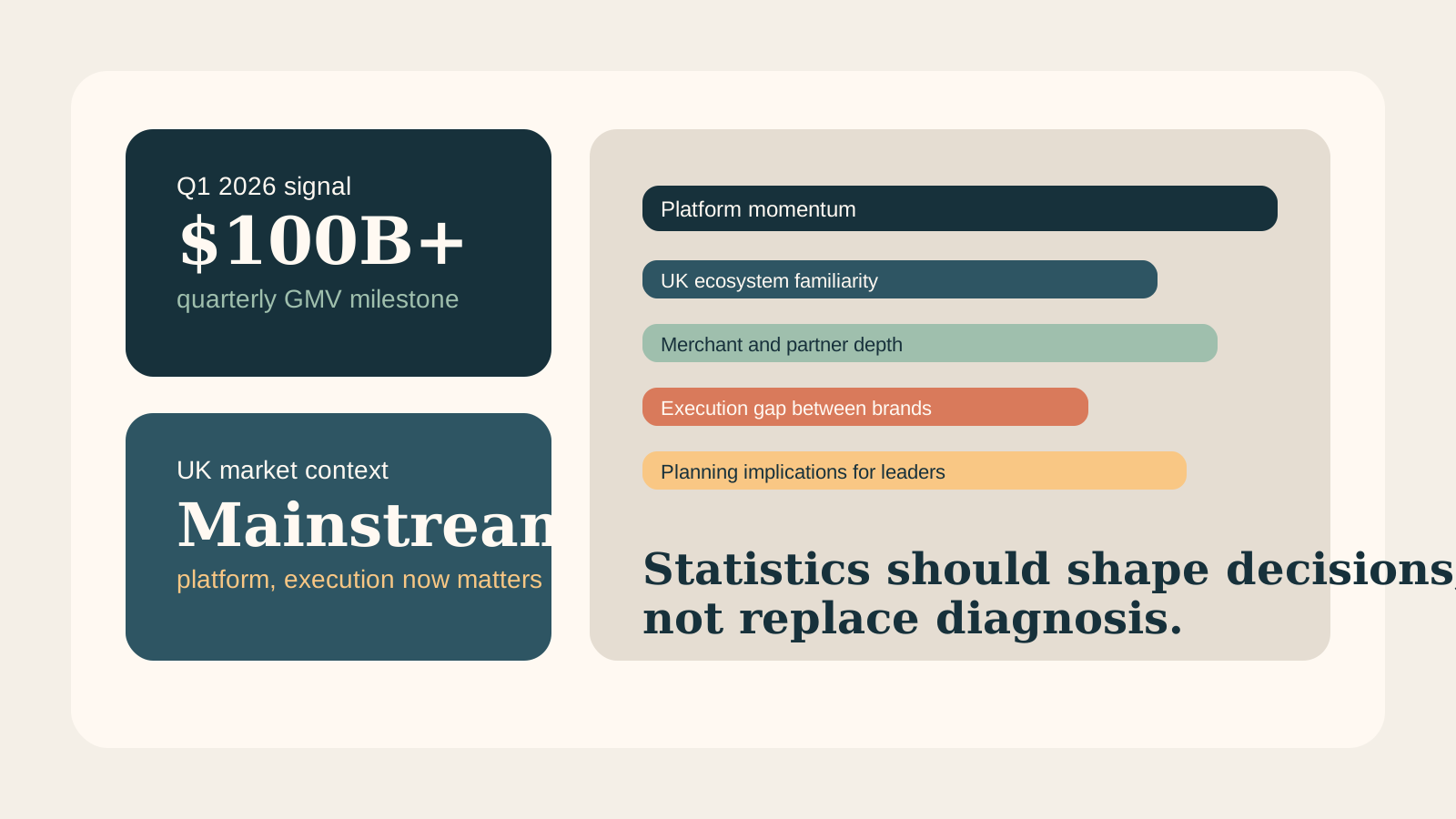
The current official signal from Shopify’s Q1 2026 results is clear: the platform continues to grow at meaningful scale. Shopify reported on May 5, 2026 that merchants cleared more than $100 billion in Q1 GMV, with revenue growth of 34% year over year. That does not tell you whether your store will win. But it does tell you the platform is not a niche bet.
At the product level, Shopify Editions continues to reinforce another important signal: the platform direction is becoming more operationally ambitious, especially around AI support, functions, and merchant tooling. For UK ecommerce teams, that means Shopify is not standing still in the way some legacy platform narratives still assume.
The more local UK statistics are also useful when interpreted carefully. Competitor research published in 2026 highlights a large live-store footprint in the UK and meaningful platform market share. Even if individual third-party counts vary, the directional takeaway is consistent: Shopify is firmly part of the mainstream UK ecommerce stack, not an edge-case choice.
What the UK market numbers actually imply
1. Shopify is common enough that execution matters more than platform novelty
For many UK brands, choosing Shopify no longer creates differentiation by itself. The commercial edge sits in how well the business uses it:
- site architecture;
- content quality;
- category intent mapping;
- retention systems;
- operational discipline.
That should change how teams think about investment. Platform choice is necessary, but not sufficient.
2. Platform momentum lowers ecosystem risk
Continued growth matters because ecosystem health follows scale. App support, partner availability, hiring familiarity, and documentation quality usually improve on growing platforms. That does not remove project risk, but it does reduce one class of risk: betting on a platform with shrinking relevance.
3. UK market share does not mean your specific operating model is solved
This is where statistics are often misused. High UK adoption does not mean Shopify is automatically right for every business shape. High-SKU spare-parts operations, specialist B2B flows, unusual retail service models, or highly bespoke enterprise estates still need proper evaluation.
4. The growth story should increase planning discipline, not reduce it
When a platform is growing quickly, it becomes easier for teams to assume the platform will fix weak internal operating models. It will not. Shopify can accelerate a good model and expose a weak one faster.
Decision table for ecommerce leaders
| Statistic or signal | What it tells you | What it does not tell you |
|---|---|---|
| Shopify’s Q1 2026 GMV and revenue growth | Platform scale and momentum remain strong | Whether your store architecture and operating model are good enough |
| Large UK store footprint | Merchant adoption and ecosystem familiarity are strong | Whether your business category is easy to execute well |
| UK market-share visibility | Shopify is a serious mainstream contender | Whether migration or redesign risk is low for your team |
| Editions and product velocity | Shopify keeps shipping and evolving | Whether your internal team can adopt those features well |
| App ecosystem scale | Support for common use cases is broad | Whether your chosen app stack will remain clean, cheap, and governable |
The main reason to use a table like this is to stop statistics from becoming sales theatre.
How to use Shopify statistics without fooling yourself
Use platform data to set context, not to end the decision
The right role of Shopify statistics is to confirm relevance and ecosystem confidence. The numbers should get you into a smarter discussion, not replace it.
Pair market numbers with business-model questions
Ask:
- Are our catalogue and merchandising needs straightforward or unusually complex?
- Do we need one commerce system across online, retail, and fulfilment?
- Is speed of iteration more valuable than highly bespoke infrastructure?
- Can our team govern apps, content, and data cleanly after launch?
Beware statistics pages that overload and under-explain
This is common in competitor content. Long lists of figures look authoritative, but the reader still needs help deciding what changes because of those figures.
Translate market evidence into one practical planning move
The most useful questions after reading Shopify statistics are:
- Should we stay on the current platform?
- Should we scope a migration?
- Should we invest next in SEO, CRO, retention, or operations?
- Should we simplify our stack before adding more tools?
If the statistics do not help answer a decision, they are probably being used as decoration.
StoreBuilt example
One UK ecommerce team came into planning with a strong bias toward “moving to Shopify because everyone serious seems to be there.” That instinct was not irrational. The market signals around Shopify were genuinely strong.
But once we reviewed the real business shape, the more urgent need was not migration speed. It was catalogue governance, search structure, and clearer ownership across content and operations. A platform move could still be right, but only if the underlying model improved too.
That is the real value of statistics. They help frame the platform conversation. They do not remove the need for diagnosis.
If your leadership team is using Shopify market data to scope a move or restructure, StoreBuilt can help shape the migration path.
High-intent AI search implementation layer
The AI-search version of this topic is not just “write more content”. A useful answer engine result needs a page that gives a direct answer, proves the claim, and shows the next operational step inside Shopify.
| Area | StoreBuilt implementation check |
|---|---|
| Primary intent | The page should map to shopify statistics and one clear buyer or operator problem, not a vague traffic topic. |
| Shopify surface | Identify whether the work belongs on a collection, product page, theme section, checkout step, app workflow, email flow, or support process. |
| Proof | Add first-hand observations, product/category examples, screenshots, policy notes, review signals, or trustworthy external sources where they make the advice safer. |
| Internal route | Link the reader to the service most likely to solve the issue: Shopify support, maintenance and audits. |
| Measurement | Check Search Console, analytics, assisted conversions, enquiry quality, and AI-response mentions after the update rather than judging success by pageviews alone. |
For this article, the useful research inputs are: StoreBuilt Shopify audits, UK ecommerce SERP intent, Shopify platform documentation, and AI-search measurement patterns. StoreBuilt would prioritise store audits, technical cleanup, roadmap governance, support cadence, and implementation priority before expanding into broader supporting content.
If this topic maps to a live store problem, review the related StoreBuilt service or Contact StoreBuilt with the store URL and the issue you want fixed.
Final StoreBuilt point of view
In 2026, the important Shopify statistics are the ones that confirm three things: the platform is large enough to trust seriously, active enough to keep evolving, and common enough that execution now matters more than novelty. In the ecommerce UK market, that means the strategic question is rarely “Is Shopify real?” The strategic question is “Are we set up to use Shopify better than the average team using it already?”