
What we have seen in Shopify SEO and rebuild projects is this: many stores treat search as a content task after the theme is built. That is backwards. Search performance depends on architecture: category structure, product data, internal links, page templates, schema, filters, indexation decisions, and how clearly each page answers a buying intent.
Charle’s article hub signals why this matters. Their content covers SEO, CRO, Shopify platform features, Online Store 2.0, automation, speed, and platform comparisons because search is now tied to the whole ecommerce system. StoreBuilt’s view is that a Shopify storefront should be search-first without becoming search-engine-first. The architecture should help Google, AI-shopping systems, and real customers understand the store faster.
If your Shopify store has strong products but weak search visibility or confusing category journeys, Contact StoreBuilt.
Table of contents
- Keyword decision and research inputs
- What search-first architecture means
- The architecture layers
- Architecture decision table
- StoreBuilt example
- 60-day architecture plan
- Final StoreBuilt point of view
Keyword decision and research inputs
Primary keyword: Shopify storefront architecture
Secondary keywords: Shopify SEO architecture, ecommerce UK market, Shopify category structure, Shopify product data, AI search ecommerce.
Search intent: technical-commercial. The reader wants to understand how Shopify structure affects SEO, UX, and conversion.
Funnel stage: middle funnel for rebuild, migration, SEO, and support enquiries.
Page type: technical strategy guide.
Why StoreBuilt can realistically win this topic:
- The article supports Shopify store design and development and Shopify SEO and AI search readiness.
- Competitor content often explains SEO tactics separately from theme architecture. This article connects storefront build decisions to search performance.
- StoreBuilt can explain how category logic, metafields, templates, and internal links work together.
Research inputs used on July 2, 2026:
- Current SERP review for Shopify SEO architecture, Shopify category structure, ecommerce site architecture, and AI search readiness.
- Charle article hub review for Shopify SEO, Online Store 2.0, platform, CRO, and speed themes.
- Official Shopify platform context around Online Store 2.0, structured data opportunities, and app-extension patterns.
What search-first architecture means
Search-first architecture means the store is structured around how customers understand products and how search systems evaluate pages. It does not mean stuffing keywords into every template. It means each important page has a clear job.
A search-first Shopify store should make it obvious:
- which collections are commercially important;
- which product attributes matter to customers;
- which filters help discovery and which create indexation noise;
- which guides support buying decisions;
- which internal links reinforce priority pages;
- which product data belongs in metafields rather than long descriptions;
- which pages should be indexed, consolidated, or noindexed;
- which templates need structured content for conversion and search.
The best architecture helps the team operate. A merchandiser should understand why a collection exists. A developer should understand which metafields feed the template. A content lead should know which guide supports which category. An SEO lead should know which URLs are canonical for each intent.
The architecture layers
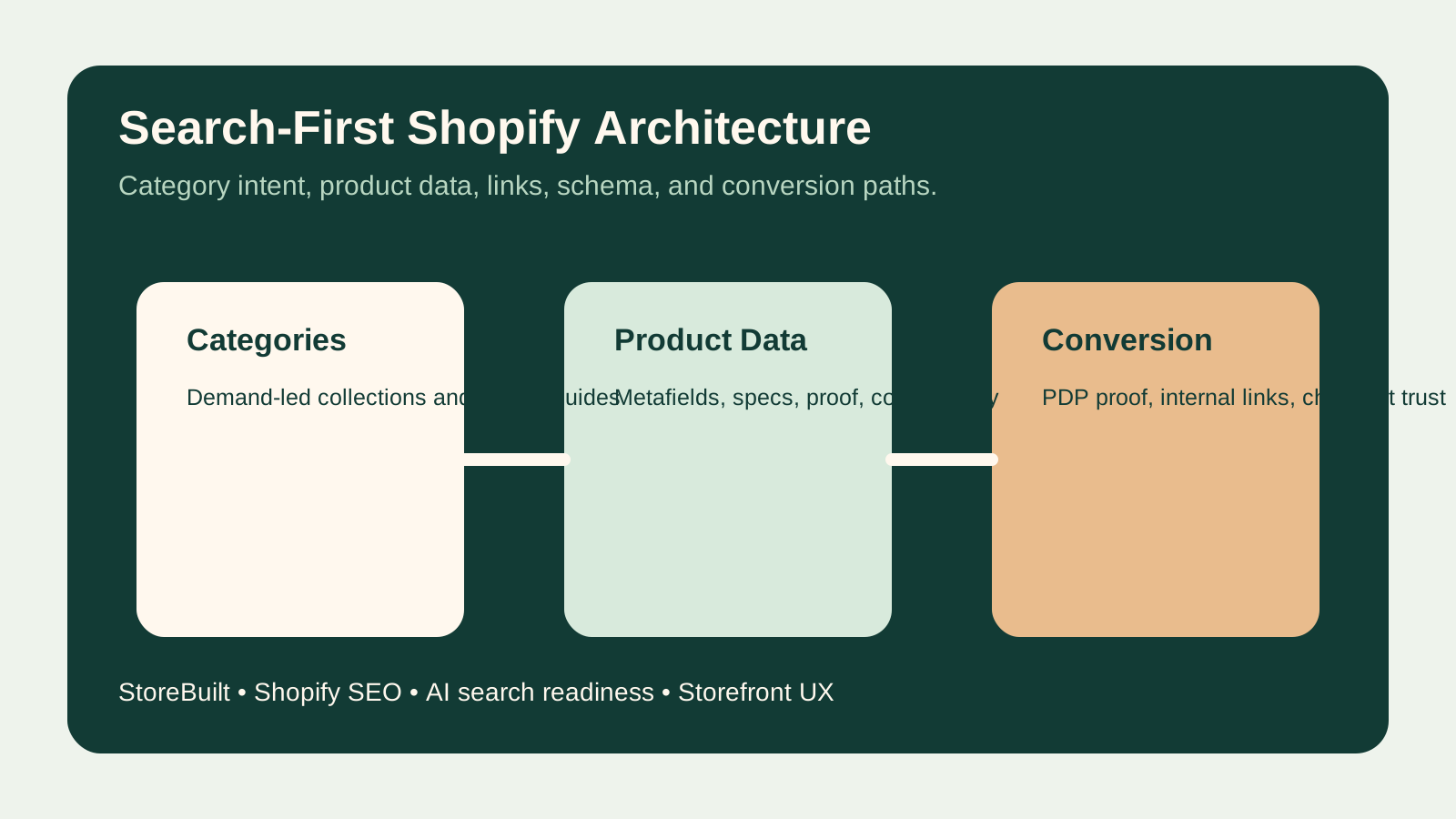
1. Category intent
Collections are not only shelves. They are search and merchandising assets. A category should exist because customers need it, the business can support it, and the page has enough product depth or buying guidance to justify attention.
For UK ecommerce brands, this might mean separating product type, use case, material, size, recipient, dietary need, room, problem, or buying occasion. The right structure depends on the category.
2. Product data
Product data should not live only in paragraph descriptions. Metafields and metaobjects can structure materials, dimensions, fit, ingredients, compatibility, care, lead time, delivery limitations, sustainability proof, and comparison facts.
Structured product data improves merchandising, onsite search, product feeds, AI-search readiness, and customer confidence.
3. Internal linking
Internal links tell customers and search engines what matters. A strong Shopify store links between guides, collections, product pages, service pages, and supporting content with clear anchor text.
For StoreBuilt, this same rule applies to agency content. Blog posts should support service routes such as Shopify migrations and replatforming or CRO and UX optimisation rather than float as isolated articles.
4. Filters and indexation
Filters are useful for users but dangerous when every combination becomes crawlable noise. Decide which filter pages deserve indexable landing pages and which should remain purely functional.
5. Template content
Templates should support useful content without becoming cluttered. Collection pages may need intro copy, buying guidance, FAQs, reviews, and cross-links. Product pages may need proof, specs, comparisons, delivery, returns, and related content.
6. Measurement
Architecture should be measured by visibility, engagement, conversion, assisted revenue, and operational ease. A page that ranks but does not help customers buy still needs work.
Architecture decision table
| Architecture area | Good decision | Risk decision |
|---|---|---|
| Collections | Built around demand, product depth, and merchandising need | Created for every minor keyword variation |
| Product data | Structured in metafields and reusable modules | Hidden in long descriptions or images |
| Internal links | Connect guides, categories, PDPs, and services | Blog posts publish without routes onward |
| Filters | Useful UX with indexation rules | Crawlable parameter noise |
| Templates | Modular, merchant-editable, and consistent | One-off sections for every request |
| Schema | Accurate and supported by visible content | Decorative markup without page substance |
| AI search | Clear product facts and category explanations | Thin pages that require inference |
StoreBuilt example
In one Shopify architecture review, the store had hundreds of products and many collections, but customers and search engines had little guidance. Products were tagged inconsistently, filters were noisy, collection copy was thin, and product facts were buried in descriptions. The team was publishing blogs, but those posts did not link back to the commercial categories that needed authority.
The useful work was structural. We grouped collections by real buying intent, moved repeatable product facts into metafields, improved internal links from guides to categories, and identified which filter combinations deserved fixed landing pages. The theme did not need to become heavier. It needed to express the product catalogue more clearly.
That is the difference between SEO decoration and search-first architecture. One adds words. The other makes the store easier to understand.
60-day architecture plan
| Period | Work | Output |
|---|---|---|
| Days 1-10 | Intent and URL audit | Priority collections, products, guides, and duplicate risks |
| Days 11-20 | Product data model | Metafield and metaobject plan for repeatable facts |
| Days 21-35 | Template improvements | Collection and PDP modules for proof, FAQs, specs, and links |
| Days 36-45 | Internal linking | Guide-to-category and category-to-product linking system |
| Days 46-60 | Crawl and measurement | Indexation rules, schema check, Search Console tracking |
High-intent AI search implementation layer
The AI-search version of this topic is not just “write more content”. A useful answer engine result needs a page that gives a direct answer, proves the claim, and shows the next operational step inside Shopify.
| Area | StoreBuilt implementation check |
|---|---|
| Primary intent | The page should map to Shopify SEO and one clear buyer or operator problem, not a vague traffic topic. |
| Shopify surface | Identify whether the work belongs on a collection, product page, theme section, checkout step, app workflow, email flow, or support process. |
| Proof | Add first-hand observations, product/category examples, screenshots, policy notes, review signals, or trustworthy external sources where they make the advice safer. |
| Internal route | Link the reader to the service most likely to solve the issue: Shopify SEO and AI search readiness. |
| Measurement | Check Search Console, analytics, assisted conversions, enquiry quality, and AI-response mentions after the update rather than judging success by pageviews alone. |
For this article, the useful research inputs are: StoreBuilt Shopify audits, UK ecommerce SERP intent, Shopify platform documentation, and AI-search measurement patterns. StoreBuilt would prioritise technical SEO, collection architecture, Product schema, answer-first content, GEO, and Search Console monitoring before expanding into broader supporting content.
If this topic maps to a live store problem, review the related StoreBuilt service or Contact StoreBuilt with the store URL and the issue you want fixed.
Final StoreBuilt point of view
Search-first Shopify architecture is not an SEO add-on. It is how the store is organised, coded, edited, and measured. StoreBuilt’s view is that the best architecture reduces confusion for everyone: customers, search engines, AI systems, merchants, and developers. When the structure is clear, content and CRO work harder.
For a search-first Shopify architecture review, Contact StoreBuilt.