
What we have seen in Shopify trading calendars is this: promotions rarely fail because the headline offer was weak. They fail because the rules around the offer were vague, rushed, or commercially disconnected from stock, margin, and customer experience.
If your store is discounting often but not learning enough, Contact StoreBuilt.
Table of contents
- Keyword decision and research inputs
- What current competitor content signals
- Why promotion governance matters on Shopify
- Promotion governance table for UK ecommerce teams
- How to design promotions without margin drift
- QA checkpoints before a campaign goes live
- StoreBuilt client example
- Final StoreBuilt point of view
Keyword decision and research inputs
Primary keyword: shopify promotion governance
Secondary keywords:
- ecommerce UK market promotion strategy
- shopify discount governance
- shopify campaign QA
- promotion controls for ecommerce
- shopify margin-safe discounting
Search intent: practical and commercial. The reader wants a framework for running offers more safely and profitably.
Funnel stage: middle to bottom.
Page type: operating framework with campaign tables.
Why StoreBuilt can win this topic:
- We routinely see how promotional logic affects CRO, stock pressure, support load, and technical QA together.
- We can explain how to run offers without treating discounting as a creative-only decision.
- We connect promotion planning to live Shopify delivery realities.
Research inputs used on June 15, 2026:
- Current SERP review around Shopify discounts, promotion strategy, margin control, and ecommerce campaign governance terms.
- Public competitor-content review across UK Shopify agency article libraries, including longer editorial formats similar to Charle’s article structure.
- StoreBuilt observations from merchandising, CRO, and support work where promotions influence both conversion and operational clarity.
What current competitor content signals
Competitor content in the Shopify and ecommerce UK market often handles promotions in one of two ways.
The first is tactical content:
- discount ideas
- seasonal campaign inspiration
- offer types that can lift conversion
The second is more platform-led content:
- app options
- discount capabilities
- checkout controls
Both are useful, but they usually stop short of a deeper question: how should a Shopify team govern promotions so they do not become a recurring source of margin drift and operational inconsistency?
This is where a lot of otherwise strong content still feels incomplete. Promotions are treated as events. In reality, they are governance tests. They reveal whether pricing logic, stock planning, QA discipline, and CX messaging are coordinated enough to support growth safely.
Why promotion governance matters on Shopify
Shopify makes launching offers easier. That is a strength. It is also why governance matters.
When campaign speed rises without clear controls, common problems appear:
- discounts stack unintentionally
- landing pages and cart behaviour communicate different rules
- low-stock products receive campaign emphasis they cannot support
- free gifts or thresholds create hidden margin loss
- support teams spend campaign week explaining avoidable confusion
The issue is not discounting itself. Many strong brands use promotions well. The issue is whether the offer lives inside a disciplined commercial system.
At StoreBuilt, one simple test helps: if the campaign cannot be explained clearly in one paragraph to support, operations, and merchandising at the same time, it is probably not ready yet.
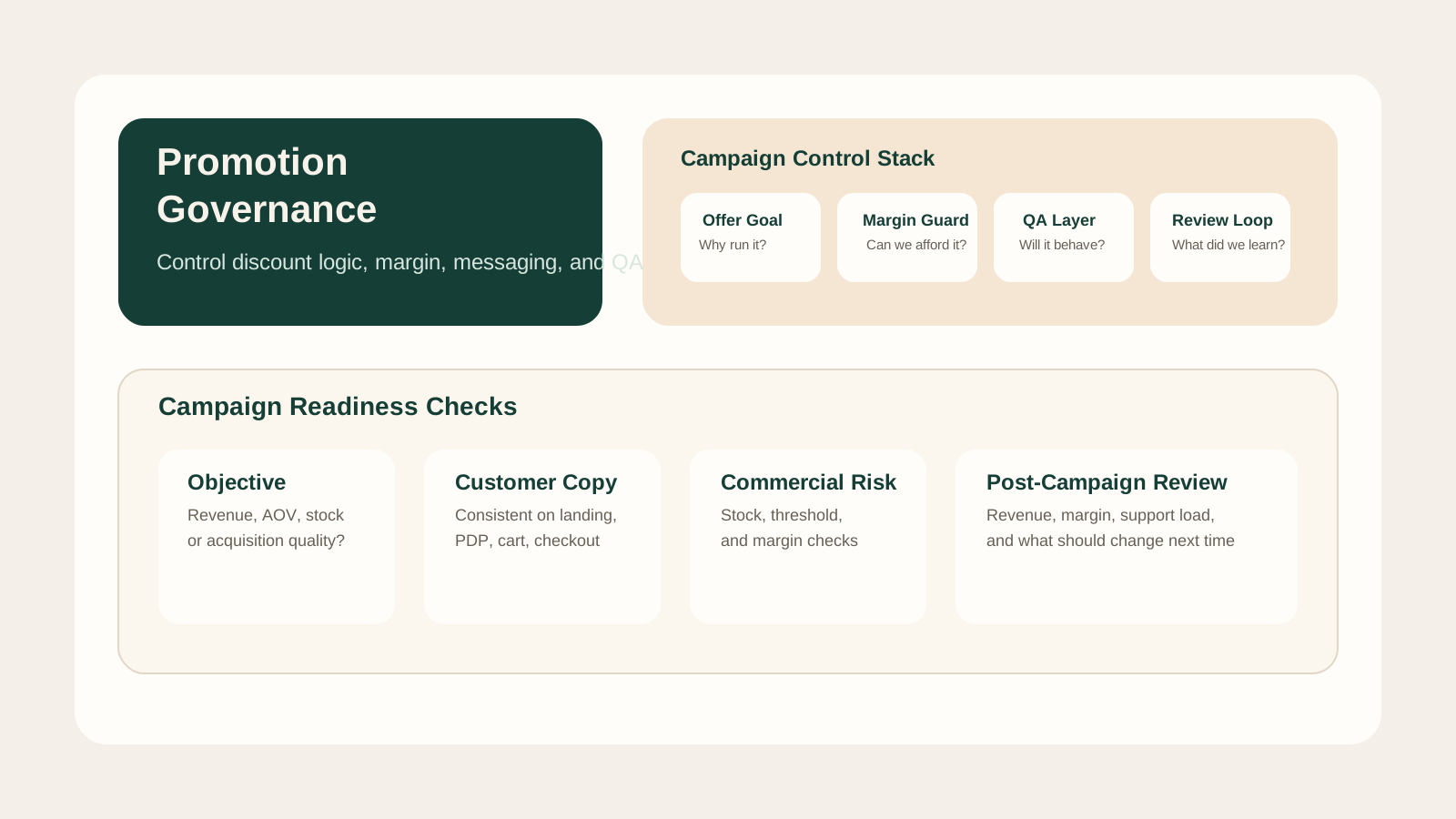
Promotion governance table for UK ecommerce teams
| Governance layer | Core question | Good control | Weak control |
|---|---|---|---|
| Offer design | Why are we running this promotion? | Clear objective tied to revenue, AOV, stock, or acquisition quality | Running a discount because competitors are active |
| Margin guardrails | What can we afford? | Defined thresholds and category exceptions | Margin checked after launch |
| Stock alignment | Can inventory support the offer? | Campaign assortment reviewed against stock and replenishment | Merchandising pushes weak or fragile inventory |
| Customer messaging | Will the offer be understood easily? | Consistent wording across PDP, cart, and landing pages | Rules are fragmented or surprising |
| Technical QA | Will the logic behave correctly? | Test cases before launch, including edge conditions | Testing happens in production through customers |
| Post-campaign review | What did we learn? | Objective, commercial, and CX review logged | Campaign ends and learning disappears |
That table is not about slowing growth down. It is about keeping the growth commercially legible.
How to design promotions without margin drift
The first step is to separate promotion intent types.
Traffic-capture offers
These are often used for acquisition bursts or list growth. Their risk is that they bring low-quality demand if the commercial design is too broad.
Basket-building offers
These aim to increase AOV through bundles, thresholds, or related-item logic. Their risk is hidden contribution loss if threshold design is not grounded in margin and fulfilment reality.
Stock-clearing offers
These are useful when handled deliberately. Their risk is training customers to wait for discounts or damaging category perception.
Loyalty or retention offers
These should be targeted carefully. Their risk is over-discounting customers who might have reordered anyway.
Once the intent is clear, the team should answer:
- what the offer is meant to change
- which customers it is meant to influence
- which categories or products are excluded
- what would make the promotion commercially unsuccessful even if revenue rises
That last question is important because plenty of campaigns look healthy in topline terms while quietly reducing margin quality or customer clarity.
If you need the offer model tied back to CRO and customer-journey design, StoreBuilt can help.
QA checkpoints before a campaign goes live
Promotions should have a release checklist, not just a creative deadline.
| QA checkpoint | What to verify | Why it matters |
|---|---|---|
| Discount logic | Correct application, exclusions, and thresholds | Prevents commercial leakage |
| PDP and landing consistency | Offer text matches actual logic | Reduces customer confusion |
| Cart and checkout behaviour | Incentives display correctly across devices | Protects conversion during the most sensitive step |
| Stock and fulfilment risk | Promoted products are operationally supportable | Avoids campaign-led service problems |
| Support readiness | CX team can explain the offer simply | Reduces avoidable ticket volume |
This checklist should be proportionate. Not every campaign needs enterprise ceremony. But every campaign does need enough discipline that the business is not learning basic logic from live customer errors.
The review loop after the campaign
Most teams review promotional performance too narrowly. They look at revenue lift and maybe AOV. The better review should also ask:
- did the offer move the behaviour we intended?
- what happened to margin quality?
- did customer-service contacts increase?
- did the offer pull demand forward or create lasting value?
- did the campaign make the store easier or harder to operate?
That final question is underused. Operational stress is a commercial cost.
StoreBuilt client example
One UK Shopify brand was running frequent promotional bursts that looked commercially active but felt increasingly hard to manage. Messaging varied across landing pages, discount rules were not always stress-tested, and support teams were spending too much time clarifying eligibility.
We helped reframe campaigns around tighter offer definitions, clearer exclusions, stronger QA, and a more consistent review loop. The key improvement was not that promotions stopped. It was that they became easier to understand, safer to execute, and more useful to learn from.
That is what governance should do.
High-intent AI search implementation layer
The AI-search version of this topic is not just “write more content”. A useful answer engine result needs a page that gives a direct answer, proves the claim, and shows the next operational step inside Shopify.
| Area | StoreBuilt implementation check |
|---|---|
| Primary intent | The page should map to promotions and one clear buyer or operator problem, not a vague traffic topic. |
| Shopify surface | Identify whether the work belongs on a collection, product page, theme section, checkout step, app workflow, email flow, or support process. |
| Proof | Add first-hand observations, product/category examples, screenshots, policy notes, review signals, or trustworthy external sources where they make the advice safer. |
| Internal route | Link the reader to the service most likely to solve the issue: Shopify migrations and replatforming. |
| Measurement | Check Search Console, analytics, assisted conversions, enquiry quality, and AI-response mentions after the update rather than judging success by pageviews alone. |
For this article, the useful research inputs are: UK ecommerce platform SERPs, StoreBuilt platform-selection reviews, Shopify operating constraints, and cost/risk signals. StoreBuilt would prioritise platform selection, roadmap planning, migration risk, TCO, operating model, and implementation sequencing before expanding into broader supporting content.
If this topic maps to a live store problem, review the related StoreBuilt service or Contact StoreBuilt with the store URL and the issue you want fixed.
Final StoreBuilt point of view
For Shopify teams in the UK ecommerce market, promotions should be treated as controlled commercial instruments, not recurring bursts of urgency. Fast-moving offers can absolutely support growth, but only when margin guardrails, messaging clarity, stock alignment, and QA discipline are built into the process.
The brands that perform better over time are usually not the ones discounting most aggressively. They are the ones running offers with clearer objectives, cleaner controls, and enough operational maturity to learn from each campaign instead of merely surviving it.