
What we have seen in Shopify audits is this: pricing problems rarely sit in the price field alone. They show up in discount habits, unclear bundles, weak product comparison, over-generous free delivery thresholds, confused subscription savings, and checkout moments where the customer cannot tell whether the offer is fair.
Charle’s article library is strong on Shopify guides, CRO, apps, SEO, ecommerce marketing, and platform comparisons. The opportunity for StoreBuilt is to make the pricing conversation more operational for UK ecommerce teams: how pricing, margin, customer trust, and storefront implementation work together.
If your Shopify store is using discounts to compensate for unclear value, Contact StoreBuilt.
Table of contents
- Keyword decision and research inputs
- Why Shopify pricing strategy is not only finance
- The UK ecommerce pricing model
- Where Shopify teams lose margin
- Pricing and merchandising table
- How to test pricing without damaging trust
- An anonymous StoreBuilt example
- StoreBuilt point of view
Keyword decision and research inputs
| Decision | Direction |
|---|---|
| Primary keyword | Shopify pricing strategy |
| Secondary keywords | ecommerce pricing UK, Shopify pricing, ecommerce UK market, ecommerce margin, Shopify promotions |
| Search intent | Learn how to set and present ecommerce pricing on Shopify without damaging margin or trust |
| Funnel stage | Middle to bottom |
| Page type | Commercial strategy guide with implementation advice |
| Why StoreBuilt can win | StoreBuilt connects storefront UX, Shopify discounts, bundles, subscriptions, checkout trust, retention, and trading operations |
Research inputs included current Google SERP intent for ecommerce pricing and Shopify pricing queries, Charle’s Shopify and ecommerce article patterns, UK Shopify agency competitor content from Eastside Co, Swanky, and agency comparison pages, public keyword-style signals from Shopify’s ecommerce SEO guidance, and a duplicate-risk review against StoreBuilt’s recent pricing, profitability, CRO, and app-stack posts.
Google’s SEO Starter Guide frames SEO as helping search engines understand content while helping users decide whether to visit. For this article, that means clear page intent, useful pricing terminology, and internal links to relevant StoreBuilt services rather than a generic pricing essay. Shopify’s own ecommerce education also treats keyword research as intent research, which supports a practical guide rather than a thin keyword page.
Why Shopify pricing strategy is not only finance
A finance team may own margin targets, but the ecommerce team controls how pricing is understood. The customer sees product hierarchy, compare-at prices, bundles, promotions, subscriptions, delivery thresholds, payment options, reviews, returns policy, and checkout reassurance as one value signal.
That is why Shopify pricing strategy has to involve ecommerce, merchandising, CRO, retention, and operations. A price can be commercially sound in a spreadsheet and still perform badly on the storefront if the customer cannot understand the difference between products, packs, sizes, bundles, or delivery options.
The opposite is also true. A sharp-looking offer can convert for a week and still damage the business when returns, fulfilment costs, support contacts, and repeat purchase behaviour are included.
For UK brands, pricing also carries trust signals. Shoppers are used to comparing prices across marketplaces, Google Shopping, TikTok Shop, Amazon, and retailer sites. If a Shopify store feels unclear, inflated, or constantly discounted, customers learn to wait.
The UK ecommerce pricing model
Use a simple operating model before changing prices:
| Layer | Question to answer | Shopify implication |
|---|---|---|
| Product economics | What is the true margin after product, payment, fulfilment, returns, and support? | Product-level margin reporting and bundle governance |
| Value communication | Why is this product worth the price? | PDP hierarchy, comparison content, reviews, ingredients, materials, use cases |
| Offer design | What behaviour should the offer encourage? | Discounts, bundles, subscriptions, free gift, free delivery, loyalty |
| Customer segment | Who should see which incentive? | Customer tags, email/SMS segmentation, Shopify customer accounts, app logic |
| Measurement | Did the offer create profit or only revenue? | Cohort tracking, AOV, contribution margin, repeat purchase, return rate |
Pricing strategy improves when teams stop asking “what discount will drive sales?” and start asking “which commercial behaviour are we trying to create?”
That behaviour might be first purchase, larger basket, subscription trial, category exploration, seasonal sell-through, stock clearance, wholesale adoption, or repeat purchase. Each requires a different Shopify setup.
Where Shopify teams lose margin
Discount stacking
Discount stacking happens when multiple incentives overlap without a clear commercial reason. A customer might receive a welcome discount, automatic bundle saving, free delivery, loyalty points, payment incentive, and email code in the same order.
Some stacking is intentional. Most is accidental. Shopify discount logic, app-based promotions, subscriptions, and loyalty tools all need governance so the team knows which combinations are allowed.
Free delivery thresholds
Free delivery can lift average order value, but the threshold should be based on contribution margin, fulfilment cost, and product mix. A threshold copied from a competitor may work for their basket economics and fail for yours.
If the threshold is too low, the store pays for delivery on orders that would have happened anyway. If it is too high, customers see it as irrelevant. The right threshold should feel reachable while protecting margin.
Bundles without logic
Bundles work best when they solve a buying problem: starter kit, routine, replenishment set, gift set, compatibility set, or value pack. Weak bundles are just discounted groups of products.
Shopify bundle presentation should explain why the products belong together and whether the customer is saving money, reducing effort, or making a better choice.
Subscription savings that hide the commitment
Subscription pricing can increase retention, but only when customers understand frequency, cancellation, delivery, billing, and suitability. A subscription saving that is too aggressive can attract bargain hunters rather than repeat buyers.
StoreBuilt’s subscriptions and recurring revenue service focuses on the storefront communication and customer control layer, not just the app installation.
Compare-at price fatigue
Permanent compare-at pricing can train customers to distrust the original price. Use it where there is a genuine promotion, sale, or price movement. If every product is always reduced, the brand’s price architecture becomes weaker.
Pricing and merchandising table
| Pricing tactic | Good use | Risk | Shopify control |
|---|---|---|---|
| Welcome discount | First purchase incentive | Low-quality customers if overused | Email/SMS segmentation and expiry |
| Bundle saving | Increase AOV and improve product fit | Margin leakage if bundle cost is unclear | Bundle app, theme module, product data |
| Free delivery threshold | Encourage basket building | Delivery subsidy without incremental margin | Shipping rules, cart progress, reporting |
| Subscription saving | Improve repeat purchase | Support burden and churn if terms are unclear | Subscription app, PDP messaging, account UX |
| Volume pricing | B2B or bulk buying | Customer confusion if tiers are hidden | Shopify Plus/B2B pricing logic |
| Loyalty points | Retention and advocacy | Points liability without repeat behaviour | Loyalty app and lifecycle flows |
How to test pricing without damaging trust
Pricing tests need more discipline than colour or copy tests. Customers notice price changes, screenshots travel, and support teams have to explain inconsistencies.
Start with safer tests:
- Test product comparison content before changing price.
- Test bundle composition before increasing the discount.
- Test free delivery threshold messaging before lowering the threshold.
- Test offer placement in cart and PDP before changing the offer.
- Test segmented incentives in email before sitewide discounts.
- Track return rate and repeat purchase, not only conversion rate.
A useful pricing test has a hypothesis, audience, guardrail, and stop rule. For example: “If we move the free delivery threshold from £45 to £55, AOV should rise without reducing conversion by more than an agreed percentage.” That is different from “let’s see what happens.”
StoreBuilt’s CRO and UX optimisation service helps teams test pricing presentation in the journey before making larger commercial moves.
An anonymous StoreBuilt example
In one Shopify review, a brand believed its issue was that prices were too high. The audit found a different problem. The product pages did not explain size differences clearly, the bundle saving was hidden below the fold, the free delivery progress bar appeared late in the cart, and email promotions were overlapping with automatic discounts.
The first recommendation was not a blanket price cut. It was to make value clearer: sharper product comparison, stronger bundle explanation, cleaner discount rules, and a more visible delivery threshold.
That gave the team a more useful question: are customers rejecting the price, or are they failing to understand the value?
High-intent AI search implementation layer
The AI-search version of this topic is not just “write more content”. A useful answer engine result needs a page that gives a direct answer, proves the claim, and shows the next operational step inside Shopify.
| Area | StoreBuilt implementation check |
|---|---|
| Primary intent | The page should map to Shopify pricing strategy and one clear buyer or operator problem, not a vague traffic topic. |
| Shopify surface | Identify whether the work belongs on a collection, product page, theme section, checkout step, app workflow, email flow, or support process. |
| Proof | Add first-hand observations, product/category examples, screenshots, policy notes, review signals, or trustworthy external sources where they make the advice safer. |
| Internal route | Link the reader to the service most likely to solve the issue: Shopify support, maintenance and audits. |
| Measurement | Check Search Console, analytics, assisted conversions, enquiry quality, and AI-response mentions after the update rather than judging success by pageviews alone. |
For this article, the useful research inputs are: UK ecommerce platform SERPs, StoreBuilt platform-selection reviews, Shopify operating constraints, and cost/risk signals. StoreBuilt would prioritise technical audits, roadmap priority, theme changes, app governance, reporting, and measured improvement before expanding into broader supporting content.
If this topic maps to a live store problem, review the related StoreBuilt service or Contact StoreBuilt with the store URL and the issue you want fixed.
StoreBuilt point of view
Shopify pricing strategy should protect margin and improve customer confidence at the same time.
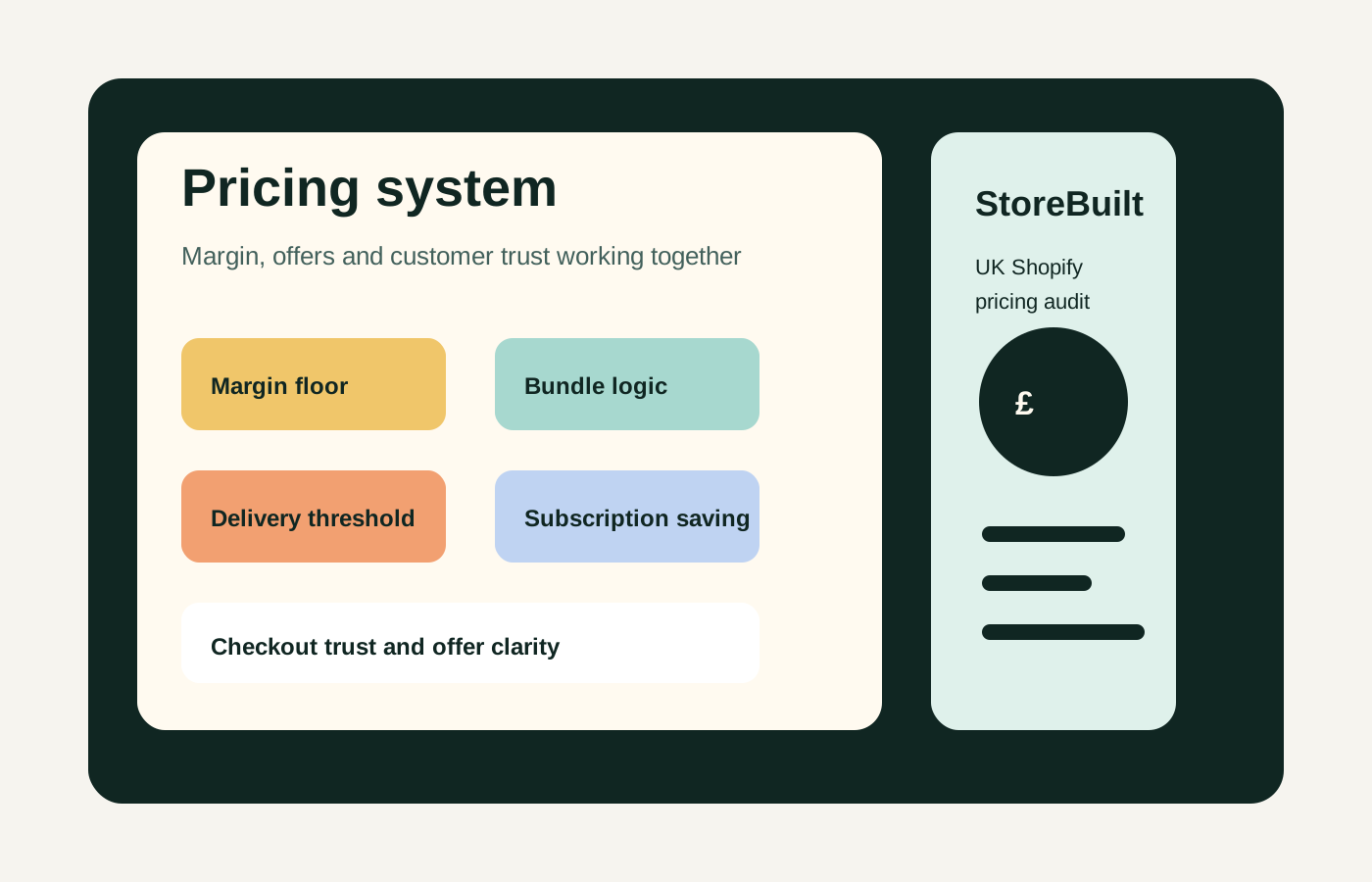
StoreBuilt’s view is that UK ecommerce teams should treat pricing as a storefront system. Product data, PDP content, cart logic, discount governance, bundles, subscriptions, delivery thresholds, and retention flows all shape how price is perceived. The brands that win do not simply discount harder. They make value easier to understand and incentives easier to trust.
For a pricing, CRO, or Shopify trading audit, Contact StoreBuilt.