
What we have seen in Shopify Plus scoping is this: teams often focus on the platform fee because it is visible, then under-budget the delivery layers that actually decide whether the move pays back.
If you want StoreBuilt to pressure-test your Shopify Plus budget before you commit, Contact StoreBuilt.
Table of contents
- Keyword decision and research inputs
- Quick answer: how much Shopify Plus costs in the UK
- What sits inside the real cost model
- Platform fee vs total cost of ownership
- When Shopify Plus is usually worth it
- Budget table for UK ecommerce teams
- StoreBuilt example
- Final StoreBuilt point of view
Keyword decision and research inputs
Primary keyword: shopify plus cost uk
Secondary keywords:
- Shopify Plus pricing UK
- Shopify Plus cost for ecommerce brands
- Shopify Plus migration budget
- Shopify Plus total cost of ownership
- ecommerce UK market Shopify cost
Search intent: high commercial intent.
Funnel stage: middle to bottom.
Page type: budgeting and decision guide.
Why StoreBuilt can realistically win this topic:
- The keyword has direct commercial intent and strong lead relevance.
- Pricing pages alone do not answer the real budgeting question buyers have.
- StoreBuilt can explain the cost model around delivery, operations, and support rather than repeating platform pricing.
Research inputs used:
- Current SERP review around
Shopify Plus cost UK,Shopify Plus pricing, and related budget terms. - Official Shopify UK pricing and Shopify Plus pricing pages reviewed on June 5, 2026.
- UK competitor article patterns around pricing, agency scoping, migration, and ecommerce growth budgeting.
Quick answer: how much Shopify Plus costs in the UK
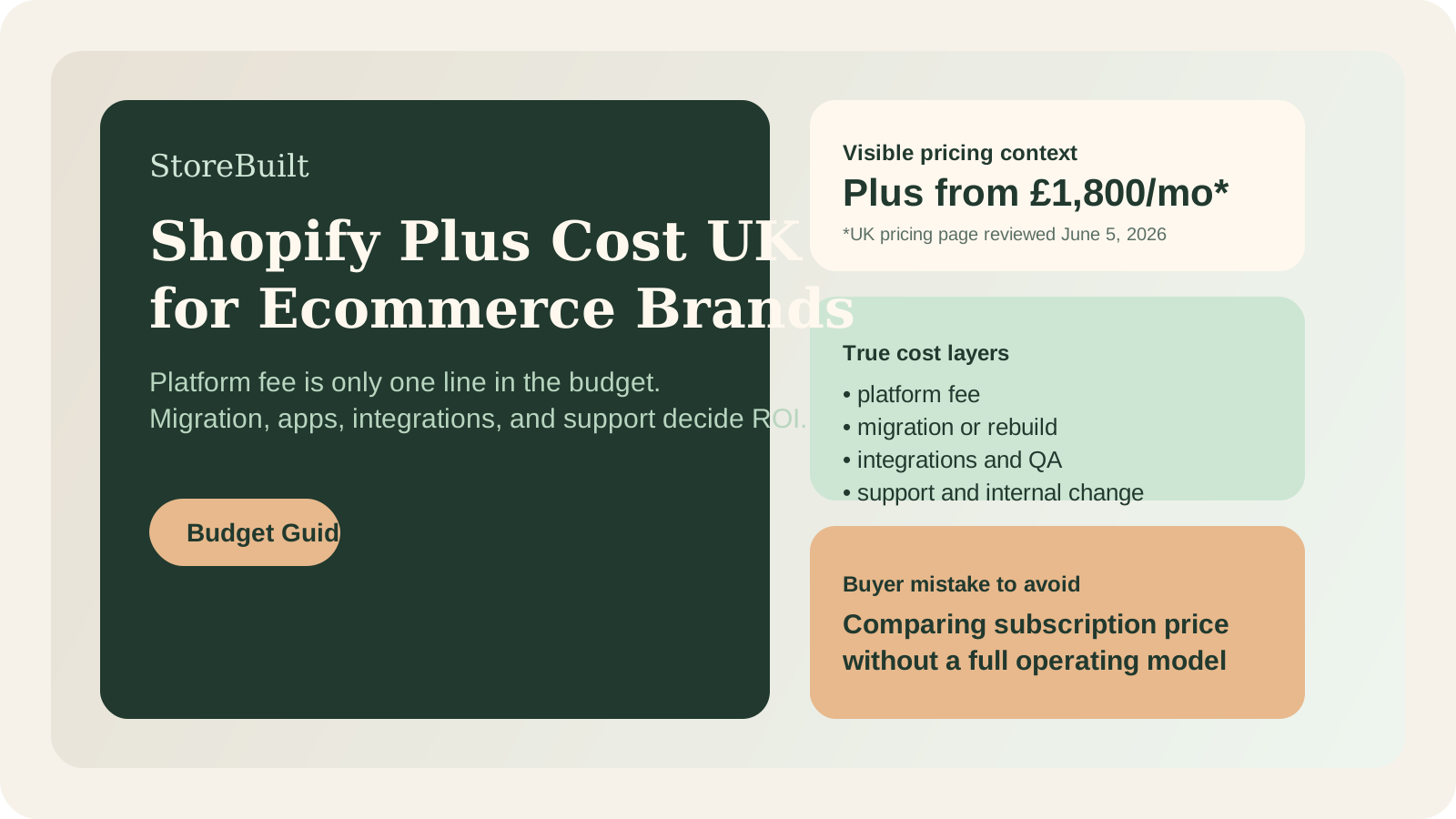
Based on Shopify’s UK pricing pages reviewed on June 5, 2026, Shopify Plus is shown as starting at £1,800 GBP per month on a 3-year term on the UK pricing page, while Shopify’s dedicated Plus pricing page presents pricing from $2,300 USD per month on a 3-year term or $2,500 USD per month on a 1-year term, with variable pricing for more complex business structures.
That gives you the visible subscription layer.
It does not give you the full project budget.
For most UK ecommerce brands, the real cost model also includes:
- migration and build work
- app rationalisation or replacement
- systems integration
- QA and release management
- analytics and tracking remediation
- post-launch support
That is why a platform-fee conversation on its own is incomplete.
What sits inside the real cost model
The easiest way to misread Shopify Plus is to compare the monthly subscription against an Advanced-plan fee and stop there.
The better comparison is total cost of ownership for your operating model.
| Cost layer | What it usually includes | Often missed by buyers |
|---|---|---|
| Platform fee | Shopify Plus subscription | Term length, additional stores, transaction context |
| Build or migration | theme, content, data, redirects, QA, launch | Scope creep around category and PDP redesign |
| Integrations | ERP, WMS, PIM, reviews, subscriptions, search, CRM | Middleware, edge cases, ownership gaps |
| Apps | retained stack or consolidated tools | Duplicate functions and rising monthly waste |
| Support | retained delivery after launch | Release cadence and accountability |
| Internal cost | team time, testing, training, change management | Hidden operational drag |
The platform fee is usually the most predictable line. The rest is where overruns happen.
Platform fee vs total cost of ownership
Shopify Plus often becomes commercially attractive not because the subscription is cheap, but because the system can simplify other cost lines.
Examples:
- reducing custom workaround maintenance
- consolidating duplicated tools
- improving admin efficiency for trading teams
- supporting B2B and DTC inside one environment
- lowering transaction friction at checkout
But none of those gains happen automatically.
If a team buys Plus without a clear reason, it can end up with a better badge, a higher platform fee, and very little operational improvement.
If your current decision is really about support, category UX, or merchandising flexibility, StoreBuilt can help scope the right layer first.
When Shopify Plus is usually worth it
In StoreBuilt scoping work, Shopify Plus usually becomes more persuasive when one or more of these are true:
- the business needs deeper B2B capability
- international selling and multiple storefront structures are growing
- flash-sale risk or high-volume checkout stability matters
- internal teams need stronger organisational control across stores
- custom integrations and API limits are becoming a constraint
It is less persuasive when the real issue is simply that the current store has weak UX or too many apps. Those are not always Plus problems. They are often execution problems.
Budget table for UK ecommerce teams
Use this as a decision frame, not a one-size-fits-all quote.
| Budget area | Low complexity | Mid complexity | Higher complexity |
|---|---|---|---|
| Platform subscription | Clear and predictable | Clear and predictable | May move into variable structure |
| Build or migration work | Theme-led adaptation | Customised implementation | Multi-system, multi-market, or heavy integration |
| App and tool stack | Light rationalisation | Partial consolidation | Full stack redesign likely |
| Internal enablement | Light training | Functional workflow changes | Significant process change |
| Ongoing support | Small sprint model | Structured monthly retainer | Multi-stream support and governance |
That table is more useful than a single number because most expensive Shopify Plus projects are expensive for structural reasons, not because the subscription changed.
Hidden cost questions to ask before signing
- Are we paying for Plus to solve a platform problem or an execution problem?
- Which current apps become redundant and which remain?
- Do we need one store, expansion stores, or separate governance structures?
- How much internal testing and content migration time should we budget?
- What will the first 90 days of support cost after launch?
If you cannot answer those questions, your budget is not ready yet.
StoreBuilt example
One UK team came into discovery focused on monthly plan pricing. The actual business case became much stronger once we mapped the wider operating picture.
The commercial benefit was not just checkout capability. It was cleaner system ownership, better B2B structure, lower app sprawl, and a more stable roadmap for international growth. At that point, the subscription fee made more sense because it was tied to fewer workaround costs elsewhere.
That is the difference between buying a plan and building a business case.
High-intent AI search implementation layer
The AI-search version of this topic is not just “write more content”. A useful answer engine result needs a page that gives a direct answer, proves the claim, and shows the next operational step inside Shopify.
| Area | StoreBuilt implementation check |
|---|---|
| Primary intent | The page should map to shopify plus and one clear buyer or operator problem, not a vague traffic topic. |
| Shopify surface | Identify whether the work belongs on a collection, product page, theme section, checkout step, app workflow, email flow, or support process. |
| Proof | Add first-hand observations, product/category examples, screenshots, policy notes, review signals, or trustworthy external sources where they make the advice safer. |
| Internal route | Link the reader to the service most likely to solve the issue: Shopify support, maintenance and audits. |
| Measurement | Check Search Console, analytics, assisted conversions, enquiry quality, and AI-response mentions after the update rather than judging success by pageviews alone. |
For this article, the useful research inputs are: UK ecommerce platform SERPs, StoreBuilt platform-selection reviews, Shopify operating constraints, and cost/risk signals. StoreBuilt would prioritise technical audits, roadmap priority, theme changes, app governance, reporting, and measured improvement before expanding into broader supporting content.
If this topic maps to a live store problem, review the related StoreBuilt service or Contact StoreBuilt with the store URL and the issue you want fixed.
Final StoreBuilt point of view
Shopify Plus cost in the UK should be judged as a total operating decision, not a subscription comparison. If Plus removes friction across teams, channels, and support overhead, it can be commercially strong. If it is being used to compensate for unclear scope, it becomes an expensive distraction.