
What we have seen in expansion planning is this: many UK brands ask whether they need multi-store or multi-currency as if it is a technology preference. In practice, it is an operating-model choice. The right answer depends on how much localisation, pricing control, reporting separation, and team ownership the business can actually sustain.
If your international setup is starting to feel improvised, Contact StoreBuilt.
Table of contents
- Keyword decision and research inputs
- What multi-currency is really good for
- When multi-store becomes the better answer
- The tradeoffs teams underestimate
- Multi-store versus multi-currency decision table
- StoreBuilt example
- A phased expansion sequence for UK brands
- Final StoreBuilt point of view
Keyword decision and research inputs
Primary keyword: shopify multi store vs multi currency
Secondary keywords:
- Shopify Markets UK
- multi-currency Shopify
- international Shopify setup
- Shopify localisation strategy
- ecommerce UK market expansion
Search intent: strategic and implementation-focused. The reader is usually planning international growth, restructuring an existing Shopify setup, or trying to reduce friction between localised demand and operational control.
Funnel stage: middle to bottom.
Page type: decision framework and implementation guide.
Why StoreBuilt can realistically win this topic:
- We can frame the choice around operations, pricing, trust, and team reality rather than platform evangelism.
- UK brands often expand in stages and need a practical transition model rather than a binary answer.
- Competitor content introduces the concepts well, but many teams still need clearer guidance on when to stop stretching one store too far.
Research inputs used on June 18, 2026:
- Current SERP review for
shopify multi store vs multi currency,shopify markets, and multi-market architecture queries. - Competitor content review from We Make Websites, Charle, Swanky, and adjacent Shopify agencies publishing on internationalisation and multi-market commerce.
- Official Shopify Help Center documentation on local currencies, international pricing, multiple-currency testing, payout constraints, and Markets currency management.
What multi-currency is really good for
Multi-currency is usually the stronger answer when the brand wants to test or support demand across more than one market without taking on full local operating complexity immediately.
It works well when:
- the catalogue is largely shared across markets
- localisation depth is still light
- the team wants to move quickly
- one operating core is commercially simpler
This is why multi-currency often makes sense as an early expansion step. Shopify’s current documentation also makes the mechanics clear: prices can be displayed in local currencies, exchange-rate behaviour can be managed, and pricing adjustments can be configured per market. That is useful.
But the setup remains one-store logic. The team still needs to decide how much market-specific merchandising, content, support, and promotion complexity that one environment can carry without getting noisy.
When multi-store becomes the better answer
Multi-store becomes more compelling when the business no longer wants one market model with local currency layered on top. It wants genuinely localised commerce operations.
That usually happens when:
- pricing strategy differs materially by market
- promotions need regional control
- content and navigation diverge significantly
- legal, fulfilment, or tax handling differs more sharply
- reporting and ownership need cleaner separation
Some UK brands wait too long to split because they fear platform overhead. Others split too early because “localisation” sounds sophisticated.
The better question is whether one store is still making market differences manageable, or whether it is now hiding them.
The tradeoffs teams underestimate
1. Conversion fees and payout reality
Shopify’s current help guidance is explicit that selling in local currencies and getting paid are not always the same thing. Currency conversion and payout structure can become a real planning factor, not just a technical footnote.
2. App and theme compatibility testing
Official Shopify guidance also recommends testing app behaviour with multiple currencies active. That matters because promos, bundles, thresholds, and market-specific experiences can behave differently than teams expect.
3. Reporting clutter
A single-store setup can become operationally messy when market-level performance needs clearer ownership. Teams then start exporting extra reports and building workaround spreadsheets instead of solving the architectural question.
4. Content and campaign complexity
One store becomes harder to manage when multiple markets need different merchandising calendars, launch emphasis, or country-specific trust language. At that point, the issue is not just language or currency. It is operational independence.
If your international roadmap needs a clearer structure, StoreBuilt international expansion and localisation is the best next step.
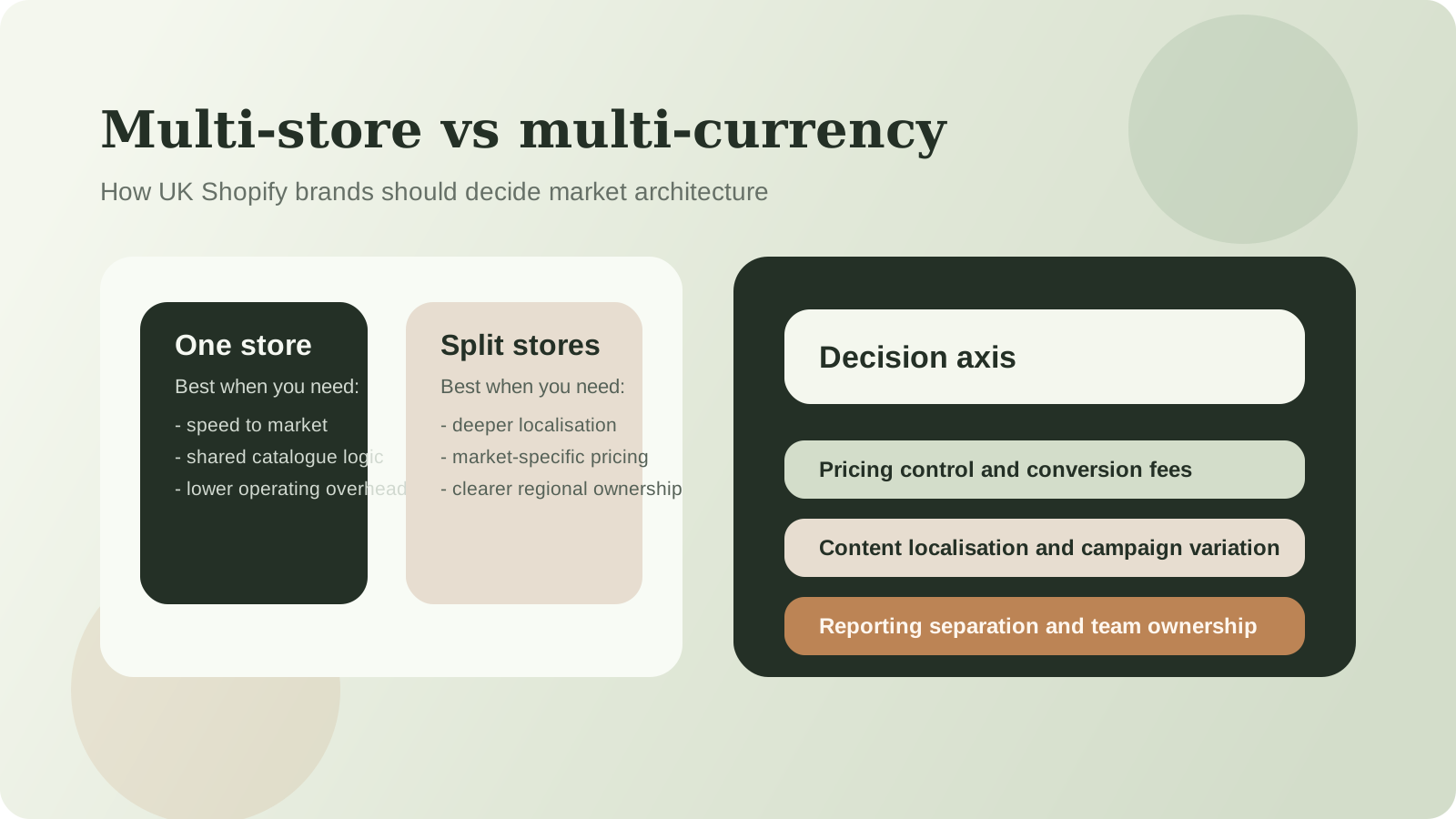
Multi-store versus multi-currency decision table
| Decision area | Multi-currency stronger when | Multi-store stronger when |
|---|---|---|
| speed to market | you want fast market testing | local execution depth matters more than speed |
| pricing control | base logic is mostly shared | each market needs deliberate pricing architecture |
| content localisation | light market variation is enough | language, navigation, and campaigns diverge significantly |
| reporting and ownership | one core team can manage centrally | market-level accountability needs separation |
| operational overhead | lean teams need simplicity | larger teams can support regional complexity |
| customer experience | customers mainly need local currency | customers need a clearly localised storefront |
StoreBuilt example
One UK brand entered several international markets through one-store logic because the initial demand picture was still uncertain. That was the right call early on. It kept launch cost lower and allowed the team to learn which markets had real traction.
The problem came later, when two stronger markets started needing more deliberate pricing, campaign timing, and support messaging than the rest. The store was still technically coping, but commercially it was becoming blurred. Promotions were harder to localise cleanly, reporting ownership was weaker, and content decisions started to conflict.
The solution was not “abandon one store” in a dramatic way. It was to phase from one-store learning into a more structured market architecture where the business case justified it.
A phased expansion sequence for UK brands
For most UK Shopify brands, the safest sequence is:
- Start with one-store, multi-currency logic if market confidence is still being proven.
- Validate demand, pricing sensitivity, and support complexity by market.
- Identify where localised content and pricing now justify more independence.
- Split only the markets that need materially different execution.
This is where We Make Websites-style competitor content is directionally useful. It highlights that multi-currency can be a lower-commitment entry route and multi-store can support deeper localisation. The practical gap is usually the transition logic, which is what brands need most when growth stops being theoretical.
For a live review of whether your current Markets setup is still helping or now holding back regional execution, use the StoreBuilt free Shopify audit.
High-intent AI search implementation layer
The AI-search version of this topic is not just “write more content”. A useful answer engine result needs a page that gives a direct answer, proves the claim, and shows the next operational step inside Shopify.
| Area | StoreBuilt implementation check |
|---|---|
| Primary intent | The page should map to shopify multi store and one clear buyer or operator problem, not a vague traffic topic. |
| Shopify surface | Identify whether the work belongs on a collection, product page, theme section, checkout step, app workflow, email flow, or support process. |
| Proof | Add first-hand observations, product/category examples, screenshots, policy notes, review signals, or trustworthy external sources where they make the advice safer. |
| Internal route | Link the reader to the service most likely to solve the issue: International expansion and localisation. |
| Measurement | Check Search Console, analytics, assisted conversions, enquiry quality, and AI-response mentions after the update rather than judging success by pageviews alone. |
For this article, the useful research inputs are: StoreBuilt Shopify audits, UK ecommerce SERP intent, Shopify platform documentation, and AI-search measurement patterns. StoreBuilt would prioritise Markets setup, localisation, hreflang, currencies, duties, content adaptation, and operational checks before expanding into broader supporting content.
If this topic maps to a live store problem, review the related StoreBuilt service or Contact StoreBuilt with the store URL and the issue you want fixed.
Final StoreBuilt point of view
Shopify multi-store versus multi-currency is not a purity debate. It is a maturity decision.
For UK ecommerce brands, one-store multi-currency often makes sense first because it preserves speed. Multi-store becomes the better answer when market differences are commercially meaningful enough that one central setup starts hiding real complexity instead of simplifying it.