
What we have seen in cross-border Shopify work is this: most UK brands do not lose margin internationally because they chose the wrong platform. They lose it because market pricing becomes a loose collection of spreadsheet decisions, emergency overrides, and campaign shortcuts instead of a governed operating model.
If your team is already selling internationally or preparing to, Contact StoreBuilt.
Table of contents
- Keyword decision and research inputs
- What current UK competitor content signals
- Why pricing architecture matters more than currency display
- Market pricing governance table
- How to structure pricing ownership on Shopify
- Margin-risk scenarios teams miss
- StoreBuilt client example
- Final StoreBuilt point of view
Keyword decision and research inputs
Primary keyword: shopify market pricing architecture
Secondary keywords:
- ecommerce UK market international pricing
- shopify pricing by market
- shopify markets pricing strategy
- cross-border ecommerce pricing on shopify
- shopify international pricing governance
Search intent: strategic and commercial. The reader is usually a UK ecommerce lead, founder, operations owner, or ecommerce manager trying to avoid pricing chaos while scaling beyond the domestic store.
Funnel stage: middle to bottom.
Page type: implementation guide with governance tables.
Why StoreBuilt can realistically win this topic:
- We see how pricing decisions affect conversion, support load, merchandising clarity, and post-launch operations together.
- We regularly assess Shopify setups where market logic exists technically but not operationally.
- We can connect pricing architecture to the real delivery work across localisation, CRO, and ongoing support.
Research inputs used on June 15, 2026:
- Current SERP intent review around Shopify market pricing, Shopify Markets strategy, and cross-border ecommerce pricing terms.
- UK competitor-content pattern review using public article libraries from Charle and adjacent Shopify agencies that publish on Shopify strategy, internationalisation, and operational ecommerce topics.
- StoreBuilt observations from UK ecommerce planning work where pricing, duties, promotions, and delivery promises must align by market.
What current UK competitor content signals
The strongest UK agency content on international ecommerce has improved in one obvious way: it now treats localisation as an operating system, not just a translation exercise. Charle-style long-form guides tend to frame the business decision clearly and make the content easy to scan. Other Shopify agencies in the UK often do a good job explaining market expansion at a strategic level.
Where the category is still weaker is in the pricing layer.
Many articles explain:
- why international demand exists
- why local currency improves trust
- why local payments matter
Fewer explain how pricing should actually be owned, changed, QA’d, and reviewed after launch. That is the gap worth fixing because pricing architecture is where margin leakage becomes operationally invisible.
In practice, the problem is rarely “we forgot to show Euros.” The problem is that pricing changes, discount logic, duties, and merchandising are being run by different people with different assumptions.
Why pricing architecture matters more than currency display
Currency display is a presentation layer. Pricing architecture is the commercial logic underneath it.
That distinction matters because a store can look localised while still behaving badly:
- promotions may stack differently by market than intended
- FX movements may compress contribution margin quietly
- product bundles may make sense in the UK but not in Germany or France
- delivery thresholds may increase conversion in one market while damaging profitability in another
This is why international pricing should be treated as a controlled system with named owners.
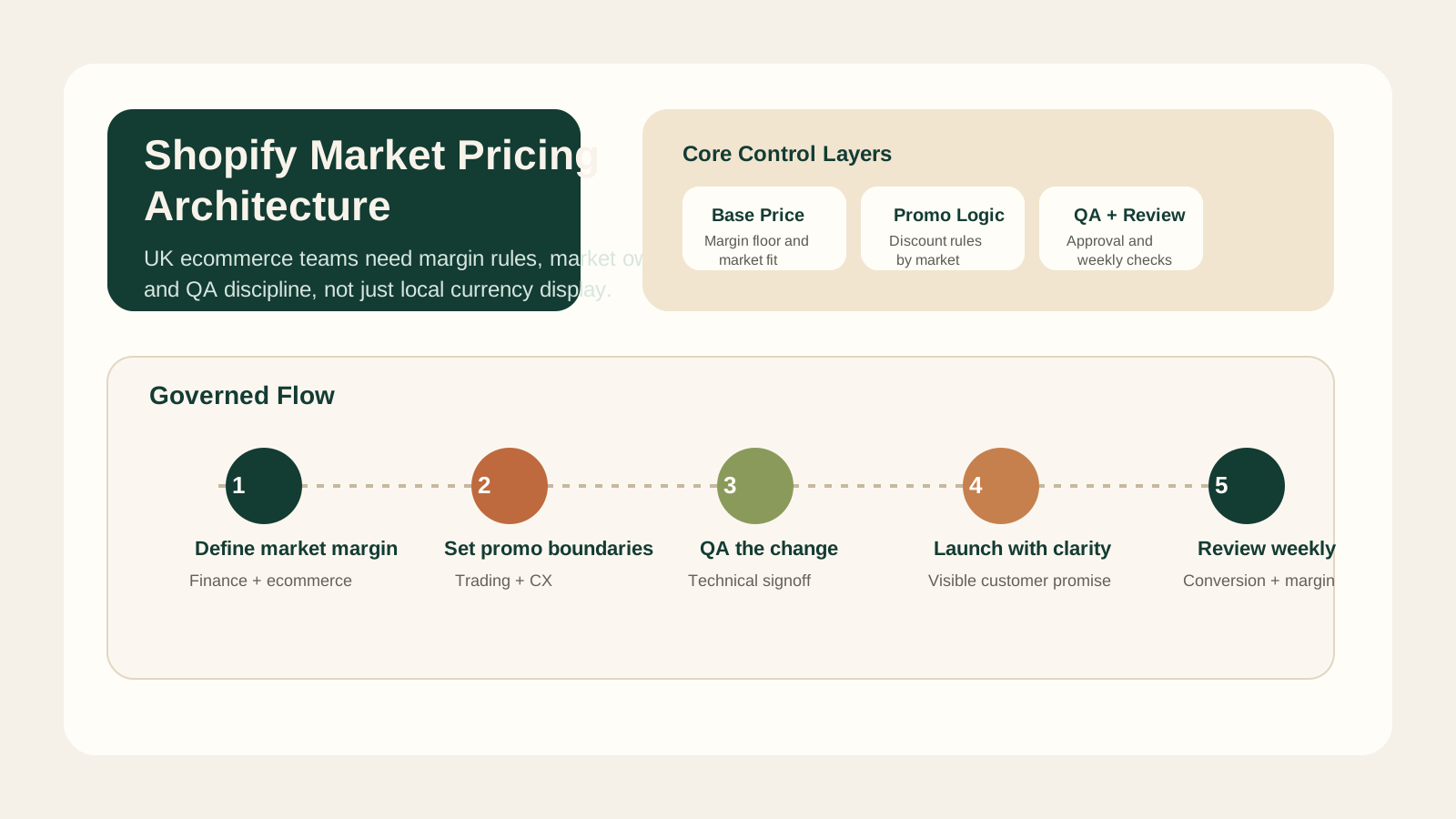
At minimum, UK Shopify brands need answers to five questions:
- Who defines target margin by market?
- Who approves price changes and when?
- Which logic is fixed versus promotional?
- How are shipping thresholds and duties communicated?
- What is reviewed weekly after launch?
If those answers are not documented, the store may still launch successfully, but it will operate reactively.
One useful rule of thumb from StoreBuilt planning work: if pricing can be changed quickly but cannot be explained clearly, the architecture is not mature yet.
Market pricing governance table
| Pricing layer | Primary owner | What must be controlled | Typical failure pattern |
|---|---|---|---|
| Base market price | Finance + ecommerce lead | Margin floor, tax handling, price positioning | UK pricing copied into other markets with weak rationale |
| FX conversion logic | Finance or pricing owner | Review cadence, rounding logic, threshold alerts | Currency movement silently erodes margin |
| Promotional pricing | Trading or ecommerce lead | Discount rules, stackability, market exceptions | Campaign logic behaves inconsistently by region |
| Shipping threshold messaging | Ecommerce + operations | Threshold economics and copy clarity | Free-shipping promise creates negative-margin baskets |
| Duties and import communication | Operations + CX | Market-level landing cost transparency | Customer trust drops after unexpected landed-cost friction |
| QA and release signoff | Ecommerce + technical owner | Test scenarios before market changes go live | Pricing errors reach customers during campaigns |
The point is not to create bureaucracy for its own sake. The point is to prevent international pricing from turning into an untraceable chain of small commercial compromises.
If your current market setup feels fragile, StoreBuilt can help structure the rollout.
How to structure pricing ownership on Shopify
For most UK brands, the cleanest structure is not the most complex one. It is the one the internal team can actually operate consistently.
That usually means separating pricing into three decision bands.
1. Permanent market logic
This includes:
- baseline price architecture
- margin targets
- tax assumptions
- delivery threshold rules
These should not be changed casually during campaign pressure. They form the commercial spine of the market.
2. Planned promotional logic
This includes:
- campaign discounts
- short-term bundles
- threshold-based incentives
- market-specific launch offers
These need pre-defined owners and a release calendar because they interact directly with margin and conversion.
3. Emergency override logic
This includes:
- rapid price corrections
- stock-led pricing protection
- temporary market pauses
- customer-service exceptions
Emergency changes are sometimes necessary. The mistake is allowing the emergency layer to become the normal layer.
From a Shopify operating perspective, the most stable teams also maintain a simple change log covering:
- what changed
- why it changed
- which markets were affected
- who approved it
- what KPI should move if the change was correct
That sounds basic, but it is often the difference between disciplined pricing and organisational guesswork.
Margin-risk scenarios teams miss
A lot of pricing damage happens in scenarios that look minor at first.
Rounding without margin review
Teams often round prices for local presentation quality, which is sensible. The issue appears when multiple SKUs are rounded without checking bundle economics, discount ladders, or free-shipping thresholds.
UK-first promotion logic reused elsewhere
A promotion that works in the UK may underperform or over-discount in another market because delivery cost, VAT treatment, or local competitive expectations differ.
Local trust messaging disconnected from price architecture
If the store signals local relevance but the pricing feels arbitrary, conversion quality suffers. People may still buy, but support friction, refund pressure, and discount dependency tend to increase.
Ownership split between too many teams
When finance owns headline pricing, ecommerce owns discounts, CX owns messaging, and operations owns duties with no clear meeting cadence, the store becomes structurally inconsistent.
This is one reason market planning should connect directly with ongoing Shopify support and audits. International pricing is not a one-time setup task. It is a maintenance discipline.
A practical weekly review model
Once a market is live, review the same signals every week:
| Review signal | Why it matters | Escalation trigger |
|---|---|---|
| Conversion rate by market | Shows whether local proposition is landing | Persistent underperformance versus expectation |
| Average order value by market | Reveals bundle and threshold effects | AOV drops after promotional or pricing updates |
| Gross margin after shipping and discounts | Protects profitability, not vanity revenue | Margin compression outside expected band |
| Customer-service tickets about price, duty, or delivery | Surfaces trust friction quickly | Repeated confusion in one market |
| Discount dependency by market | Shows weak local pricing or offer fit | Sales require constant incentives to sustain |
This cadence should live in the trading workflow, not in a quarterly deck nobody revisits.
StoreBuilt client example
One UK retailer came into planning with healthy international interest but unstable commercial outcomes. The visible issue looked like inconsistent market performance. The real issue was pricing architecture.
Their UK logic had been adapted market by market without a clean ownership model. Shipping thresholds were set more by optimism than contribution logic. Promotions launched quickly, but their interaction with margin and duties was barely reviewed. Customer-service teams were then forced to explain outcomes they had not helped design.
We re-scoped the market model around fixed pricing rules, promotional approval paths, and a tighter weekly reporting loop. The benefit was not only cleaner margin control. Teams also gained more confidence in what each market was trying to do commercially.
That matters because international growth is easier when internal explanations become simpler.
High-intent AI search implementation layer
The AI-search version of this topic is not just “write more content”. A useful answer engine result needs a page that gives a direct answer, proves the claim, and shows the next operational step inside Shopify.
| Area | StoreBuilt implementation check |
|---|---|
| Primary intent | The page should map to shopify markets and one clear buyer or operator problem, not a vague traffic topic. |
| Shopify surface | Identify whether the work belongs on a collection, product page, theme section, checkout step, app workflow, email flow, or support process. |
| Proof | Add first-hand observations, product/category examples, screenshots, policy notes, review signals, or trustworthy external sources where they make the advice safer. |
| Internal route | Link the reader to the service most likely to solve the issue: Shopify support, maintenance and audits. |
| Measurement | Check Search Console, analytics, assisted conversions, enquiry quality, and AI-response mentions after the update rather than judging success by pageviews alone. |
For this article, the useful research inputs are: StoreBuilt Shopify audits, UK ecommerce SERP intent, Shopify platform documentation, and AI-search measurement patterns. StoreBuilt would prioritise technical audits, roadmap priority, theme changes, app governance, reporting, and measured improvement before expanding into broader supporting content.
If this topic maps to a live store problem, review the related StoreBuilt service or Contact StoreBuilt with the store URL and the issue you want fixed.
Final StoreBuilt point of view
For UK ecommerce brands on Shopify, international pricing should be treated as commercial architecture, not merchandising decoration. A store can display local currency and still be strategically confused.
The brands that scale better are usually not the ones with the most aggressive market rollout. They are the ones with clearer ownership, tighter pricing governance, and enough operational discipline to protect both trust and margin at the same time.