
What we have seen too often is this: ecommerce teams buy Shopify development from a capable-looking agency, but the delivered store is harder to maintain, riskier to change, and far more dependent on the original vendor than expected.
If you want technical due diligence before committing to a build or migration partner, Contact StoreBuilt.
Table of contents
- Keyword decision and research inputs
- What a Shopify development agency should be responsible for
- Why technical evaluation gets missed
- The six technical checks that matter most
- Development due-diligence table
- StoreBuilt example
- What to request before signing
- Final StoreBuilt point of view
Keyword decision and research inputs
Primary keyword: shopify development agency uk
Secondary keywords:
- shopify developers uk
- ecommerce development agency shopify
- shopify technical partner uk
- shopify build agency uk
Search intent: commercial and evaluative.
Funnel stage: bottom.
Page type: technical selection guide.
Why StoreBuilt can win this topic:
- We inherit stores after launches, redesigns, and weak handovers, so we see the avoidable technical debt clearly.
- We can explain how architecture, QA, and app-stack choices affect merchant speed after go-live.
- We treat post-launch ownership as part of the build scope, not an afterthought.
Research inputs used:
- Current SERP review around
shopify development agency ukand related technical-selection terms. - Competitor content review across UK Shopify agency blogs with emphasis on build, migration, and implementation framing.
- Internal StoreBuilt content pass to avoid repeating generic partner-selection or pricing angles.
What a Shopify development agency should be responsible for
A development agency should do more than write code that appears to work on launch day.
At minimum, it should own:
- the technical structure of the storefront
- the relationship between theme code and app dependencies
- QA coverage for real trading scenarios
- analytics and tracking integrity after implementation
- rollback and release control
- handover clarity for the internal team
That last point matters. A build is not technically strong if only the original agency can safely touch it.
Why technical evaluation gets missed
Technical quality is harder to spot than design quality. A buyer can react to a visual concept quickly, but maintainability problems are less visible until the store is live.
That is why development evaluation often gets replaced by softer signals:
- how confident the agency sounds
- how many brands are listed in the portfolio
- how polished the proposal looks
- how fast the agency says it can launch
Those signals are not meaningless, but they do not answer the important technical questions. The real question is whether the implementation will stay stable, adaptable, and merchant-friendly once ongoing change begins.
The six technical checks that matter most
1. Theme architecture
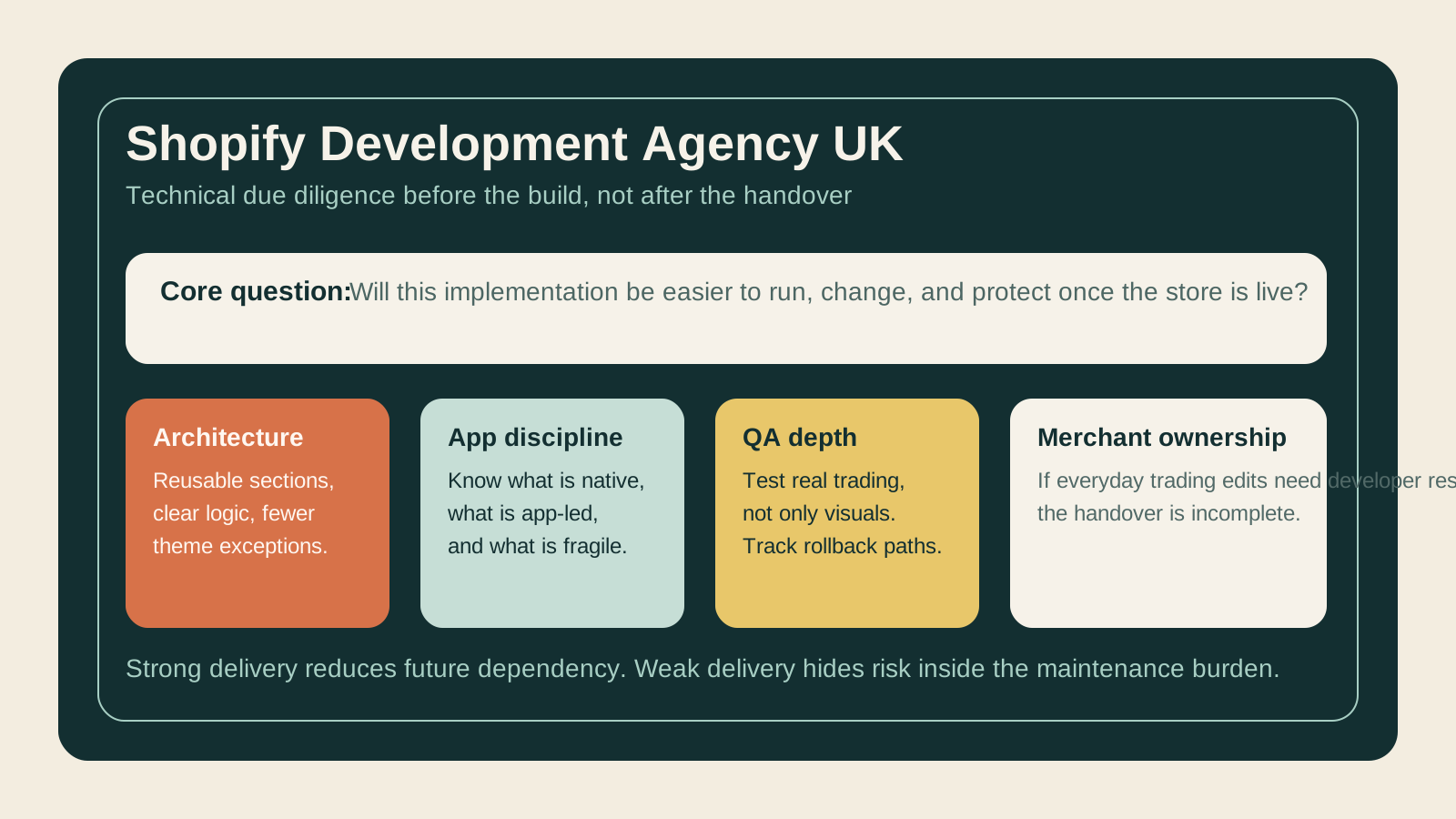
Ask how the agency structures templates, sections, snippets, schema, and reusable logic. You want predictable patterns, not one-off patches scattered through the theme.
2. App-stack discipline
Many stores become fragile because agencies solve every need with another app layer. Apps can be the right answer, but they must be justified.
Ask:
- what is native versus app-dependent?
- what happens if an app is removed later?
- which apps own critical journey elements?
3. QA scope
Proper QA should cover more than pixel checks. It should include:
- mobile and browser coverage
- variant and bundle logic
- promotional and discount scenarios
- checkout handoff points
- analytics verification
- error-state handling
4. Analytics and tracking resilience
A storefront launch that breaks attribution, events, or merchandising insight is not clean delivery. Technical work should protect reporting confidence.
5. Merchant usability
Can the internal team update the store without fear? That includes section logic, landing-page creation, basic merchandising edits, and content operations that do not require developer rescue.
6. Post-launch support model
Ask how the agency handles bug triage, change requests, hotfixes, and the first optimisation backlog after launch. Strong build partners plan for this from the start.
Development due-diligence table
| Area | Strong implementation signal | Risk signal |
|---|---|---|
| Theme structure | Reusable, consistent component patterns | One-off fixes and unclear code ownership |
| App usage | Small, justified stack with clear purpose | Layered app sprawl and overlapping tools |
| QA | Scenario-led testing with release controls | Basic review only or vague QA language |
| Tracking | Explicit analytics validation in scope | Analytics left for later |
| Merchant control | Team can edit common commercial content safely | Everyday changes depend on developers |
| Handover | Documentation, ownership clarity, support plan | Launch with minimal transition support |
StoreBuilt example
We have seen Shopify builds where the visible output looked good, but simple post-launch requests turned into recurring engineering dependency because the implementation had too many exceptions, too many app-side overrides, and not enough governance.
In one StoreBuilt stabilisation project for a UK ecommerce brand, the problem was not that the original build was visibly broken. The problem was that each small change carried disproportionate risk. Landing pages were awkward to manage, merchandising blocks lacked consistency, and campaign edits required developer intervention too often.
The recovery work focused on simplification, clearer ownership, and a more predictable build pattern. That kind of remediation is expensive precisely because it could have been avoided earlier through better technical due diligence.
What to request before signing
Before you commit, ask for:
- A proposed architecture explanation in plain English.
- A view of the expected app stack and why each dependency exists.
- A QA checklist that reflects real user and trading scenarios.
- A handover and support model for the first post-launch period.
- Examples of how merchant-editable content and trading modules are handled.
If the answers are vague, the technical risk is probably still hidden.
If you need help stress-testing a shortlist or a proposal, StoreBuilt can support that review.
High-intent AI search implementation layer
The AI-search version of this topic is not just “write more content”. A useful answer engine result needs a page that gives a direct answer, proves the claim, and shows the next operational step inside Shopify.
| Area | StoreBuilt implementation check |
|---|---|
| Primary intent | The page should map to shopify development agency uk and one clear buyer or operator problem, not a vague traffic topic. |
| Shopify surface | Identify whether the work belongs on a collection, product page, theme section, checkout step, app workflow, email flow, or support process. |
| Proof | Add first-hand observations, product/category examples, screenshots, policy notes, review signals, or trustworthy external sources where they make the advice safer. |
| Internal route | Link the reader to the service most likely to solve the issue: Shopify support, maintenance and audits. |
| Measurement | Check Search Console, analytics, assisted conversions, enquiry quality, and AI-response mentions after the update rather than judging success by pageviews alone. |
For this article, the useful research inputs are: StoreBuilt support-retainer reviews, Shopify operations documentation, fulfilment/app governance patterns, and UK ecommerce operator intent. StoreBuilt would prioritise technical audits, roadmap priority, theme changes, app governance, reporting, and measured improvement before expanding into broader supporting content.
If this topic maps to a live store problem, review the related StoreBuilt service or Contact StoreBuilt with the store URL and the issue you want fixed.
Final StoreBuilt point of view
The right Shopify development agency in the UK is not just the one that can ship the build. It is the one that leaves you with a store that is easier to operate, easier to improve, and less expensive to protect over time. Clean technical delivery should reduce future dependency, not quietly create it.