
What we have seen in omnichannel projects is this: brands like the commercial logic of buy online, return in store, but they often underestimate how many systems and staff behaviours have to agree before the promise becomes trustworthy.
If you are trying to reduce refund friction without creating store-floor confusion, Contact StoreBuilt.
Table of contents
- Keyword decision and research inputs
- Why BORIS matters for UK ecommerce brands
- The operating risks most teams miss
- BORIS workflow table for Shopify teams
- How to design the customer-facing journey
- What to align before launch
- StoreBuilt example
- Final StoreBuilt point of view
Keyword decision and research inputs
Primary keyword: buy online return in store Shopify
Secondary keywords:
- BORIS ecommerce
- Shopify returns workflow
- omnichannel returns UK
- ecommerce UK market post-purchase
- Shopify POS returns
Search intent: commercial-operational intent from retail teams structuring omnichannel returns on Shopify.
Funnel stage: middle to bottom.
Likely page type: implementation guide.
Why StoreBuilt can realistically win this topic:
- This is an execution topic where the gap between customer promise and internal capability is commercially expensive.
- Competitor content often covers Shopify POS broadly but under-covers refund governance and store-ops friction.
- StoreBuilt can position BORIS as a joint UX and operations system, not a feature checklist.
Research inputs used on June 4, 2026:
- Current SERP review around
buy online return in store,shopify returns in store, and omnichannel retail return terms. - UK competitor review across Shopify-agency content clusters, especially where Shopify POS and post-purchase operations are discussed lightly but not deeply.
- Public search-modifier research around refunds, in-store returns, exchange workflow, stock accuracy, and omnichannel CX.
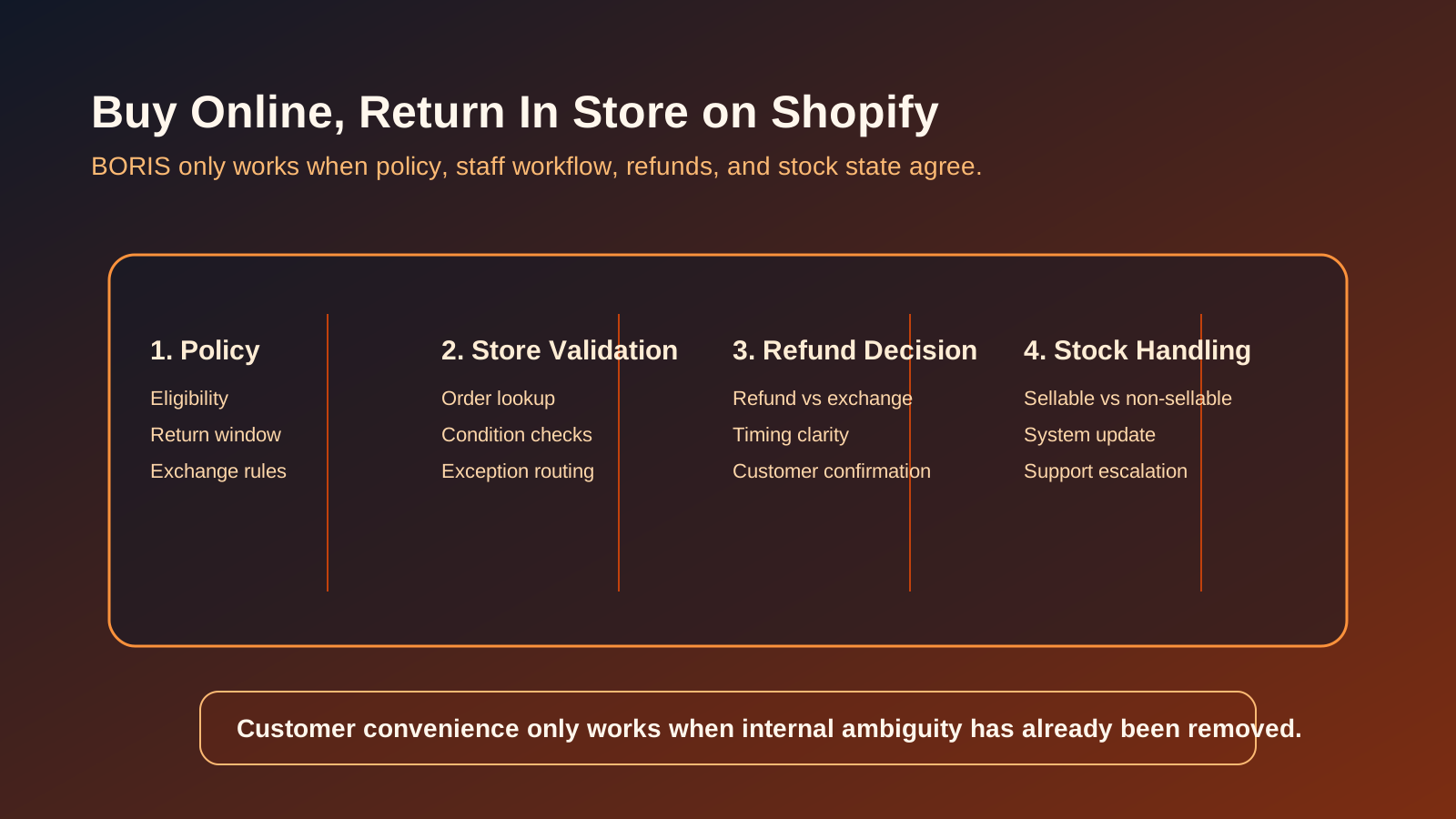
Why BORIS matters for UK ecommerce brands
BORIS matters because it can improve convenience, reduce delivery-related return cost, and create another physical touchpoint with the customer. It can also create avoidable friction if the store team, refund logic, and customer messaging are not aligned.
For UK shoppers, returns expectations are strong. That does not mean every brand should promise the most generous return experience possible. It means the promise has to be clear, credible, and operationally repeatable.
The commercial upside usually sits in four places:
- fewer return-shipping costs on eligible orders;
- faster perceived resolution for the customer;
- potential exchange or save opportunities in store;
- better integration between ecommerce and retail operations.
The downside appears just as quickly when:
- store teams cannot verify eligibility confidently;
- refund timing is inconsistent;
- stock cannot be reclassified correctly;
- online and in-store policy language do not match;
- edge cases are escalated ad hoc.
That is why BORIS is not a simple “add returns to store” feature. It is a service model.
The operating risks most teams miss
The first risk is assuming policy clarity alone is enough. It is not.
Most BORIS failures come from workflow ambiguity:
- Can a store colleague identify the original order quickly?
- What happens if the item was discounted?
- Can the customer exchange instead of refunding?
- What condition rules apply?
- Does the item go back to sellable inventory immediately?
- Who owns exceptions?
If those questions are still being decided after launch, the customer will experience the uncertainty directly.
The second risk is stock-state confusion. A return is not only a refund event. It is also an inventory event. If the store receives a returned item but the ecommerce system reflects stock inaccurately, the brand has now introduced both margin and trust risk.
The third risk is refund-governance inconsistency. Teams often want store staff to “use judgement” in the moment. That sounds customer-friendly but usually produces variable outcomes across locations.
BORIS workflow table for Shopify teams
| Workflow area | What must be true | Common failure mode | Commercial impact |
|---|---|---|---|
| Order lookup | Staff can identify eligible online orders fast | Manual searching and uncertainty | Queue friction and lower customer confidence |
| Policy validation | Return window and item rules are explicit | Staff interpretation varies by location | Refund inconsistency and complaints |
| Refund path | Refund method and timing are defined | Customer expects instant outcome that ops cannot support | Support follow-up and trust loss |
| Inventory handling | Returned stock is classified correctly | Sellable and non-sellable items are mixed | Margin leakage and oversell risk |
| Exchange logic | Staff know when exchange is allowed and how it is recorded | Save opportunities are missed | Lower retention and unnecessary refund volume |
| Exception routing | Escalation owner is clear | Managers improvise | Slow resolution and inconsistent treatment |
This table should sit behind the customer promise. If the workflow is not defensible internally, the BORIS offer is not launch-ready yet.
How to design the customer-facing journey
BORIS works best when the customer journey feels deliberate rather than improvised.
That means communicating:
- which orders or products are eligible;
- whether returns can be refunded or exchanged in store;
- what the customer should bring;
- how long the process usually takes;
- whether any product conditions apply;
- what happens if the item is not approved.
The right message is rarely “returns made easy” on its own. It is “here is exactly how this works, so you know what to expect.”
This is also where ecommerce and retail teams need one shared language. If the policy page says one thing, the order email says another, and store colleagues explain a third version, the brand will look disorganised.
Useful internal next steps often include:
- aligning BORIS messaging across policy, checkout, and post-purchase email;
- testing store scripts with real scenarios;
- checking POS or return-tool data flow before launch;
- defining when the store should refund versus escalate.
If your Shopify setup needs broader operational joining-up, Shopify Apps, Integrations & Automation is often part of the solution.
What to align before launch
Before launching BORIS on Shopify, we would want a UK brand to confirm:
- Policy logic
Is BORIS available to all locations, all SKUs, and all order types? If not, the exclusions need to be obvious.
- System pathway
How will the store team validate the order, process the outcome, and update stock state without introducing reconciliation pain later?
- Training and scripts
Can a store colleague handle the five most common scenarios without asking for improvised management decisions?
- Returns economics
Is BORIS being offered because it genuinely improves economics and customer experience, or because it sounds modern? Not every retail model benefits equally.
- Exception ownership
When something falls outside the rules, who owns the final call?
Related StoreBuilt content:
- Shopify POS for UK Retailers Implementation Playbook
- Shopify Address Validation and Delivery Failure Reduction Playbook
- Shopify Returns Economics for Ecommerce UK Market Teams
If you want to pressure-test your refund and post-purchase process before launch, Run the free StoreBuilt AI audit.
StoreBuilt example
A retailer with both ecommerce and physical locations wanted BORIS mainly to reduce shipping-related return cost. On paper, the logic was strong. In practice, store teams did not yet have a confident path for validating online order exceptions, and ecommerce policy wording was broader than what the stores could actually support.
The real work was not adding a headline promise. It was narrowing the policy to what could be executed consistently, clarifying exchange versus refund rules, and defining how returned stock should be handled by condition.
Once the workflow was tightened, BORIS became a credibility gain rather than a service gamble.
High-intent AI search implementation layer
The AI-search version of this topic is not just “write more content”. A useful answer engine result needs a page that gives a direct answer, proves the claim, and shows the next operational step inside Shopify.
| Area | StoreBuilt implementation check |
|---|---|
| Primary intent | The page should map to buy online return in store and one clear buyer or operator problem, not a vague traffic topic. |
| Shopify surface | Identify whether the work belongs on a collection, product page, theme section, checkout step, app workflow, email flow, or support process. |
| Proof | Add first-hand observations, product/category examples, screenshots, policy notes, review signals, or trustworthy external sources where they make the advice safer. |
| Internal route | Link the reader to the service most likely to solve the issue: Shopify support, maintenance and audits. |
| Measurement | Check Search Console, analytics, assisted conversions, enquiry quality, and AI-response mentions after the update rather than judging success by pageviews alone. |
For this article, the useful research inputs are: StoreBuilt support-retainer reviews, Shopify operations documentation, fulfilment/app governance patterns, and UK ecommerce operator intent. StoreBuilt would prioritise store operations, app governance, fulfilment logic, support workflows, reporting, and technical maintenance before expanding into broader supporting content.
If this topic maps to a live store problem, review the related StoreBuilt service or Contact StoreBuilt with the store URL and the issue you want fixed.
Final StoreBuilt point of view
Buy online, return in store only works when operations are calmer than the marketing line suggests.
For UK Shopify brands, BORIS should be treated as a managed service model across ecommerce, store operations, refunds, and inventory control. If one part is vague, the customer feels it immediately.
The best BORIS launches are not the broadest. They are the clearest. They define eligibility, give store teams reliable scripts, and turn an omnichannel promise into something the business can actually repeat at scale. If you need that model designed properly, Contact StoreBuilt.