
What we have seen repeatedly is this: many ecommerce teams choose a Shopify design agency based on visual taste, then discover too late that UX depth, CRO logic, and implementation quality were not really part of the offer.
If you need a second opinion before signing a Shopify design scope, Contact StoreBuilt.
Table of contents
- Keyword decision and research inputs
- What a Shopify design agency should actually do
- How competitor content frames the category
- The five evaluation questions that matter most
- Agency scorecard table
- StoreBuilt example
- Questions to ask before you buy
- Final StoreBuilt point of view
Keyword decision and research inputs
Primary keyword: shopify design agency uk
Secondary keywords:
- shopify web design agency uk
- ecommerce design agency shopify
- shopify ux agency
- shopify design partner uk
Search intent: commercial selection. The reader is likely comparing agencies or validating what a credible Shopify design partner should include.
Funnel stage: bottom.
Page type: evaluation guide.
Why StoreBuilt can win this topic:
- We work where design, build, CRO, and merchant workflows overlap.
- We can explain what design scopes often hide.
- We can speak to both the buying team and the implementation reality after sign-off.
Research inputs used:
- Current SERP review for
shopify design agency ukand adjacent design-selection modifiers. - Competitor pattern scan across Charle and We Make Websites, especially their design, CRO, and strategy article framing.
- Current StoreBuilt inventory check to avoid repeating generic
best shopify agency ukselection angles.
What a Shopify design agency should actually do
A proper Shopify design agency should not just make the store look better. It should improve how the store sells.
That means the work must cover:
- navigation and collection logic
- product-page decision support
- landing-page structure for campaigns
- basket and checkout pre-commitment clarity
- reusable modules the internal team can manage safely
If the offer is mostly moodboards, page mockups, and generic claims about premium brand experience, the risk is obvious. The merchant pays for visual confidence but still inherits the same buying friction, the same app clutter, and the same internal dependency problems.
For UK ecommerce teams, a Shopify design partner also needs to understand the category context. A beauty brand, food merchant, fashion store, B2B hybrid, and homeware brand do not need the same proof model, navigation logic, or conversion path.
How competitor content frames the category
The best UK competitor content usually does two things well:
- it packages the topic clearly with guide-style titles that are easy for commercial readers to scan
- it turns specialist Shopify delivery into accessible, buyer-friendly language
Where a lot of competitor content is still weak is in the buying-depth layer. Many articles explain what Shopify is, how design influences conversion, or why UX matters. Fewer clearly show how to judge whether an agency can carry design decisions through merchant reality, QA, and post-launch iteration.
That gap matters because a store does not fail at the design-pitch stage. It fails when campaign demand, catalogue complexity, and real content operations hit the system.
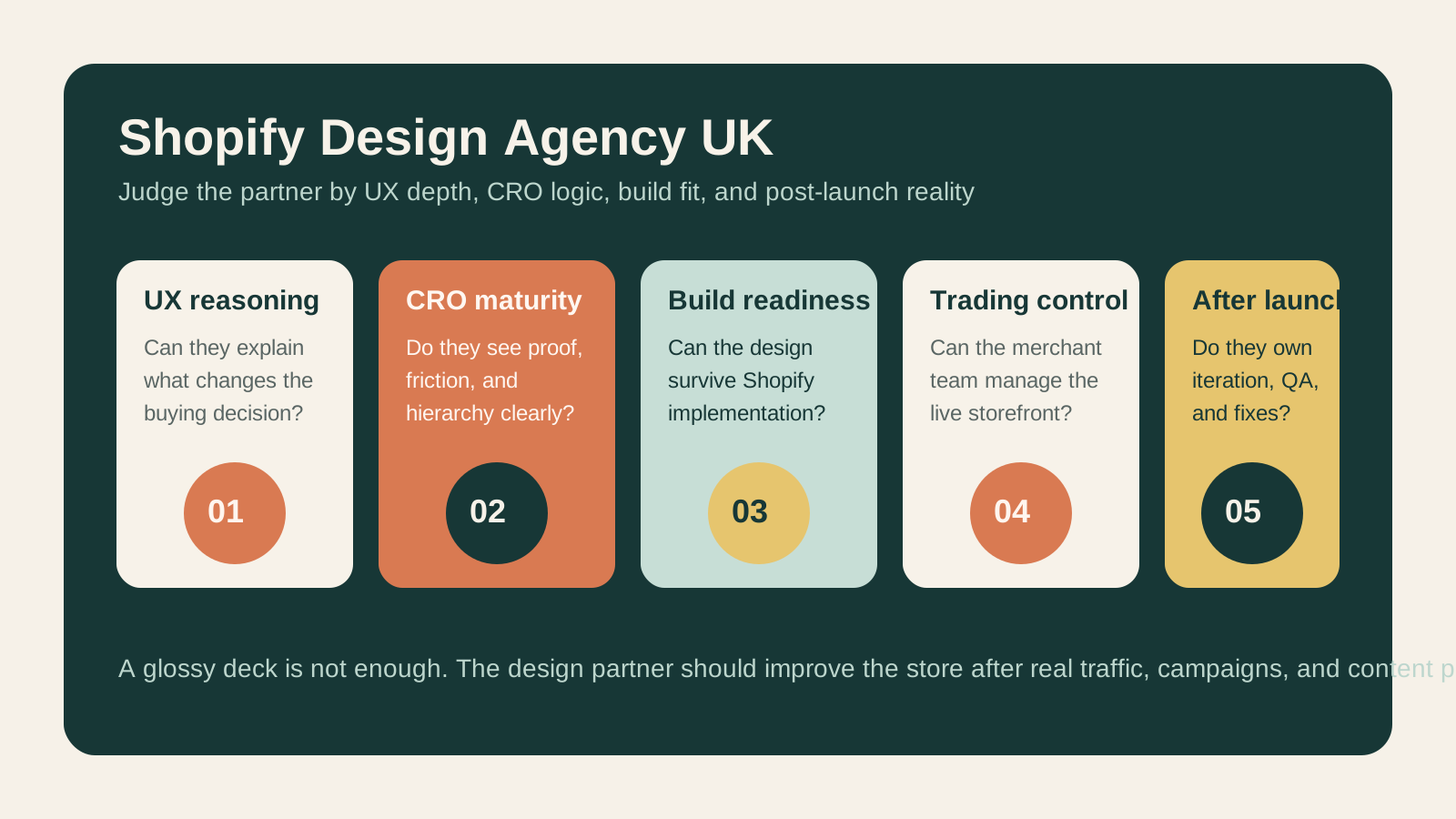
The five evaluation questions that matter most
1. Can the agency explain how design choices improve specific buying moments?
Ask for examples tied to:
- category discovery
- PDP confidence
- mobile browsing speed
- basket progression
- landing-page performance
If answers stay abstract, the team may be design-led but not conversion-literate enough.
2. Does the design system survive merchandising pressure?
The agency should be able to show how promo blocks, bundles, campaigns, seasonal edits, and urgent trading changes fit into the system without making the store feel chaotic.
3. Is there real CRO thinking, or just design language?
You do not need an agency to promise miracles. You do need one that understands hierarchy, proof, friction, and testable hypotheses.
4. Can the design be built cleanly on Shopify?
Beautiful concepts that collapse during implementation are expensive. Ask how the design system maps into sections, templates, content governance, and performance constraints.
5. What happens after launch?
Good agencies think beyond launch day. Ask how the first 60 to 90 days are usually handled: QA follow-up, issue triage, merchandising refinement, and the first optimisation wave.
Agency scorecard table
| Area | Strong signal | Weak signal |
|---|---|---|
| UX reasoning | Can explain hierarchy choices with commercial logic | Talks mostly about aesthetics |
| CRO maturity | Identifies friction and proof gaps clearly | Uses conversion language without practical detail |
| Shopify fit | Understands sections, templates, apps, and merchant workflows | Treats Shopify like a generic CMS |
| Design governance | Plans for trading, campaigns, and team edits | Focuses only on launch-state visuals |
| Delivery model | Aligns design, build, QA, and rollout | Hands over concepts with unclear implementation responsibility |
| Post-launch thinking | Has an optimisation and support view | Treats launch as the finish line |
If you want StoreBuilt to benchmark your shortlist against the points above, StoreBuilt can help.
StoreBuilt example
One UK ecommerce team approached StoreBuilt after receiving visually strong design proposals from multiple partners. The decks looked polished, but the buyer team still could not tell how product discovery would improve, how campaign landing pages would be governed, or how the internal team would manage the site after launch.
We reframed the discussion around buyer journey, module governance, and implementation realism. That immediately changed which proposal looked strongest. The best-looking option was not the best operational choice. The stronger option was the one that showed how the store would work under trading pressure, not just in a presentation.
That is a useful rule in general: if an agency cannot describe how the design behaves after the handover, the evaluation is incomplete.
Questions to ask before you buy
Use these in the next agency conversation:
- Which three buying-friction points are you solving first, and why?
- How would this design system hold up during seasonal campaigns and merchandising changes?
- Which parts of the experience are merchant-editable without developer support?
- How do you validate mobile UX beyond visual review?
- What usually changes in the first 30 to 60 days after launch?
Short, concrete answers are usually a better sign than long brand-language explanations.
If your shortlist still feels hard to separate, Contact StoreBuilt for a senior second opinion.
High-intent AI search implementation layer
The AI-search version of this topic is not just “write more content”. A useful answer engine result needs a page that gives a direct answer, proves the claim, and shows the next operational step inside Shopify.
| Area | StoreBuilt implementation check |
|---|---|
| Primary intent | The page should map to shopify design agency uk and one clear buyer or operator problem, not a vague traffic topic. |
| Shopify surface | Identify whether the work belongs on a collection, product page, theme section, checkout step, app workflow, email flow, or support process. |
| Proof | Add first-hand observations, product/category examples, screenshots, policy notes, review signals, or trustworthy external sources where they make the advice safer. |
| Internal route | Link the reader to the service most likely to solve the issue: CRO and UX optimisation. |
| Measurement | Check Search Console, analytics, assisted conversions, enquiry quality, and AI-response mentions after the update rather than judging success by pageviews alone. |
For this article, the useful research inputs are: StoreBuilt CRO audit patterns, analytics QA checks, Shopify theme constraints, and buyer-intent SERP patterns. StoreBuilt would prioritise PDP hierarchy, cart friction, mobile merchandising, testing policy, analytics QA, and measured releases before expanding into broader supporting content.
If this topic maps to a live store problem, review the related StoreBuilt service or Contact StoreBuilt with the store URL and the issue you want fixed.
Final StoreBuilt point of view
The right Shopify design agency in the UK is not the one with the glossiest presentation. It is the one that can turn UX thinking into cleaner merchandising, stronger product evaluation, safer implementation, and faster post-launch improvement. In practical ecommerce work, design quality is only real when the store keeps performing after the pitch deck disappears.