
What we have seen in Shopify content programmes is this: most teams publish enough articles, but too few build the category-cluster architecture needed to turn visibility into revenue.
If your blog is active but commercial lead quality is flat, Contact StoreBuilt.
Table of contents
- Keyword decision and research inputs
- Why cluster strategy beats isolated blog publishing
- Three-layer content architecture for Shopify brands
- Internal-link governance model
- UK competitor content library observations
- StoreBuilt example
- Final StoreBuilt point of view
Keyword decision and research inputs
Primary keyword: shopify content strategy uk
Secondary keywords:
- ecommerce uk market content strategy
- shopify seo content clusters
- ecommerce keyword clusters uk
- shopify category content architecture
- ecommerce blog to lead generation
Search intent: strategic implementation guidance.
Funnel stage: middle.
Page type: long-form SEO system guide.
Why StoreBuilt can win this topic:
- We combine content architecture with Shopify service-level execution.
- We optimise for lead quality, not only article traffic.
- We operationalise internal linking and CTA pathways in real builds.
Research inputs used in angle selection:
- SERP review for Shopify content strategy and ecommerce content cluster intent.
- UK agency content-library scan including Charle’s article model and topic spread.
- Keyword-style cluster mapping for platform comparisons, operations queries, and conversion guidance.
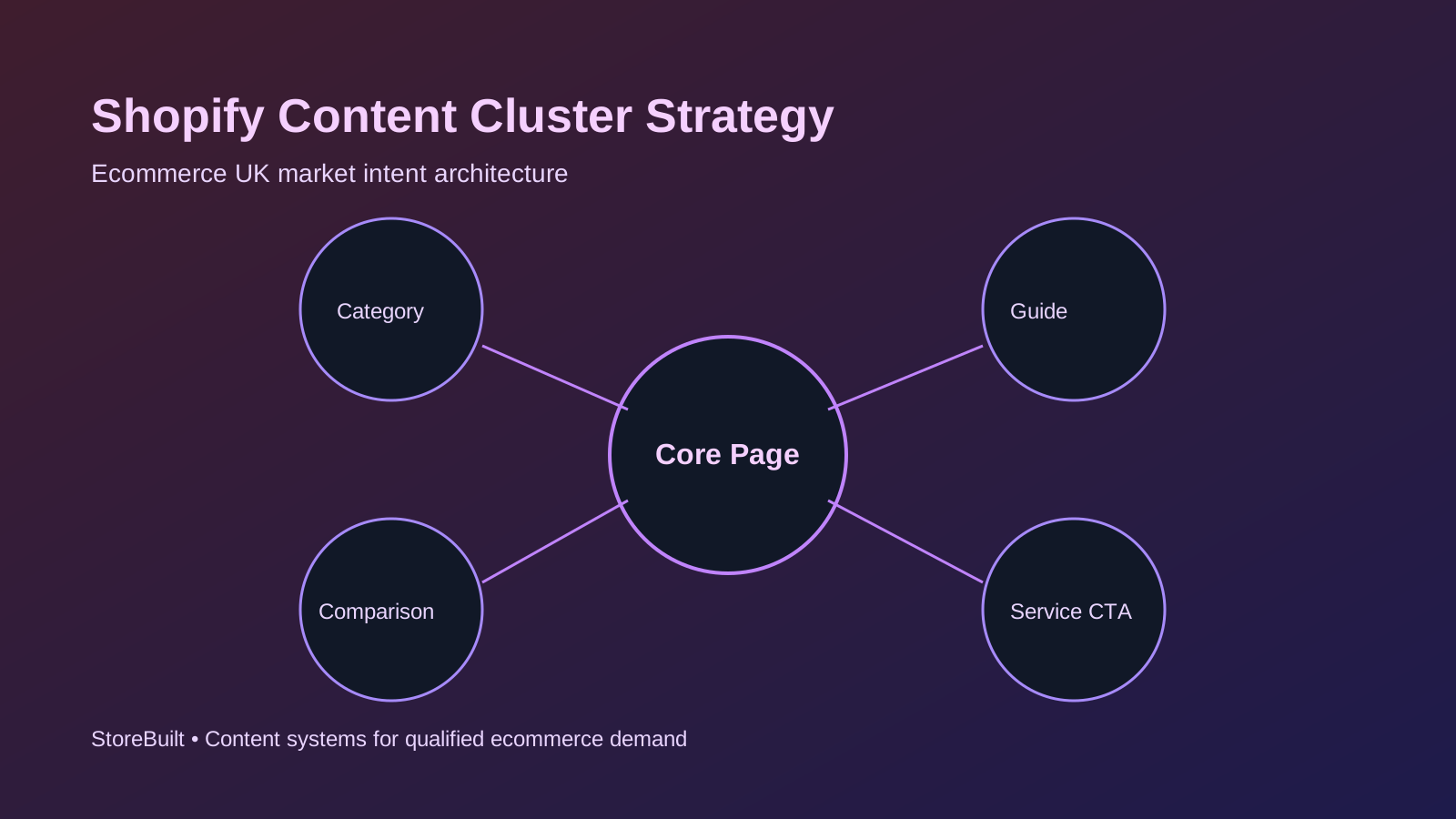
Why cluster strategy beats isolated blog publishing
Isolated publishing creates fragmented intent coverage. Cluster strategy creates ranking depth and better user pathways.
In practical terms, clusters help you:
- defend category terms against stronger domains
- capture evaluation intent with comparison and implementation pages
- route readers from information to service-qualified actions
- reduce duplicate article production around near-identical keywords
For UK Shopify brands, this matters because competition is high and buyer journeys involve multiple research stages before enquiry.
Three-layer content architecture for Shopify brands
| Layer | Page types | Core objective |
|---|---|---|
| Commercial core | Service pages, platform decision guides | Convert high-intent demand into qualified enquiries |
| Support cluster | Category guides, migration/CRO/SEO frameworks | Build depth and authority around core themes |
| Discovery cluster | Trend and early-stage educational pages | Capture awareness and route to mid-funnel assets |
Each new article should be assigned to a cluster before writing starts. If no cluster fit exists, the topic is usually not strategically necessary.
Internal-link governance model
| Linking rule | Why it matters | Execution note |
|---|---|---|
| Every support article links to at least one commercial page | Builds lead path clarity | Use contextual anchors, not generic “learn more” |
| Every cluster has a canonical hub page | Prevents topic sprawl | Keep hub updated quarterly |
| Comparison pages link both to guides and service pages | Supports multi-stage journeys | Match anchor language to search intent |
| Update links during content refresh cycles | Maintains crawl and relevance quality | Include link QA in editorial checklist |
This is where many teams underperform: content gets published, but link governance is not maintained.
If you want this architecture implemented with Shopify SEO delivery, StoreBuilt can help.
UK competitor content library observations
Across UK Shopify agency libraries, including Charle and similar competitors, three consistent patterns appear:
| Pattern | Strength | Gap opportunity |
|---|---|---|
| High-volume commercial guides | Strong buying-intent coverage | Often weak differentiation in implementation detail |
| Frequent trend-led posts | Good freshness signals | Limited conversion path depth in many libraries |
| Broad topic breadth | Useful authority signal | Cluster coherence can break without internal-link governance |
Use these patterns as editorial signals. Your edge comes from first-hand implementation depth, tighter internal links, and clearer enquiry pathways.
StoreBuilt example
A UK ecommerce team had dozens of Shopify articles but weak lead quality from organic traffic. Content was active, yet users were not moving toward commercial pages.
We re-clustered existing articles, rewired internal links by buyer stage, and revised CTAs around relevant service pathways. Traffic quality did not need to spike dramatically for results to improve; better structure produced better enquiry intent.
If your content is publishing but not converting, Contact StoreBuilt.
High-intent AI search implementation layer
The AI-search version of this topic is not just “write more content”. A useful answer engine result needs a page that gives a direct answer, proves the claim, and shows the next operational step inside Shopify.
| Area | StoreBuilt implementation check |
|---|---|
| Primary intent | The page should map to shopify content strategy and one clear buyer or operator problem, not a vague traffic topic. |
| Shopify surface | Identify whether the work belongs on a collection, product page, theme section, checkout step, app workflow, email flow, or support process. |
| Proof | Add first-hand observations, product/category examples, screenshots, policy notes, review signals, or trustworthy external sources where they make the advice safer. |
| Internal route | Link the reader to the service most likely to solve the issue: Shopify SEO and AI search readiness. |
| Measurement | Check Search Console, analytics, assisted conversions, enquiry quality, and AI-response mentions after the update rather than judging success by pageviews alone. |
For this article, the useful research inputs are: Google Search Central guidance, Shopify platform documentation, Ahrefs AI Responses/Brand Radar patterns, and StoreBuilt Shopify audit observations. StoreBuilt would prioritise technical SEO, collection architecture, Product schema, answer-first content, GEO, and Search Console monitoring before expanding into broader supporting content.
If this topic maps to a live store problem, review the related StoreBuilt service or Contact StoreBuilt with the store URL and the issue you want fixed.
Final StoreBuilt point of view
In the ecommerce UK market, Shopify content success is not about posting frequency. It is about architecture discipline: intent coverage, cluster coherence, and conversion-ready internal linking. That is what turns articles into commercial pipeline support.