
What we have seen in StoreBuilt audits and planning workshops is this: ecommerce teams rarely lose momentum because they lack ideas. They lose it because search, platform, conversion, retention, and operating decisions are treated as separate projects. This guide turns that problem into a practical Shopify decision framework for UK brands.
The topic was chosen after reviewing current UK Shopify agency content patterns, including Charle’s article hub, and checking how ecommerce, ecommerce UK market, Shopify, and platform-comparison keywords are being served. StoreBuilt’s angle is deliberately operator-led: helpful enough for a team to use, commercial enough to support a qualified enquiry.
If you want StoreBuilt to review how this applies to your store, Contact StoreBuilt.
Table of contents
- Keyword decision and research inputs
- Start with operating fit
- The decision tree
- Where Shopify competitors genuinely win
- StoreBuilt example
- Questions to ask before choosing
- Migration risk if you switch
- Final StoreBuilt point of view
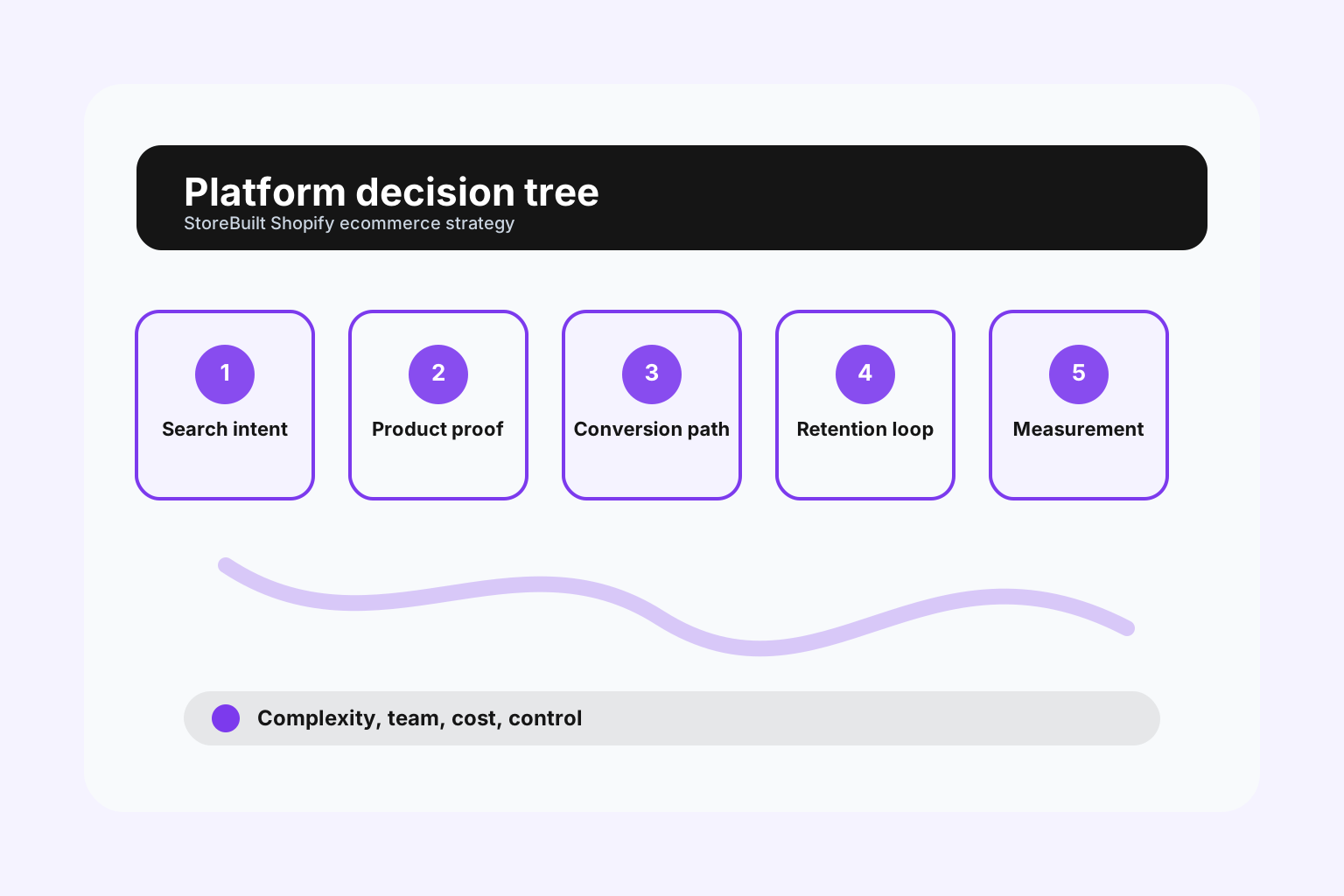
Keyword decision and research inputs
Primary keyword: Shopify competitors UK. Secondary keywords include ecommerce platforms UK, Shopify alternatives, Shopify vs BigCommerce UK, Shopify vs WooCommerce UK, and enterprise ecommerce platform comparison. Intent is commercial research: the buyer wants to know whether Shopify is the right default or whether another platform fits better. Funnel stage is middle funnel. The correct page type is a decision framework.
Charle has recently targeted Shopify competitor and platform-comparison content. Other UK ecommerce agencies also use platform comparisons to capture buyers before they write an agency brief. StoreBuilt’s gap is to make the comparison operational: what team, catalogue, integration, and governance model should push a brand away from Shopify or back toward it.
This post supports StoreBuilt’s Shopify migrations and replatforming and Shopify store design and development services without pretending Shopify is right for every brand.
Start with operating fit
Platform choice fails when teams compare feature lists before they compare operating reality. A platform can be powerful and still be wrong for the team that has to run it. For UK ecommerce brands, the practical questions are usually:
- How quickly does the trading team need to launch campaigns?
- How complex are products, prices, bundles, and fulfilment rules?
- How much internal engineering capacity exists?
- Is the business DTC, B2B, marketplace-led, subscription-led, or omnichannel?
- How much governance can the team maintain after launch?
Shopify tends to win when speed, maintainability, checkout reliability, and ecosystem depth matter more than bespoke platform control. Competitors can win when the business has unusual catalogue logic, heavy content-first requirements, deep enterprise governance, or a strong reason to own more infrastructure.
The decision tree
| If your priority is… | Shopify default? | Competitor to evaluate | Why |
|---|---|---|---|
| Fast DTC launch and iteration | Yes | BigCommerce as a secondary check | Shopify’s ecosystem and theme workflow are usually stronger for lean teams |
| WordPress-first content ownership | Maybe | WooCommerce | Content governance may matter more than commerce speed |
| Heavy enterprise governance | Maybe | Salesforce Commerce Cloud or Adobe Commerce | Larger programmes may need deeper control and process |
| Low-cost starter website | Maybe | Wix or Squarespace | Simplicity can beat platform depth at the earliest stage |
| Complex B2B catalogue | Yes, with checks | BigCommerce, Adobe Commerce, custom stack | Pricing, accounts, and ERP rules decide the answer |
| International DTC expansion | Usually yes | Centra, Adobe Commerce, composable options | Market complexity and team maturity decide |
The decision tree is not anti-Shopify. It is anti-mismatch.
Where Shopify competitors genuinely win
WooCommerce can be sensible when a business is deeply WordPress-led, has strong developer ownership, and treats content architecture as the primary system. BigCommerce can be worth evaluating for some B2B or catalogue-heavy cases. Adobe Commerce can fit complex enterprise environments with engineering maturity. Salesforce Commerce Cloud can make sense where Salesforce alignment is already strategic. Wix and Squarespace can suit very small teams that need a simple shop before a growth platform.
The danger is choosing a competitor because a feature list looks richer, then discovering that every change needs more people, more process, and more budget than the business expected.
StoreBuilt example
A UK retailer considering a replatform wanted to compare Shopify with a heavier enterprise platform. The brief included international growth, B2B trade accounts, and a cleaner content model. On paper, the enterprise option looked safer. In discovery, the limiting factor was not platform capability. It was the team’s ability to ship changes every week with limited internal engineering support.
The recommendation was to keep the architecture lighter, strengthen governance, and avoid buying complexity before the organisation could operate it. That kind of decision is less glamorous than a feature matrix, but it protects the trading team after launch.
Questions to ask before choosing
Before choosing Shopify or a competitor, ask questions that expose operating fit rather than vendor preference. Who will own theme changes after launch? How often does the team need to change merchandising, navigation, landing pages, and promotions? Which integrations are genuinely business-critical? What happens during peak trading if a checkout, payment, stock, or fulfilment issue appears?
Also ask what should stay boring. Checkout reliability, product data governance, redirects, analytics, and app permissions do not need creative reinvention. They need disciplined ownership. A platform that makes those basics easier for the current team may be more valuable than a platform with a broader theoretical ceiling.
A good decision workshop should produce a short list of tradeoffs, not a single sales answer. If Shopify wins, the team should know which constraints still need governance. If another platform wins, the team should know what extra cost, delivery capacity, and maintenance overhead they are accepting.
Migration risk if you switch
Changing platforms creates risk even when the new platform is better. SEO redirects, collection architecture, product data, customer records, order history, subscriptions, reviews, analytics, payment settings, fulfilment rules, and content templates all need careful handling.
This is why StoreBuilt treats platform selection and migration planning as connected decisions. The right platform on paper can still become a poor project if the migration plan is vague. The platform decision should include a realistic go-live route, not just a preferred destination.
High-intent AI search implementation layer
The AI-search version of this topic is not just “write more content”. A useful answer engine result needs a page that gives a direct answer, proves the claim, and shows the next operational step inside Shopify.
| Area | StoreBuilt implementation check |
|---|---|
| Primary intent | The page should map to Shopify competitors and one clear buyer or operator problem, not a vague traffic topic. |
| Shopify surface | Identify whether the work belongs on a collection, product page, theme section, checkout step, app workflow, email flow, or support process. |
| Proof | Add first-hand observations, product/category examples, screenshots, policy notes, review signals, or trustworthy external sources where they make the advice safer. |
| Internal route | Link the reader to the service most likely to solve the issue: Shopify migrations and replatforming. |
| Measurement | Check Search Console, analytics, assisted conversions, enquiry quality, and AI-response mentions after the update rather than judging success by pageviews alone. |
For this article, the useful research inputs are: StoreBuilt Shopify audits, UK ecommerce SERP intent, Shopify platform documentation, and AI-search measurement patterns. StoreBuilt would prioritise redirects, data migration, template parity, analytics continuity, launch QA, and post-launch monitoring before expanding into broader supporting content.
If this topic maps to a live store problem, review the related StoreBuilt service or Contact StoreBuilt with the store URL and the issue you want fixed.
Final StoreBuilt point of view
The best ecommerce platform is the one your team can operate without slowing growth. Shopify is often the right UK mid-market default, but not because it has every possible feature. It is right when it gives the business enough capability with less operational drag.
For a structured platform decision workshop, Contact StoreBuilt.