
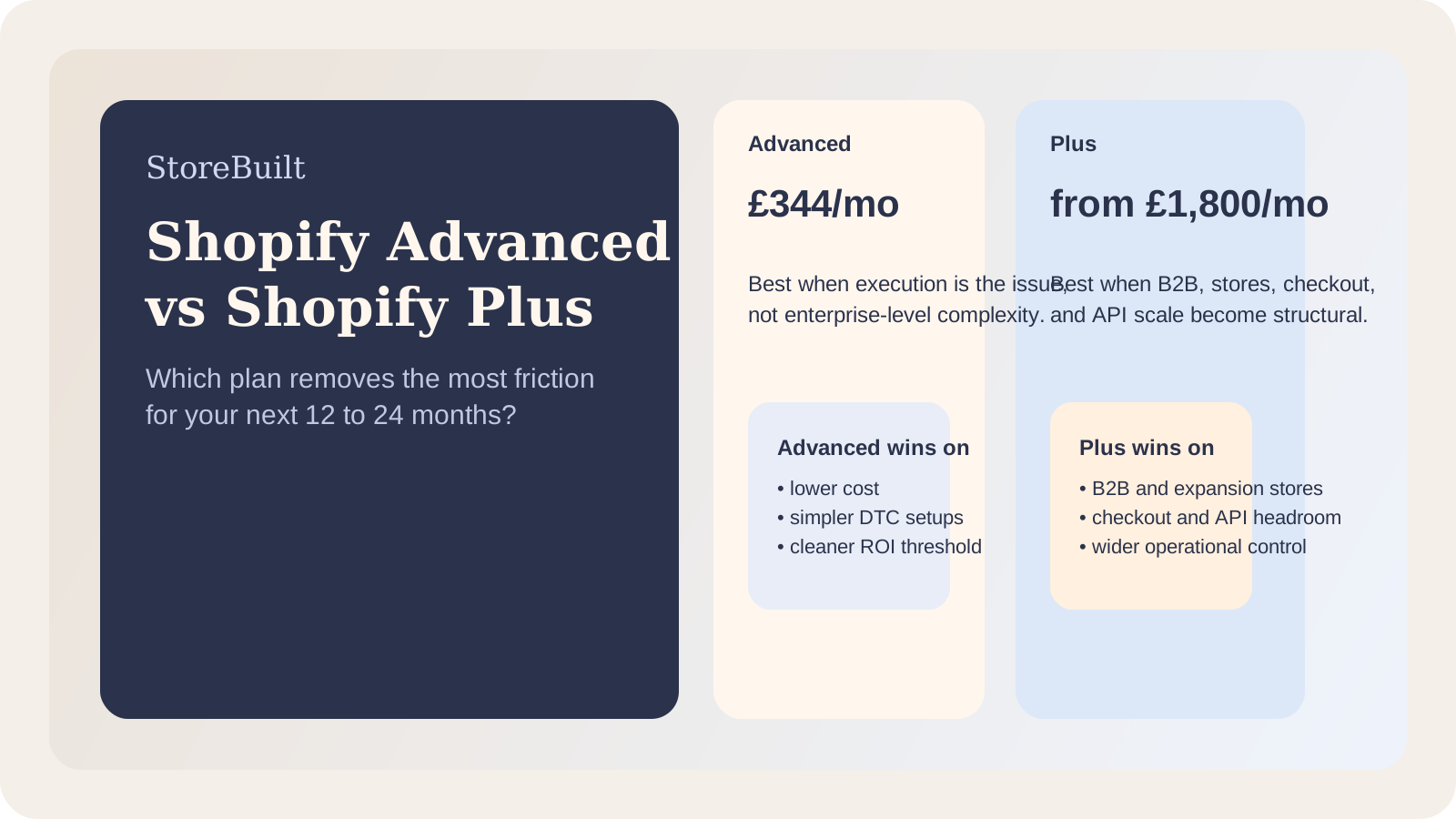
What we have seen in plan-selection work is this: the wrong comparison is feature count. The right comparison is which plan removes the most operational friction for the next 12 to 24 months.
If you want a neutral view on whether Advanced or Plus fits your next stage, Contact StoreBuilt.
Table of contents
- Keyword decision and research inputs
- Quick answer: Advanced vs Plus
- Current pricing context in the UK
- Feature differences that actually matter
- When Advanced is enough
- When Plus is justified
- Decision table for UK ecommerce teams
- StoreBuilt example
- Final StoreBuilt point of view
Keyword decision and research inputs
Primary keyword: shopify advanced vs shopify plus
Secondary keywords:
- Shopify Plus vs Advanced UK
- Shopify plan comparison UK
- Shopify Plus worth it UK
- ecommerce UK market Shopify plans
- Shopify checkout and B2B comparison
Search intent: evaluative and highly commercial.
Funnel stage: middle to bottom.
Page type: comparison guide with recommendation logic.
Why StoreBuilt can realistically win this topic:
- The query is tightly aligned with migration and support leads.
- Official pricing pages do not explain operational fit clearly enough for most buyers.
- StoreBuilt can tie feature differences directly to delivery, team design, and commercial risk.
Research inputs used:
- Current SERP review around
Shopify Advanced vs Shopify Plus,Shopify Plus worth it, and related plan-selection modifiers. - Official Shopify UK pricing and Shopify Help pages reviewed on June 5, 2026.
- UK competitor content patterns around plan decisions, migration scoping, and platform strategy.
Quick answer: Advanced vs Plus
For many UK ecommerce brands, Shopify Advanced is enough until operational complexity starts outrunning the store setup.
Shopify Plus becomes more compelling when the business needs:
- more complex B2B structure
- heavier international store governance
- deeper checkout control
- higher API capacity
- expansion-store logic
- stronger organisational control across teams and storefronts
The mistake is upgrading for status before the operating case is real.
Current pricing context in the UK
On Shopify’s UK pricing page reviewed on June 5, 2026, the monthly listed UK pricing showed:
- Advanced at £344 GBP per month
- Plus starting at £1,800 GBP per month on a 3-year term
That gap is material, so the plan decision needs to be tied to measurable business value.
It is also worth noting that Shopify’s Plus pricing page separately presents pricing from $2,300 USD per month on a 3-year term or $2,500 USD per month on a 1-year term, depending on structure and region.
The exact figure matters less than the decision rule: what new capability or lower friction are you buying?
Feature differences that actually matter
Many plan comparison tables overload buyers with everything. These are the differences that usually matter most in real UK projects.
| Area | Advanced | Plus | Why buyers care |
|---|---|---|---|
| Subscription cost | Much lower | Much higher | Changes the ROI threshold |
| Checkout flexibility | Strong, but more limited | More powerful customisation pathways | Matters for larger optimisation programmes |
| B2B capability | More limited | Much deeper native B2B potential | Important for wholesale and hybrid models |
| API scale | Strong for many teams | Higher limits and more complex build headroom | Matters for system-heavy operations |
| Expansion stores | No equivalent Plus-style package | Included expansion-store logic | Useful for multi-market and multi-structure brands |
| Support posture | Standard higher-tier support | Priority support and enterprise-style context | Helps complex operating environments |
The practical takeaway is simple: Advanced is often sufficient for brands that are growing cleanly. Plus matters when the business model itself is becoming structurally more demanding.
When Advanced is enough
Advanced is usually the better decision when:
- the brand runs mostly DTC from one core storefront
- the current friction is UX, merchandising, or content workflow rather than platform limits
- international selling is present but not structurally complex
- B2B is light or still early
- the roadmap does not require heavy checkout or system architecture changes
Some teams move to Plus too early because their current implementation is messy. That is often the wrong remedy.
If the root issue is app sprawl, weak theme architecture, or poor support discipline, those issues can travel with you into Plus.
When Plus is justified
Plus gets easier to justify when one or more of these are true:
- B2B is now a serious revenue stream
- international operations need cleaner market and storefront control
- the brand needs expansion stores
- complex integrations are straining current limits
- checkout performance and customisation are tied to serious revenue upside
- organisational governance across multiple storefronts is becoming harder
This is where plan choice becomes an operating-model decision, not a line-item upgrade.
If your current growth constraints look more structural than cosmetic, StoreBuilt can help scope the right Shopify architecture.
Decision table for UK ecommerce teams
| Situation | Better fit |
|---|---|
| Single-brand DTC store with solid growth and manageable complexity | Advanced |
| Multi-market structure with growing operational overhead | Depends, often Plus |
| B2B and DTC in one environment with serious wholesale needs | Often Plus |
| Store needs better UX and cleaner theme execution, but not enterprise structure | Often Advanced plus better implementation |
| Team wants stronger governance across multiple stores and regions | Often Plus |
That table is intentionally blunt because the wrong plan decisions usually happen when teams overcomplicate the question.
Cost logic beyond plan pricing
The subscription delta is only worth paying if it improves one or more of these:
- release speed
- supportability
- margin through lower workaround/tool cost
- team efficiency
- conversion capability
- international or B2B scalability
If the answer is vague, stay cautious.
StoreBuilt example
One brand entered discovery assuming Plus was the obvious next step because revenue had grown quickly. After mapping the roadmap, the stronger answer was actually Advanced with a better support model and cleaner storefront governance.
The immediate blockers were not enterprise platform limits. They were merchandising friction, release discipline, and theme flexibility. Fixing those first avoided an unnecessary subscription jump and bought time to reassess Plus later against a clearer B2B roadmap.
That sequence was commercially safer and easier to defend.
High-intent AI search implementation layer
The AI-search version of this topic is not just “write more content”. A useful answer engine result needs a page that gives a direct answer, proves the claim, and shows the next operational step inside Shopify.
| Area | StoreBuilt implementation check |
|---|---|
| Primary intent | The page should map to shopify advanced and one clear buyer or operator problem, not a vague traffic topic. |
| Shopify surface | Identify whether the work belongs on a collection, product page, theme section, checkout step, app workflow, email flow, or support process. |
| Proof | Add first-hand observations, product/category examples, screenshots, policy notes, review signals, or trustworthy external sources where they make the advice safer. |
| Internal route | Link the reader to the service most likely to solve the issue: Shopify Plus and B2B. |
| Measurement | Check Search Console, analytics, assisted conversions, enquiry quality, and AI-response mentions after the update rather than judging success by pageviews alone. |
For this article, the useful research inputs are: StoreBuilt Shopify audits, UK ecommerce SERP intent, Shopify platform documentation, and AI-search measurement patterns. StoreBuilt would prioritise company accounts, price lists, catalogues, net terms, wholesale UX, and B2B operating controls before expanding into broader supporting content.
If this topic maps to a live store problem, review the related StoreBuilt service or Contact StoreBuilt with the store URL and the issue you want fixed.
Final StoreBuilt point of view
Advanced vs Plus is not a prestige decision. It is a constraint-removal decision. For UK ecommerce brands, Plus is worth paying for when complexity is genuinely structural. If the pain is still mostly executional, a better implementation on Advanced often creates more value first.