
What we have seen in platform selection projects is this: brands rarely regret choosing the platform that helps their team execute consistently. They regret choosing the platform that sounded powerful but became slower, harder, or more expensive to operate.
That is why the question is not simply why choose Shopify. The real question is why choose Shopify for your specific team model in the UK market.
If your business is still deciding between platform options or planning a move, Contact StoreBuilt.
Table of contents
- Keyword decision and research inputs
- Why UK ecommerce brands choose Shopify
- When Shopify is the wrong answer
- Shopify decision table for ecommerce teams
- What competitor content often misses
- StoreBuilt example
- 90-day platform evaluation plan
- Final StoreBuilt point of view
Keyword decision and research inputs
Primary keyword: why choose Shopify
Secondary keywords:
- Shopify for ecommerce
- best ecommerce platform UK
- Shopify for UK brands
- why use Shopify
- ecommerce platform comparison UK
Search intent: educational and commercial comparison intent.
Funnel stage: middle funnel moving toward decision.
Page type: long-form platform rationale guide.
Why StoreBuilt can realistically win this topic:
- We can explain Shopify from the perspective of speed, governance, and commercial execution rather than generic feature marketing.
- UK competitor content often lists benefits without enough emphasis on team fit.
- StoreBuilt can connect Shopify’s strengths to migration, CRO, SEO, and operating-model consequences.
Research inputs used in angle selection:
- Current SERP review for
why choose Shopify, Shopify platform comparisons, and UK ecommerce platform queries. - Charle’s article patterns around broad Shopify explainers and adjacent UK agency content.
- Official Shopify positioning and public ecommerce-platform discussion.
Why UK ecommerce brands choose Shopify
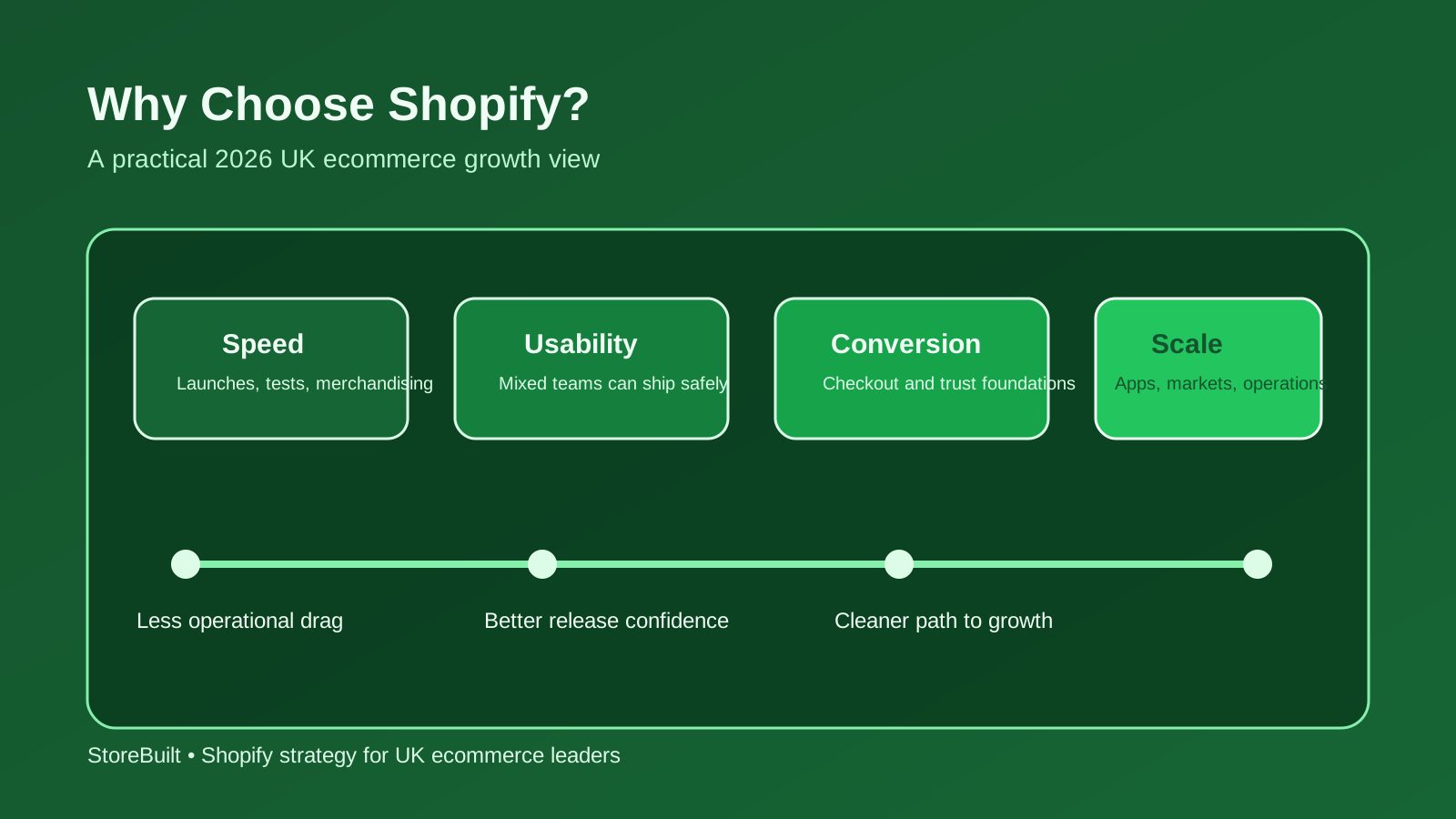
In practice, most UK ecommerce brands choose Shopify for one of four reasons:
- faster commercial execution
- better usability across mixed teams
- stronger checkout and conversion foundations
- a cleaner path to scaling without owning unnecessary infrastructure complexity
These reasons matter because platform choice is rarely won by abstract capability. It is won by how easily the business can ship profitable improvements.
1. Shopify helps mixed teams move faster
Many brands do not have a large internal engineering team. They have ecommerce managers, marketers, merchandisers, external partners, and a leadership team that wants changes to go live without constant dependency bottlenecks.
Shopify is strong when the business needs:
- campaign speed
- merchant-friendly merchandising workflows
- simpler app and partner ecosystem coordination
- a stable core for everyday trading
This matters more in fast-moving UK ecommerce environments where promotions, launches, and content shifts happen constantly.
2. Checkout and trust foundations are already strong
Brands often underestimate how much platform choice is really checkout choice.
If the store depends on:
- strong mobile buying
- wallet-led speed
- dependable payment presentation
- clear delivery communication
then Shopify’s checkout model is a meaningful advantage for many merchants. That does not guarantee high conversion, but it creates a strong base.
3. Shopify usually reduces operational drag
Operational drag shows up as:
- delayed launches
- brittle release cycles
- plugin conflict anxiety
- extra QA burden
- support load after platform changes
For many UK brands, Shopify wins because it keeps more of that complexity inside a simpler operating environment.
4. The ecosystem is commercially useful
The strongest Shopify advantage is not that there are many apps or agencies. It is that the ecosystem makes it easier to assemble a practical solution quickly when the business model is not unusually custom.
That is especially helpful for brands scaling through:
- retention
- merchandising
- CRO
- subscriptions
- B2B extensions
- international rollout
When Shopify is the wrong answer
This is the part broad explainer content often avoids.
Shopify is not automatically right for every ecommerce business.
It can be the wrong answer when:
- the business needs highly unusual architecture and has the capability to operate it
- in-house engineering wants deeper control for clearly justified reasons
- marketplace, quoting, or operational complexity exceeds the value of a platform-native approach
- leadership expects Shopify alone to solve weak product, poor positioning, or low-demand problems
| Condition | Shopify fit | Why |
|---|---|---|
| growth-stage DTC or retail brand | strong | speed and usability matter most |
| operationally lean team | strong | simpler ownership model helps |
| highly custom enterprise architecture | depends | justification must be explicit |
| weak internal discipline | mixed | Shopify helps, but it does not replace governance |
| business with unclear product-market fit | low relevance | platform alone will not fix demand |
The wrong platform decision usually happens when teams buy for imagined future complexity instead of present commercial need.
Shopify decision table for ecommerce teams
Use a team-fit lens before comparing feature lists.
| Decision area | Why teams choose Shopify | What to validate first |
|---|---|---|
| Speed to market | faster campaign and merchandising execution | can the business actually use that speed well? |
| Merchant usability | non-technical users can work with more confidence | does the team need deeper custom control instead? |
| Checkout performance | strong buying foundations and trusted flow | are delivery, payment, and trust signals already clear? |
| Ecosystem access | broad app and agency support | can the stack stay governed and not become bloated? |
| Scaling path | easier growth across retention, content, and operational tooling | is the roadmap realistic for Shopify-native delivery? |
This is why StoreBuilt often frames platform choice as an operating-model decision first and a technical decision second.
What competitor content often misses
One useful competitor signal from UK agency publishing is that many articles answer “why Shopify” with a familiar list:
- easy to use
- scalable
- secure
- app-rich
- popular
Those points are broadly true, but they are too generic to help a serious ecommerce team decide.
What matters more is:
- whether Shopify reduces execution drag for your actual team
- whether the core customer journey can stay clear as the business grows
- whether the app and partner model can be governed well
- whether a move to Shopify improves release confidence, not just platform aesthetics
That is the missing layer. Platform value is operational, not just descriptive.
If your brand is evaluating a replatform or rescue from a more fragile setup, StoreBuilt Shopify migrations and replatforming is the most relevant next step.
StoreBuilt example
One UK ecommerce brand came into platform review assuming it needed a more “powerful” stack to support growth. Their current setup could technically trade, but the team felt slow, campaign launches were harder than they should have been, and small changes produced too much QA overhead.
The review showed the opportunity more clearly: the business did not need more architectural power. It needed more execution reliability. Shopify became attractive not because it solved every problem automatically, but because it reduced the friction around everyday progress.
That is often the real reason businesses choose Shopify. They want a platform that helps the team do better work more often.
90-day platform evaluation plan
If the business is still unsure, do not decide on brand perception alone.
| Timeline | Focus | Output |
|---|---|---|
| Weeks 1-2 | map team pain, release blockers, and current platform debt | platform problem statement |
| Weeks 3-5 | compare Shopify against realistic alternatives by team fit | weighted decision model |
| Weeks 6-9 | assess migration, SEO, app, and support implications | implementation risk view |
| Weeks 10-13 | choose route and define success criteria | business case and delivery scope |
Questions leadership should ask:
- What is slowing us down today?
- Which problems are platform problems versus governance problems?
- Will Shopify improve campaign speed and release confidence?
- What would we still need to fix after moving?
- Do we need a better platform, or a better operating model on the current one?
If those questions stay vague, the platform choice is still too emotional.
For a commercially grounded review tied to live-store priorities, use the StoreBuilt free Shopify audit.
High-intent AI search implementation layer
The AI-search version of this topic is not just “write more content”. A useful answer engine result needs a page that gives a direct answer, proves the claim, and shows the next operational step inside Shopify.
| Area | StoreBuilt implementation check |
|---|---|
| Primary intent | The page should map to why choose shopify and one clear buyer or operator problem, not a vague traffic topic. |
| Shopify surface | Identify whether the work belongs on a collection, product page, theme section, checkout step, app workflow, email flow, or support process. |
| Proof | Add first-hand observations, product/category examples, screenshots, policy notes, review signals, or trustworthy external sources where they make the advice safer. |
| Internal route | Link the reader to the service most likely to solve the issue: Shopify support, maintenance and audits. |
| Measurement | Check Search Console, analytics, assisted conversions, enquiry quality, and AI-response mentions after the update rather than judging success by pageviews alone. |
For this article, the useful research inputs are: StoreBuilt Shopify audits, UK ecommerce SERP intent, Shopify platform documentation, and AI-search measurement patterns. StoreBuilt would prioritise technical audits, roadmap priority, theme changes, app governance, reporting, and measured improvement before expanding into broader supporting content.
If this topic maps to a live store problem, review the related StoreBuilt service or Contact StoreBuilt with the store URL and the issue you want fixed.
Final StoreBuilt point of view
UK ecommerce brands should choose Shopify when they need a platform that helps the business ship, test, merchandise, and scale with less operational drag.
That is its real strength. Shopify is not magic, and it is not correct for every architecture. But for many brands, it is the platform that turns good commercial intent into consistent execution. That usually matters more than having the most theoretically flexible stack.