
What we have seen in enterprise platform conversations is this: teams often treat Shopify Commerce Components as a prestige signal before they have proved it is a commercial fit.
That is risky. Commerce Components can make sense, but only when the business already knows why platform-native Shopify is no longer enough.
If your team is weighing enterprise architecture options and wants a practical decision lens, Contact StoreBuilt.
Table of contents
- Keyword decision and research inputs
- What Shopify Commerce Components actually is
- Who it tends to fit in the UK market
- When native Shopify is still the better answer
- Commerce Components decision table
- StoreBuilt example
- 90-day evaluation plan
- Final StoreBuilt point of view
Keyword decision and research inputs
Primary keyword: shopify commerce components
Secondary keywords:
- Shopify enterprise UK
- composable Shopify
- enterprise ecommerce platform UK
- Shopify for large retailers
- Commerce Components Shopify guide
Search intent: commercial research with architecture evaluation intent.
Funnel stage: middle to bottom.
Page type: long-form enterprise decision guide.
Why StoreBuilt can realistically win this topic:
- We can translate architectural language into delivery and governance consequences for real ecommerce teams.
- UK agency content often explains the concept, but not the timing risk.
- StoreBuilt can connect Shopify architecture choices to launch velocity, support cost, and release confidence.
Research inputs used in angle selection:
- Current SERP intent around
shopify commerce components, enterprise Shopify, and composable commerce comparisons. - Charle’s 2026 article library and other UK Shopify agency content patterns that lean toward broad guides and platform explainers.
- Official Shopify product positioning and public ecommerce architecture discussions around composable delivery.
What Shopify Commerce Components actually is
The simplest explanation is this: Commerce Components is Shopify positioned for businesses that want to assemble a more tailored commerce stack rather than run everything through a standard storefront approach.
That matters because the conversation changes immediately.
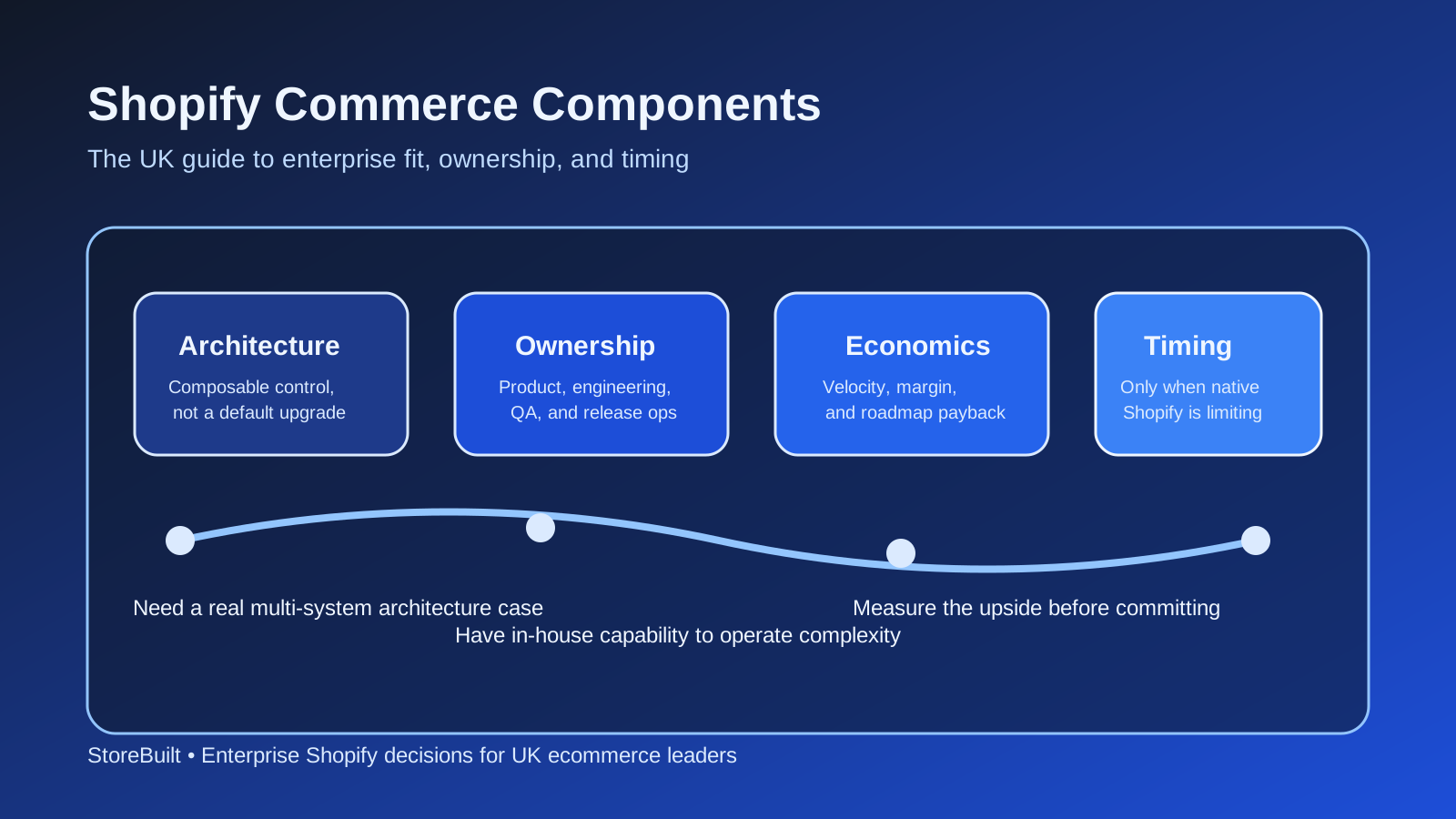
Instead of asking, “Can Shopify handle our brand?” the question becomes, “Do we have a strong enough product, engineering, QA, and operations model to run a more composable Shopify implementation safely?”
In practice, UK ecommerce teams usually evaluate Commerce Components when they have one or more of these conditions:
- multiple systems already own critical parts of the customer journey
- complex merchandising or experience requirements are pushing against standard patterns
- internal engineering maturity is high enough to support custom architecture
- leadership wants more control over speed, integration design, or channel orchestration
The mistake is assuming those conditions are aspirational rather than real. Commerce Components is not a reward for growth. It is an operating model choice.
Who it tends to fit in the UK market
It tends to fit teams that already behave like product-led ecommerce operators.
That usually means:
- in-house engineering leadership exists
- release ownership is explicit
- QA is systematic rather than informal
- analytics and experimentation are mature enough to justify custom capability
- finance, operations, and support can absorb more system complexity
In the UK market, that often points to larger retailers, established DTC groups, or multi-brand businesses with meaningful integration depth.
It is less about revenue headline and more about organisational readiness.
| Fit signal | Why it matters |
|---|---|
| Internal product and engineering capability | custom architecture only helps if it can be operated well |
| Real integration complexity | the stack must solve a proven system problem |
| Clear roadmap value | custom build cost needs a measurable payoff |
| Strong release discipline | more moving parts increase regression risk |
| Cross-functional ownership | ecommerce, ops, support, and finance all feel the platform choice |
If your current problem is slow merchandising, theme debt, weak app governance, or unclear SEO architecture, Commerce Components may be an overreaction rather than a solution.
When native Shopify is still the better answer
For many UK ecommerce brands, the better move is a stronger Shopify operating model, not a more complex one.
Native or theme-led Shopify is often still the right answer when:
- the team needs faster campaign execution more than bespoke architecture
- in-house engineering resource is limited
- the biggest blockers are app sprawl, weak QA, or poor storefront structure
- SEO and CRO fundamentals remain inconsistent
- launch reliability matters more than architectural flexibility
This is where competitor content can become misleading. “Enterprise” language sounds strategic, but it can push businesses toward complexity before they have fixed simpler commercial issues.
If your store still needs tighter SEO, app governance, or migration planning, StoreBuilt Shopify SEO and AI search readiness or Shopify migration support is usually a better next step than jumping straight into composable architecture.
Commerce Components decision table
Use a capability-led model instead of a feature-led one.
| Decision area | Strong case for Commerce Components | Strong case for native Shopify |
|---|---|---|
| Experience control | highly specific journeys with real business value | standard Shopify patterns can support the roadmap |
| System architecture | multiple services already own key commerce logic | most complexity still sits in the storefront and apps |
| Team capability | in-house product and engineering ownership is strong | merchant and agency-led execution is the realistic model |
| Release risk | business can manage custom deployment and QA | stability and speed are more important than flexibility |
| Economics | custom capability has measurable payoff | cost and speed need tighter control first |
The most useful enterprise question is not “Can we do this?” It is “What will this architecture let us do profitably every month that we cannot do safely today?”
If the answer is vague, the business case is not ready.
StoreBuilt example
One ecommerce team approached architecture planning convinced that a more composable Shopify model would solve slow delivery and experimentation frustration. On review, the bigger issues were weaker than expected: unclear ownership between ecommerce and engineering, inconsistent campaign QA, and a backlog shaped more by internal debate than real platform limits.
What changed the outcome was not a technical rejection. It was a reframed sequence.
The team first tightened release governance, reduced app overlap, clarified who owned merchandising requests, and improved roadmap prioritisation. Once those issues were addressed, they could see more clearly which custom capabilities were still justified and which had only felt urgent because the operating model was messy.
That pattern is common. Mature architecture decisions become easier after simpler execution problems stop distorting them.
90-day evaluation plan
If Commerce Components is genuinely under consideration, do not start with implementation. Start with an evidence pass.
| Timeline | Focus | Output |
|---|---|---|
| Weeks 1-2 | map current systems, owners, and recurring blockers | architecture problem statement |
| Weeks 3-5 | identify which constraints are truly platform-native versus operational | validated decision criteria |
| Weeks 6-9 | model the delivery, QA, and support burden of custom architecture | realistic ownership model |
| Weeks 10-13 | compare native Shopify uplift versus custom-stack upside | business case with sequencing |
Questions leadership should be able to answer before approving a move:
- What specific capability is missing today?
- How often does that limitation hurt revenue or execution speed?
- Who owns the custom stack after launch?
- How will SEO, CRO, support, and analytics be protected during delivery?
- What is the cheaper alternative if the main issue is still operational discipline?
If those answers are not written down, the architecture decision is still too early.
For a practical review tied to live-store execution rather than abstract enterprise language, use the StoreBuilt free Shopify audit.
High-intent AI search implementation layer
The AI-search version of this topic is not just “write more content”. A useful answer engine result needs a page that gives a direct answer, proves the claim, and shows the next operational step inside Shopify.
| Area | StoreBuilt implementation check |
|---|---|
| Primary intent | The page should map to shopify commerce components and one clear buyer or operator problem, not a vague traffic topic. |
| Shopify surface | Identify whether the work belongs on a collection, product page, theme section, checkout step, app workflow, email flow, or support process. |
| Proof | Add first-hand observations, product/category examples, screenshots, policy notes, review signals, or trustworthy external sources where they make the advice safer. |
| Internal route | Link the reader to the service most likely to solve the issue: Apps, integrations and automation. |
| Measurement | Check Search Console, analytics, assisted conversions, enquiry quality, and AI-response mentions after the update rather than judging success by pageviews alone. |
For this article, the useful research inputs are: UK ecommerce platform SERPs, StoreBuilt platform-selection reviews, Shopify operating constraints, and cost/risk signals. StoreBuilt would prioritise app stack decisions, integration logic, automation, data flow QA, and operational reliability before expanding into broader supporting content.
If this topic maps to a live store problem, review the related StoreBuilt service or Contact StoreBuilt with the store URL and the issue you want fixed.
Final StoreBuilt point of view
Shopify Commerce Components is not the “serious brand” version of Shopify. It is a more demanding operating model for businesses that can already prove why extra architectural control is worth the cost.
For many UK ecommerce teams, better native Shopify execution will create more commercial value than premature composable ambition. The right time to go further is when platform-native Shopify is genuinely the bottleneck, not when enterprise architecture simply sounds more impressive.