
What we have seen in live Shopify partner selections is this: the local versus remote question is rarely about geography alone. It is usually about how much strategy access, delivery rhythm, and commercial accountability the brand actually needs.
If you want StoreBuilt to review your shortlist before you sign, Contact StoreBuilt.
Table of contents
- Keyword decision and research inputs
- What UK competitor signals say right now
- Local versus remote: what actually changes
- Decision table for ecommerce teams
- Questions to ask before you commit
- StoreBuilt client example
- Final StoreBuilt point of view
Keyword decision and research inputs
Primary keyword: local Shopify partner vs remote UK partner
Secondary keywords:
- Shopify partner selection
- ecommerce uk market
- ecommerce agency london
- remote Shopify partner UK
- shopify partner for ecommerce brands
Search intent: commercial investigation from UK ecommerce teams comparing partner options before a redesign, migration, or growth retainer.
Funnel stage: bottom of funnel.
Why StoreBuilt can realistically win this topic:
- We are London-based and regularly help brands compare local access with remote delivery models.
- We see where buyers overpay for proximity that they do not use, and where they underinvest in access they actually need.
- We can tie agency choice back to Shopify governance, sprint speed, and post-launch stability.
Research inputs used on June 3, 2026:
- Current SERP review for local Shopify partner, remote Shopify partner UK, partner selection, and related commercial modifiers.
- Public positioning and content review across Charle, Swanky, Eastside Co, Superco, and We Make Websites.
- Shopify Partner Directory visibility checks to confirm which agencies still present strong Shopify-specialist signals in the UK market.
What UK competitor signals say right now
The strongest UK Shopify agencies are not selling location first. They are selling outcomes, sector fit, and operating confidence.
Charle’s article model is useful here because it tends to package commercial guidance in plain language rather than vague agency branding. Other competitor signals are similar: Swanky emphasises Shopify depth and sector breadth, Eastside Co still carries long-running brand recognition in the UK ecommerce space, Superco positions around scale and speed, and We Make Websites continues to show enterprise Shopify credibility. Those signals matter, but they do not answer the question your team actually needs to solve: will this partner be easy to run every week?
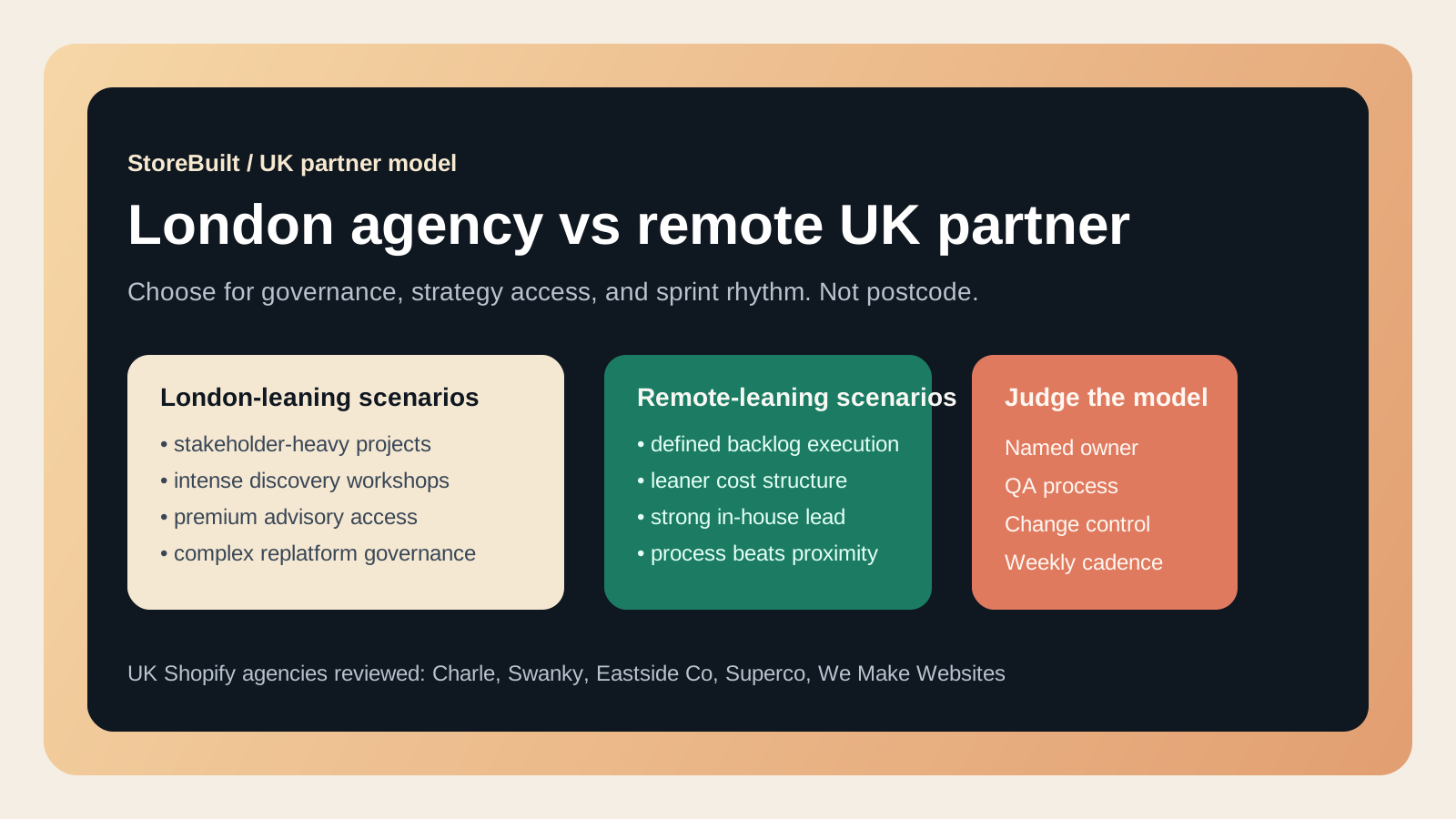
That is where location becomes relevant. London-based access can matter when your project has one or more of these traits:
- multiple senior stakeholders who need alignment quickly
- a politically sensitive replatform where decisions stall easily
- an in-house team that wants regular working sessions, not just ticket delivery
- a premium or complex brand where merch, UX, and technical decisions are tightly connected
If none of those apply, a remote UK partner may perform just as well or better if their process discipline is stronger.
Local versus remote: what actually changes
The wrong way to evaluate this is to ask whether face-to-face meetings are nice. The right way is to ask what delivery problem proximity solves.
| Decision area | Local partner advantage | Remote UK partner advantage |
|---|---|---|
| Stakeholder alignment | Easier in-person workshops and board-level sessions | Often leaner decision-making and less calendar friction |
| Discovery and planning | Strong for intensive kickoff, migration, and roadmap work | Strong if workshops are already well structured online |
| Sprint collaboration | Helpful when cross-functional teams want frequent live working sessions | Often more efficient if the work is mainly backlog execution |
| Cost structure | May include a premium for senior advisory access | Can be more budget-efficient for defined scope delivery |
| Relationship model | Better when the brand wants a true embedded strategic partner | Better when the brand wants specialised execution without heavy ceremony |
For many ecommerce teams, the real differentiator is not city versus remote. It is whether the agency has a clean operating model with named owners, acceptance criteria, QA process, and clear escalation pathways.
That means a weaker local agency is still weaker than a better-run remote one.
Decision table for ecommerce teams
Use this scorecard before shortlisting by feel.
| Scenario | Better default | Why |
|---|---|---|
| Replatform with multiple integrations and senior stakeholders | London-leaning | High coordination load benefits from tighter workshop access |
| Ongoing Shopify support and CRO backlog | Either | Process quality matters more than postcode |
| Founder-led brand with limited in-house ecommerce capability | London-leaning if strategy support is needed | More advisory access can reduce expensive mistakes |
| Strong in-house ecommerce lead, clear backlog, defined priorities | Remote-leaning | Efficient execution may beat a premium advisory model |
| Hybrid DTC and wholesale complexity | Either, but only if governance is mature | Team structure and technical ownership matter more than location |
A simple test is this: if your team cannot clearly describe the weekly cadence you want from the agency, you are not ready to choose based on location.
The weekly cadence should define:
- who owns commercial priorities
- who translates those priorities into Shopify tickets
- who signs off releases
- how issues escalate during campaigns or launch windows
If an agency cannot answer those four points in plain English, location will not save the relationship.
If you need help shaping that cadence before outreach, StoreBuilt can help structure it.
Questions to ask before you commit
Most agency selection processes spend too much time on portfolio taste and not enough on operating fit. Use these questions instead:
- Who is the named senior owner after the sales process ends?
- How often do strategy and implementation meet in the same room or call?
- What does a normal weekly sprint look like?
- How do you handle QA before promotions, launches, and seasonal peaks?
- What happens if priorities change mid-sprint?
- What documentation do we receive during and after delivery?
You should also ask one uncomfortable question: “What types of clients are not a good fit for your model?” Strong agencies usually answer that clearly. Weak agencies try to sound universal.
In the ecommerce UK market, fit is often more valuable than agency size. A partner that works brilliantly for a large omnichannel retailer may be wrong for a lean founder-led Shopify brand, and the reverse is also true.
StoreBuilt client example
A London-based lifestyle brand came to us after talking to both city agencies and remote specialists. Their first instinct was to choose London because leadership wanted the reassurance of being able to “sit in a room together.”
Once we mapped the actual operating need, the picture changed. The team already had a strong ecommerce lead, clear campaign calendar, and a practical backlog. What they lacked was not workshop access. They lacked disciplined Shopify execution and better release QA.
In that case, the shortlist shifted away from geographic preference and toward delivery mechanics. The eventual structure worked because it matched the brand’s real bottleneck instead of its initial assumption.
That is the pattern we see repeatedly: geography becomes clearer once the operating model is clear.
High-intent AI search implementation layer
The AI-search version of this topic is not just “write more content”. A useful answer engine result needs a page that gives a direct answer, proves the claim, and shows the next operational step inside Shopify.
| Area | StoreBuilt implementation check |
|---|---|
| Primary intent | The page should map to shopify partner selection and one clear buyer or operator problem, not a vague traffic topic. |
| Shopify surface | Identify whether the work belongs on a collection, product page, theme section, checkout step, app workflow, email flow, or support process. |
| Proof | Add first-hand observations, product/category examples, screenshots, policy notes, review signals, or trustworthy external sources where they make the advice safer. |
| Internal route | Link the reader to the service most likely to solve the issue: Shopify migrations and replatforming. |
| Measurement | Check Search Console, analytics, assisted conversions, enquiry quality, and AI-response mentions after the update rather than judging success by pageviews alone. |
For this article, the useful research inputs are: UK ecommerce platform SERPs, StoreBuilt platform-selection reviews, Shopify operating constraints, and cost/risk signals. StoreBuilt would prioritise platform selection, roadmap planning, migration risk, TCO, operating model, and implementation sequencing before expanding into broader supporting content.
If this topic maps to a live store problem, review the related StoreBuilt service or Contact StoreBuilt with the store URL and the issue you want fixed.
Final StoreBuilt point of view
For UK ecommerce brands, the best agency choice is rarely “local is better” or “remote is cheaper.” The better question is whether the agency model matches your current stage, your internal team, and your level of Shopify complexity.
If senior stakeholder alignment, strategy workshops, and commercial translation are your biggest risks, a local senior Shopify partner can be worth the premium. If the work is already well defined and the main need is dependable execution, a remote UK partner may be the smarter buy. What matters most is not where the agency sits. It is whether they can run your ecommerce delivery system without waste, confusion, or preventable release risk.