
What we have seen in Shopify campaign reviews is this: paid traffic often fails because the landing page system is weaker than the media buying. The ads may be well targeted, the creative may be strong, and the offer may be commercially sensible. Then the click lands on a generic collection page, crowded homepage, or one-off page that the team cannot update quickly.
Charle’s article hub shows strong attention to ecommerce marketing, CRO, Shopify growth, and paid-media-adjacent topics. StoreBuilt’s practical angle is that UK Shopify brands need landing page systems, not isolated landing pages.
If your paid campaigns depend on last-minute page builds or generic collection pages, Contact StoreBuilt.
Table of contents
- Keyword decision and research inputs
- Why landing page systems beat one-off campaign pages
- The modules every Shopify landing page system needs
- SEO boundaries for paid pages
- Landing page QA table
- An anonymous StoreBuilt example
- StoreBuilt point of view
Keyword decision and research inputs
| Decision | Direction |
|---|---|
| Primary keyword | ecommerce paid landing pages |
| Secondary keywords | Shopify landing pages, ecommerce UK market, Shopify CRO, paid social landing pages, ecommerce campaign pages |
| Search intent | Build better Shopify landing pages for paid campaigns and ecommerce conversion |
| Funnel stage | Bottom |
| Page type | Shopify CRO and campaign implementation guide |
| Why StoreBuilt can win | StoreBuilt connects Shopify theme sections, campaign execution, CRO, analytics, SEO boundaries, and post-launch support |
Research inputs included current ecommerce landing page SERP intent, Charle’s ecommerce marketing and CRO article topics, Shopify storefront implementation patterns, and StoreBuilt’s duplicate-risk pass against seasonal landing pages, Shopify landing pages for paid traffic, merchandising calendars, CRO roadmaps, and theme architecture articles.
Why landing page systems beat one-off campaign pages
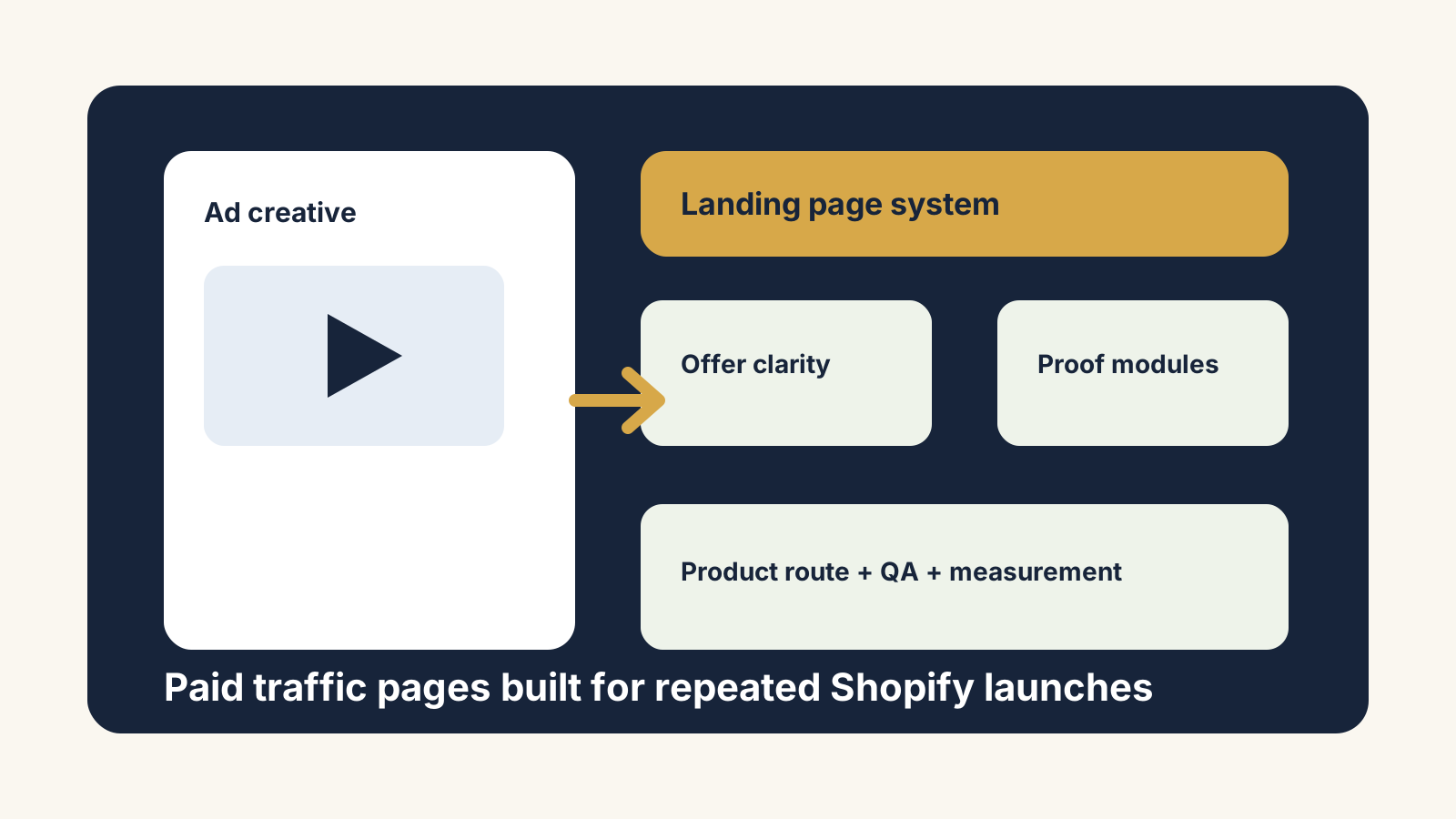
A landing page system is a set of reusable, merchant-editable Shopify sections designed for repeated campaign use. It lets the team assemble a page quickly without reinventing structure for every launch.
That matters in the UK ecommerce market because campaign cycles are fast. Brands need pages for new launches, seasonal events, influencer traffic, paid search, paid social, bundles, gifting, clearance, retail moments, and product education. If every page needs bespoke design and development, the team either moves slowly or publishes weak pages.
One-off landing pages also create measurement problems. If each page has a different structure, the team cannot easily compare results. A system lets you test offers, proof, product order, video, FAQs, and page length with more discipline.
The modules every Shopify landing page system needs
Creative continuity
The landing page should reflect the promise made in the ad. If the ad focuses on a product problem, the page should open with that problem. If the ad shows a bundle, the page should make the bundle obvious. If the ad uses a founder story, the page should continue the trust narrative.
Creative continuity reduces the “where am I?” moment after the click.
Offer clarity
The offer should be visible, specific, and margin-aware. Discount, bundle, gift, free delivery, sample, subscription saving, or limited launch positioning all need clear rules. Vague promo copy creates support tickets and checkout hesitation.
Product route
Some paid pages should sell one product. Others should route to a curated set. The page should make the next step obvious: add to cart, choose a bundle, compare options, shop the collection, claim the sample, or book a consultation.
Proof
Reviews, press, expert notes, UGC, before-and-after proof, customer use cases, and warranty reassurance all work better when placed near the decision they support. Do not place every proof element in one block at the bottom.
Objection handling
Landing pages need answers to delivery, returns, sizing, suitability, ingredients, setup, compatibility, stock, subscription terms, and payment options. The best objections come from support tickets, reviews, failed searches, and returns reasons.
Analytics and testing
A landing page system should have consistent event tracking. At minimum, teams should understand product clicks, add-to-cart, scroll depth, form starts, payment starts, and conversion by traffic source.
StoreBuilt’s CRO and UX optimisation service focuses on this kind of diagnostic work because page performance is not only a visual issue.
SEO boundaries for paid pages
Not every paid landing page should be indexed. Some pages are temporary, offer-led, duplicate-heavy, or thin outside the campaign context. Others are evergreen buying guides that can support organic discovery.
Decide the page’s role before publishing:
- Evergreen category education can usually be indexable.
- Temporary sale pages may need noindex or careful canonical handling.
- Duplicate campaign variants should not compete with canonical collection pages.
- Paid-only offer pages should not create internal-link clutter.
- Pages with useful long-term content should have clear internal links and sitemap inclusion.
This is where ecommerce and SEO teams need to work together. Paid pages can support SEO when planned properly, but they can also create thin duplicates and crawl noise.
Landing page QA table
| QA area | What to check | Owner |
|---|---|---|
| Message match | Ad promise, headline, hero product, and offer align | Marketing |
| Product logic | Products, variants, bundles, subscriptions, and stock are correct | Ecommerce |
| Mobile UX | Sections fit, CTAs remain visible, video does not slow load | UX / dev |
| Trust | Reviews, returns, delivery, payment, and support are present | CRO |
| Tracking | UTMs, events, pixels, consent, and checkout attribution work | Analytics |
| SEO | Indexability, canonical, internal links, and duplicate risk are intentional | SEO |
An anonymous StoreBuilt example
In one campaign review, a Shopify brand was sending paid social traffic to a collection page because it was the fastest option. The collection had products, but it did not explain the offer, show campaign proof, answer objections, or continue the creative angle from the ads.
The fix was a reusable landing-page system: hero promise, product route, proof blocks, comparison module, delivery reassurance, FAQ, and campaign-specific sections. The team could then launch future pages without starting from a blank template or waiting for a full design cycle.
The important change was operational. The brand moved from “can we get a page live?” to “can we launch a page that matches the campaign and can be measured properly?”
High-intent AI search implementation layer
The AI-search version of this topic is not just “write more content”. A useful answer engine result needs a page that gives a direct answer, proves the claim, and shows the next operational step inside Shopify.
| Area | StoreBuilt implementation check |
|---|---|
| Primary intent | The page should map to ecommerce paid landing pages and one clear buyer or operator problem, not a vague traffic topic. |
| Shopify surface | Identify whether the work belongs on a collection, product page, theme section, checkout step, app workflow, email flow, or support process. |
| Proof | Add first-hand observations, product/category examples, screenshots, policy notes, review signals, or trustworthy external sources where they make the advice safer. |
| Internal route | Link the reader to the service most likely to solve the issue: CRO and UX optimisation. |
| Measurement | Check Search Console, analytics, assisted conversions, enquiry quality, and AI-response mentions after the update rather than judging success by pageviews alone. |
For this article, the useful research inputs are: StoreBuilt Shopify audits, UK ecommerce SERP intent, Shopify platform documentation, and AI-search measurement patterns. StoreBuilt would prioritise PDP hierarchy, cart friction, mobile merchandising, testing policy, analytics QA, and measured releases before expanding into broader supporting content.
If this topic maps to a live store problem, review the related StoreBuilt service or Contact StoreBuilt with the store URL and the issue you want fixed.
StoreBuilt point of view
Paid landing pages should be treated as ecommerce infrastructure, not disposable campaign assets.
StoreBuilt’s view is that the best Shopify landing page system gives UK ecommerce teams speed without chaos. It protects brand quality, improves conversion diagnostics, keeps SEO boundaries clear, and lets the team learn from every campaign instead of rebuilding from scratch.
For a Shopify paid landing-page system or CRO audit, Contact StoreBuilt.