
What we have seen in migration kick-offs is this: leadership wants a launch date before anyone has mapped product data, ERP feeds, or redirect logic. UK ecommerce teams need a timeline for ecommerce migration that finance, ops, and SEO can all sign — not a Gantt chart built on optimism.
Shopify migrations or Contact StoreBuilt.
Table of contents
- Keyword decision and research inputs
- Why migration timelines fail in UK ecommerce
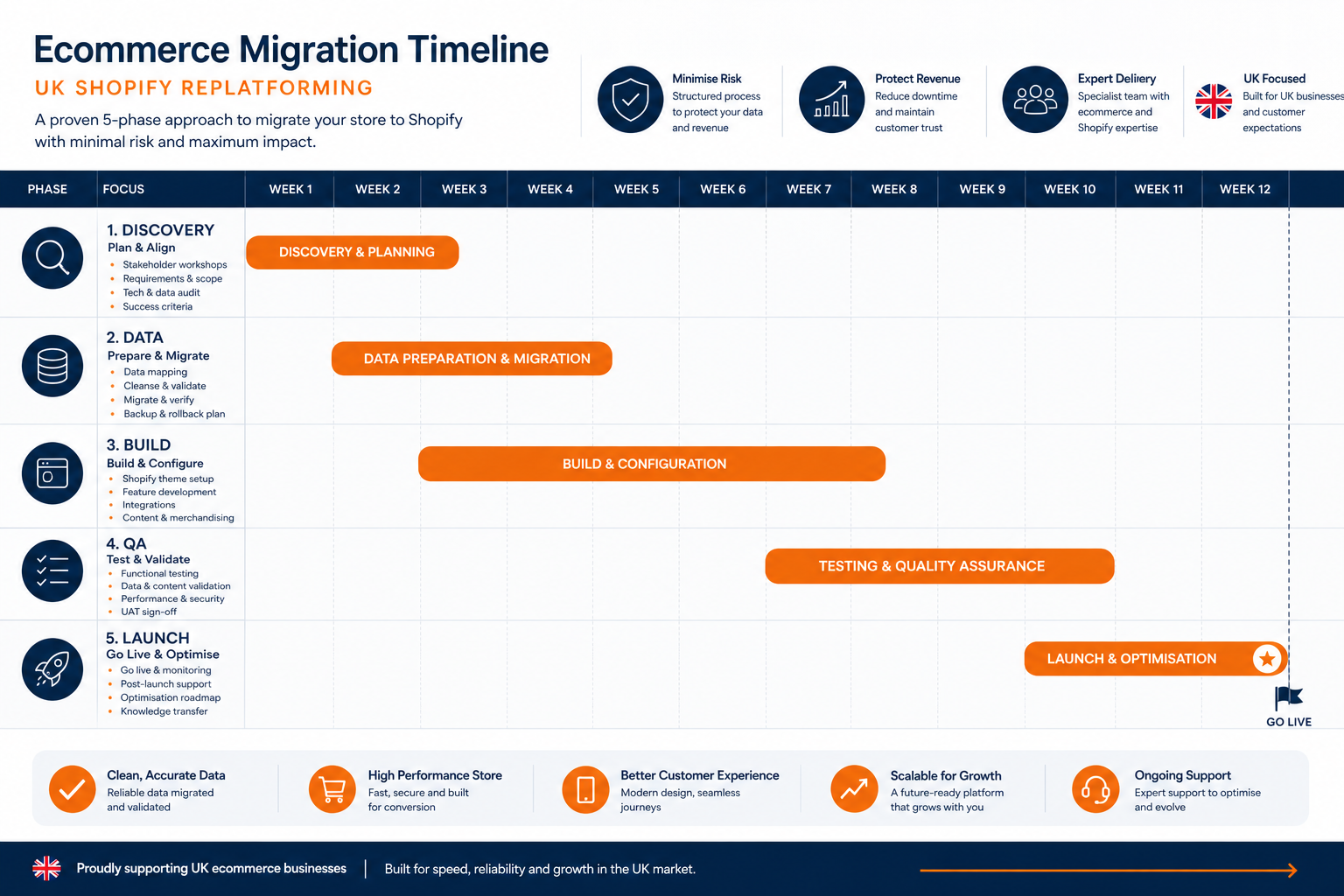
- Phase 0: Discovery and scope lock (weeks 1–3)
- Phase 1: Design, data, and integration design (weeks 4–8)
- Phase 2: Build, content, and redirect mapping (weeks 9–14)
- Phase 3: QA, SEO validation, and soft launch (weeks 15–18)
- Phase 4: Cutover and stabilisation (weeks 19–20+)
- Timeline by migration profile
- StoreBuilt example
- Final StoreBuilt point of view
Keyword decision and research inputs
Primary keyword: timeline for ecommerce migration UK
Secondary keywords: ecommerce migration timeline UK, Shopify migration timeline UK, replatforming schedule UK.
Search intent: planning and vendor evaluation. Funnel: middle. Page type: implementation guide.
Why StoreBuilt can win: first-hand migration delivery with SEO-safe launch controls, not generic project-management theory.
Why migration timelines fail in UK ecommerce
| Failure pattern | What breaks | Timeline impact |
|---|---|---|
| Launch date before data audit | Product, variant, and metafield gaps surface late | +4–8 weeks |
| Redirects treated as IT-only | Organic traffic drops post-launch | Recovery adds months |
| Integration scope creep | ERP, WMS, subscriptions added mid-build | +3–6 weeks |
| Peak-season cutover | No rollback path; ops firefighting | Revenue + reputation risk |
Phase 0: Discovery and scope lock (weeks 1–3)
- Catalogue audit: products, variants, collections, metafields, media
- Integration inventory: ERP, WMS, reviews, loyalty, subscriptions, tax
- SEO baseline: indexed URLs, top landing pages, redirect requirements
- Stakeholder RACI: who approves theme, data, and launch
Exit gate: signed scope, data ownership assigned, no “TBC” on critical integrations.
Phase 1: Design, data, and integration design (weeks 4–8)
- Theme or headless storefront design aligned to merchandising model
- Data migration mapping: source → Shopify fields, cleanup rules
- Integration architecture: API limits, sync frequency, error handling
- Content migration plan: blogs, policies, landing pages
Phase 2: Build, content, and redirect mapping (weeks 9–14)
- Theme development, app configuration, checkout and shipping rules
- Redirect spreadsheet: old URL → new URL, status codes, priority tiers
- Sample data loads and reconciliation checks
- UAT environments for ops and merchandising
Phase 3: QA, SEO validation, and soft launch (weeks 15–18)
- Crawl QA: orphan pages, broken internal links, canonical conflicts
- Redirect testing on top 500 URLs by traffic
- Payment, tax, and fulfilment end-to-end tests
- Optional soft launch or staged collection rollout
See also: SEO impact of migrating to Shopify and migration vs optimisation.
Phase 4: Cutover and stabilisation (weeks 19–20+)
- DNS / domain cutover with rollback window
- Search Console and Bing Webmaster URL resubmit
- IndexNow ping for new URL set
- 30-day hypercare: orders, integrations, organic monitoring
Timeline by migration profile
| Profile | Typical duration | Notes |
|---|---|---|
| DTC catalogue under 2k SKUs | 12–16 weeks | Theme-first Shopify, few integrations |
| Multi-channel with ERP | 16–24 weeks | Data sync and testing dominate |
| Magento / Adobe exit | 18–26 weeks | Redirect volume and attribute mapping |
| International + multi-store | 20–28 weeks | Markets, tax, and hreflang add phases |
StoreBuilt example
A UK homeware brand wanted a Black Friday launch from WooCommerce. Discovery showed 1,400 legacy URLs, duplicate variant logic, and an ERP feed nobody had documented. StoreBuilt reset the timeline: 18 weeks with a September soft launch for new collections and a controlled redirect go-live six weeks before peak. Organic visibility held; ops stopped firefighting in November.
Final StoreBuilt point of view
The right ecommerce migration timeline UK teams trust is built backwards from risk — SEO, data integrity, and peak trading — not forwards from a boardroom date. If your timeline cannot survive a one-week integration delay, it was never realistic.