
What we have seen in boardrooms is this: migration gets treated as a rebrand moment while the real problem is checkout friction, bad data, or weak category SEO on a platform that could still win. Conversely, some teams optimise for years on a stack that cannot support B2B, markets, or automation.
Shopify migrations or Contact StoreBuilt.
Table of contents
- Keyword decision and research inputs
- Definitions: migration vs optimisation
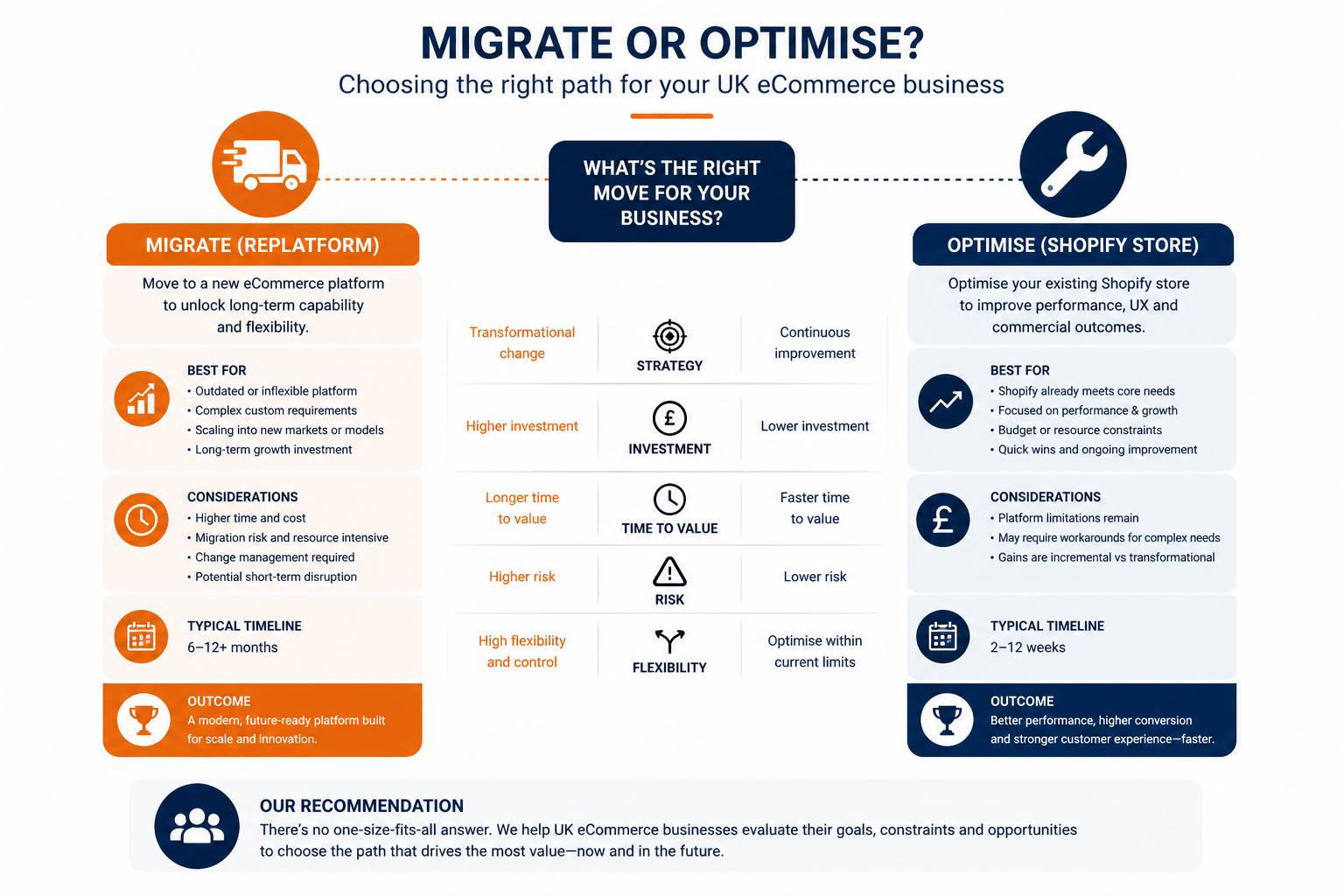
- Signals you should migrate
- Signals you should optimise in place
- Cost and risk comparison
- Phased hybrid path
- StoreBuilt example
- Final StoreBuilt point of view
Keyword decision and research inputs
Primary keyword: ecommerce migration vs optimisation UK
Secondary keywords: replatform or optimise Shopify, platform migration decision UK, Shopify optimisation vs migrate.
Search intent: strategic decision — leadership choosing next investment.
Funnel stage: middle funnel, high commercial value.
Page type: decision framework.
Related: migration SEO impact, improve ecommerce SEO, migration playbook.
Definitions: migration vs optimisation
| Path | What changes | Typical scope |
|---|---|---|
| Migration | Platform, URLs, integrations, ops | Replatform to Shopify or new stack |
| Optimisation | Theme, apps, data, processes | Same platform, better outcomes |
Optimisation is not “do nothing” — it is deliberate improvement without replatform risk.
Signals you should migrate
Strong migrate triggers:
- Platform cannot support required B2B, markets, or subscription models
- Total cost of ownership exceeds revenue growth capacity
- Security/compliance gaps on current stack
- Integration debt blocks ERP/WMS automation
- Leadership commits budget for 6–12 month transformation
Weak migrate triggers (often excuses):
- “We want a rebrand”
- “Competitor migrated”
- “Agency said Magento is dead” without SKU/ops analysis
Signals you should optimise in place
Optimise when:
- Search Console shows fixable indexation/template issues
- Conversion fails on trust, speed, or merchandising — not platform ceiling
- Team lacks capacity to run migration and peak trading
- Shopify (or current platform) already supports roadmap with config/dev
- SEO recovery from last migration still in progress
Run technical SEO checklist before assuming migration.
Cost and risk comparison
| Factor | Migration | Optimisation |
|---|---|---|
| Upfront cost | Higher | Lower |
| SEO risk | Redirect/template | Lower if in-place |
| Time to first win | Months | Weeks |
| Ops disruption | High at cutover | Incremental |
| Long-term ceiling | Raises if platform fit | Bounded by platform |
Finance should compare 12-month contribution, not project sticker price alone.
Phased hybrid path
Many UK brands:
- Optimise critical journeys on current stack (90 days)
- Migrate catalogue subset or single market to Shopify
- Expand after proving unit economics
Avoid big-bang unless regulatory or platform failure forces it.
StoreBuilt example
A UK wholesale brand planned Magento migration primarily for UX refresh. StoreBuilt optimised B2B ordering on existing stack while scoping Shopify Plus for one region. Migration proceeded with clearer requirements; six months of premature replatforming cost was avoided.
Final StoreBuilt point of view
Migration vs optimisation is a commercial sequencing question. Fix what blocks revenue now; replatform when the platform blocks the next two years of roadmap.