
What we have seen in migration work is this: teams rarely get into trouble because Shopify was the wrong destination. They get into trouble because the migration was run like a design project instead of a revenue-protection programme.
If your team is planning a move and wants an independent migration readiness review, Contact StoreBuilt.
Table of contents
- Keyword decision and research inputs
- Why this topic is still commercially important
- What UK Shopify competitors are signalling
- The StoreBuilt migration playbook
- Migration workstream table
- StoreBuilt example
- Final StoreBuilt point of view
Keyword decision and research inputs
Primary keyword: shopify migration playbook
Secondary keywords:
- migrate to shopify
- shopify migration agency uk
- ecommerce migration checklist
- shopify replatforming guide
Search intent: commercial-investigational with strong operational anxiety. The reader is usually already considering Shopify and wants a safer path, not a generic platform explainer.
Funnel stage: middle to bottom.
Page type: long-form operational playbook.
Why StoreBuilt can realistically win this topic:
- UK competitor libraries cover migration often, but many stop at feature comparison or high-level checklists.
- StoreBuilt can connect SEO continuity, tracking integrity, launch governance, and post-launch operating stability in one piece.
- This topic leads naturally into
/services/shopify-migrations-and-replatforming/and/services/shopify-support-maintenance-and-audits/.
Research inputs used on June 9, 2026:
- Current SERP pattern review around
migrate to shopify,shopify migration agency uk, and related replatforming intent. - UK competitor checks across Charle, Swanky, and We Make Websites migration positioning and article patterns.
- StoreBuilt observations from migration recovery, pre-launch QA, and post-handover audit work.
Why this topic is still commercially important
The migration question is still one of the highest-intent queries in the ecommerce UK market because it usually appears when an internal team has already hit a ceiling.
That ceiling might be:
- a slow release cycle on the current platform
- app or integration fragility
- rising maintenance cost
- poor merchandising control
- limited international, B2B, or checkout flexibility
When buyers search for migration guidance, they are not normally asking, “Can Shopify do ecommerce?” They are asking, “Can we move without breaking what currently funds the business?”
That is why migration content converts well when it is honest about risk.
What UK Shopify competitors are signalling
Charle’s recent article approach around migration, ecommerce agency selection, and technical operations makes one thing clear: the UK market responds to practical, decision-stage content written in plain language. Swanky positions migration through specialist service assurance. We Make Websites leans into enterprise confidence, international complexity, and safe delivery.
That tells us three things about current intent:
- readers want process clarity, not vague “seamless migration” claims
- migration buyers are often cross-functional, including ecommerce, operations, SEO, and leadership
- agencies that publish the best migration content are using it to pre-qualify serious projects
StoreBuilt should not copy those angles. But it should compete where demand is strongest: governance, risk visibility, and commercial decision support.
The StoreBuilt migration playbook
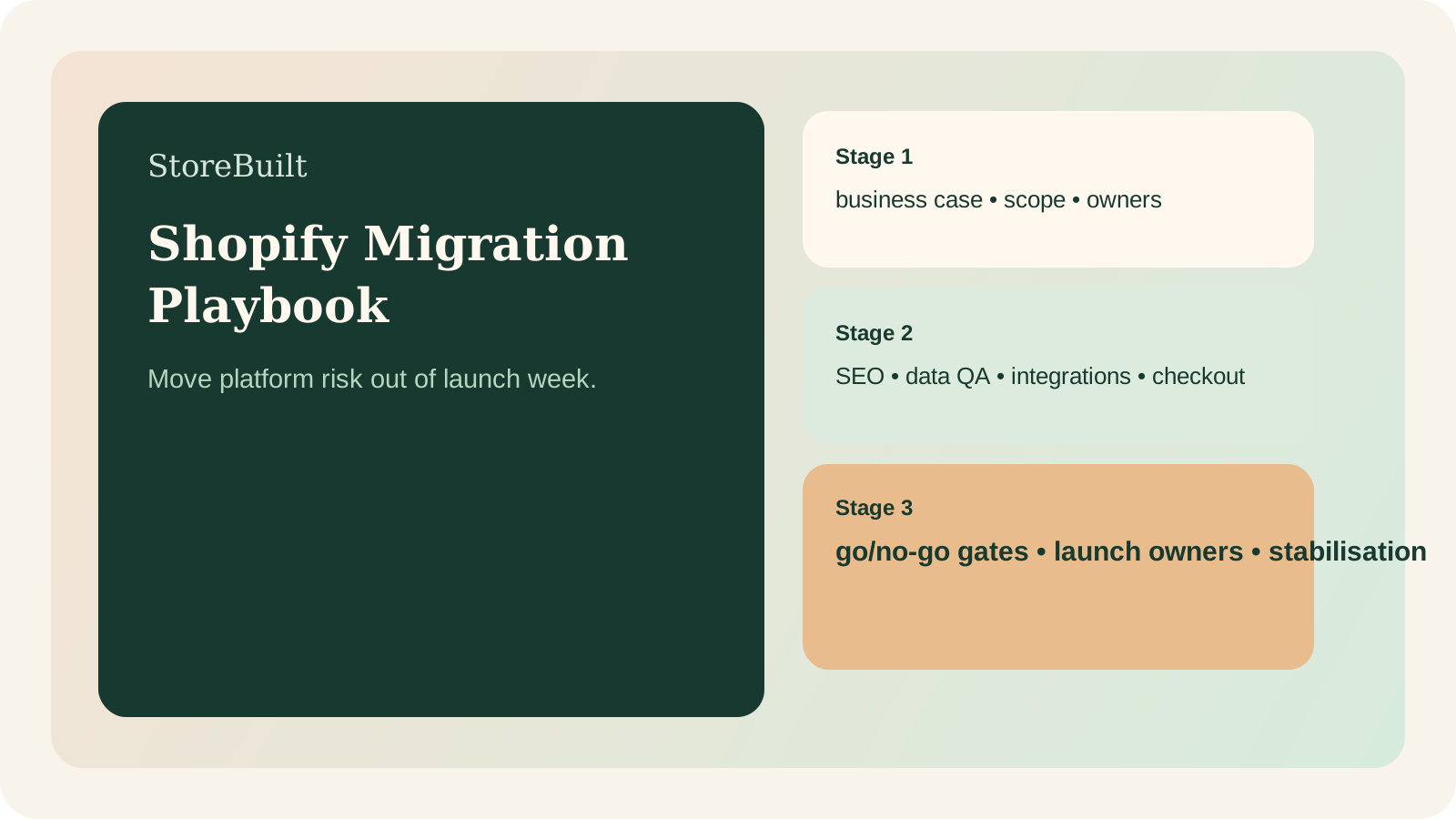
The right playbook is not “export, import, and launch”. It is a staged risk-reduction model.
1. Define why the migration exists
If the business case is vague, the project becomes vulnerable to scope drift immediately.
Your migration should be anchored to a few explicit outcomes such as:
- faster merchandising changes
- lower technical overhead
- cleaner checkout and conversion performance
- more reliable app and integration governance
- better international or B2B capability
If none of those are clear, the team will start arguing about features instead of outcomes.
2. Lock the migration scope before design enthusiasm expands it
This is one of the most common failure patterns. The team agrees to migrate, then quietly turns the project into a redesign, a content rewrite, a systems clean-up, and an analytics rebuild all at once.
Sometimes that is justified. Often it is not.
Separate the work into:
| Layer | Core question |
|---|---|
| Platform move | What must change to replatform safely? |
| UX uplift | Which customer-facing improvements are essential now? |
| Commercial enhancement | Which growth improvements can wait until stabilisation? |
This keeps launch risk proportional.
3. Treat SEO continuity as a structured workstream
Too many migration plans reduce SEO to “add redirects”. That is not enough.
The migration SEO layer should cover:
- URL mapping for priority commercial pages
- canonical logic on product and collection templates
- metadata parity or intentional improvements
- internal-link preservation for high-value paths
- collection and product indexation review after go-live
- Search Console inspection on core pages after release
If your team needs this mapped into implementation tickets, StoreBuilt can support the SEO layer of the migration.
4. Run catalogue and integration QA as if operations owns the launch
Migration issues become expensive when they leak into trading operations. That means catalogue and systems QA cannot be treated as a technical afterthought.
The important checks usually include:
- product and variant parity
- collection assignment logic
- pricing and compare-at logic
- shipping rules
- ERP, WMS, CRM, and email event integrity
- tax, payment, and fraud settings
For UK ecommerce brands, a launch that breaks order flow or stock sync usually causes more practical damage than a temporary visual imperfection.
5. Use go/no-go criteria, not hope
Every migration needs a short written decision gate before launch.
Recommended questions:
- Are all top-revenue URLs validated for redirect and canonical behaviour?
- Have critical checkout paths been tested end to end?
- Do orders, refunds, notifications, and fulfilment statuses behave correctly?
- Does tracking support decision-making on day one?
- Is there named ownership for launch-day incidents?
If the answer is not a clean yes, the date is not the most important variable anymore.
Migration workstream table
| Workstream | What good looks like | Common mistake |
|---|---|---|
| Business case | Clear commercial reason for moving | Migration approved on frustration alone |
| Scope control | Launch scope separated from growth backlog | Redesign and replatform mixed without guardrails |
| SEO | Redirects, canonicals, indexation, and links reviewed | SEO reduced to a redirect CSV |
| Data QA | Catalogue, customers, and order logic tested | Assuming import success means trading success |
| Integrations | Failure paths and edge cases tested | Only happy-path sync tested |
| Launch governance | Named owners, rollback logic, war-room plan | Launch run from a generic project checklist |
| Stabilisation | First 30-day issue triage and roadmap defined | Team disperses immediately after go-live |
StoreBuilt example
One UK retailer came into a migration with a familiar assumption: the hard part was getting the new storefront built. What slowed them down was everything around the storefront. Collection logic did not match the old trading model, reporting confidence dropped in staging, and campaign timing started to shape launch decisions more than readiness did.
The fix was not more design work. It was stronger sequencing. We separated revenue-critical migration tasks from post-launch enhancements, tightened QA around catalogue and events, and used explicit go/no-go gates instead of an aspirational timeline. That reduced internal stress immediately because the team knew what counted as truly launch-critical.
This is often what migration success looks like in real life: fewer surprises, cleaner ownership, and a calmer first month after go-live.
If your current platform is slowing growth but the migration path still feels risky, review StoreBuilt’s Shopify migration service.
High-intent AI search implementation layer
The AI-search version of this topic is not just “write more content”. A useful answer engine result needs a page that gives a direct answer, proves the claim, and shows the next operational step inside Shopify.
| Area | StoreBuilt implementation check |
|---|---|
| Primary intent | The page should map to shopify migration playbook and one clear buyer or operator problem, not a vague traffic topic. |
| Shopify surface | Identify whether the work belongs on a collection, product page, theme section, checkout step, app workflow, email flow, or support process. |
| Proof | Add first-hand observations, product/category examples, screenshots, policy notes, review signals, or trustworthy external sources where they make the advice safer. |
| Internal route | Link the reader to the service most likely to solve the issue: Shopify migrations and replatforming. |
| Measurement | Check Search Console, analytics, assisted conversions, enquiry quality, and AI-response mentions after the update rather than judging success by pageviews alone. |
For this article, the useful research inputs are: StoreBuilt migration QA patterns, redirect/indexation checks, Shopify platform guidance, and UK ecommerce replatforming SERPs. StoreBuilt would prioritise redirects, data migration, template parity, analytics continuity, launch QA, and post-launch monitoring before expanding into broader supporting content.
If this topic maps to a live store problem, review the related StoreBuilt service or Contact StoreBuilt with the store URL and the issue you want fixed.
Final StoreBuilt point of view
The best Shopify migration playbook for UK ecommerce teams is not the one with the longest checklist. It is the one that protects revenue, search visibility, operational confidence, and post-launch momentum at the same time.
Migrations should be judged less by how exciting the new storefront looks on launch day and more by how calmly the business trades in the weeks after it. That is where strong migration work proves itself.