
What we have seen is this: brands activate twelve Klaviyo flows before fixing duplicate profiles, consent gaps, and product feed accuracy. Marketing automation on Shopify amplifies whatever data and ops truth you already have — good or bad.
CRO & UX or Contact StoreBuilt.
Table of contents
- Keyword decision and research inputs
- Automation stack on Shopify
- Foundation before flows
- Core flow playbook
- Segmentation and personalisation
- Consent and UK compliance basics
- Measurement and hygiene
- StoreBuilt example
- Final StoreBuilt point of view
Keyword decision and research inputs
Primary keyword: ecommerce marketing automation Shopify UK
Secondary keywords: Klaviyo flows Shopify, marketing automation playbook UK, lifecycle automation ecommerce.
Search intent: implementation playbook — marketing lead building automation programme.
Funnel stage: middle funnel.
Page type: operational playbook.
Related: marketing automation flows, cart recovery system, retention strategies.
Automation stack on Shopify
Typical UK stack:
| Layer | Role |
|---|---|
| Shopify | Orders, products, customers, consent |
| ESP (e.g. Klaviyo) | Flows, campaigns, SMS |
| Onsite | Popups, quizzes, zero-party data |
| Analytics | Attribution, cohort reporting |
| CS tools | Gorgias etc. for reply context |
Automation connects these — it does not replace strategy.
Foundation before flows
Complete before scaling:
- Single customer identity rules (email/phone dedupe)
- Consent captured at checkout and forms
- Product/catalog sync accuracy
- UTM and offer governance
- Deliverability basics (domains, authentication)
See zero-party data guide for quiz-led capture.
Core flow playbook
Launch in order:
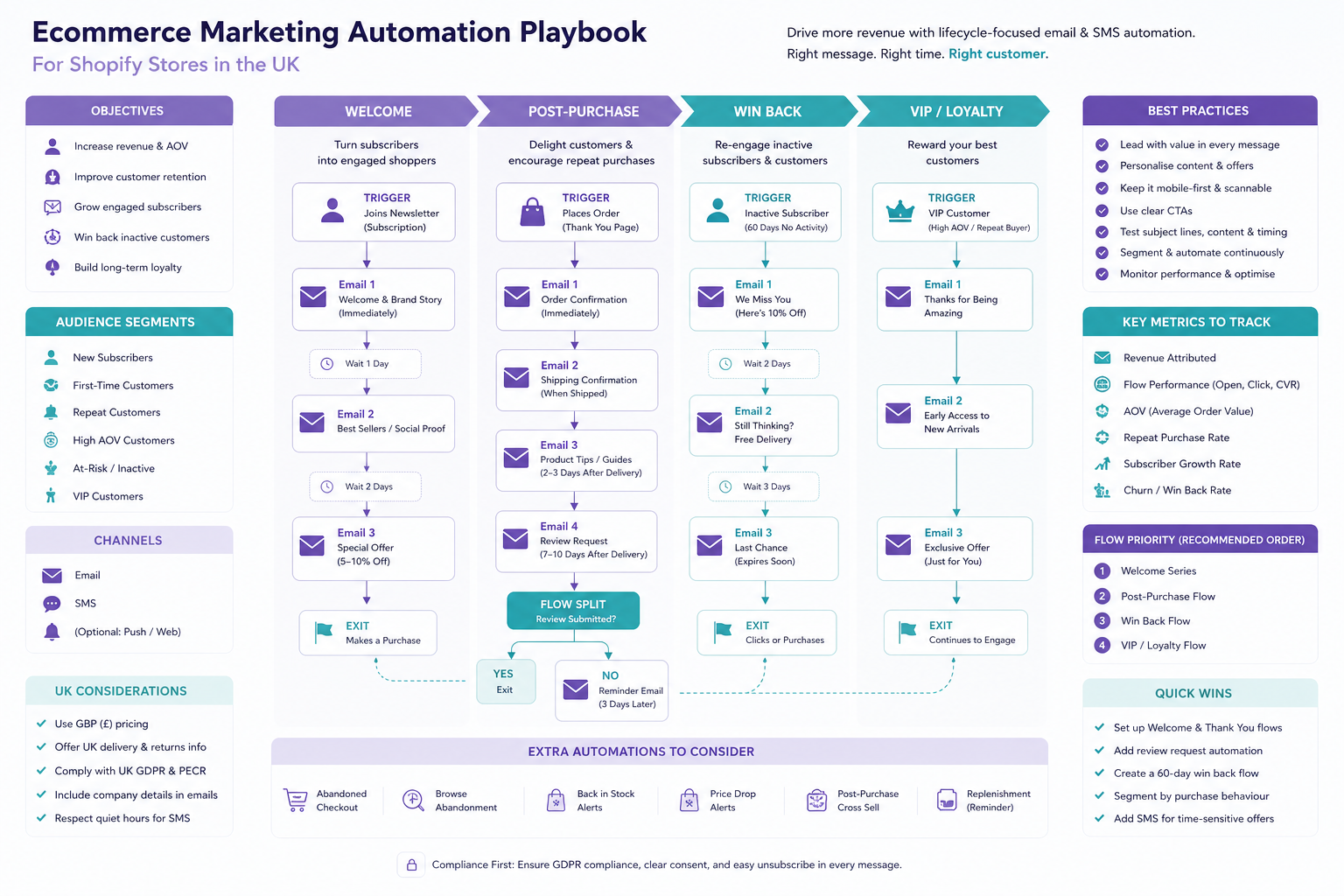
| Flow | Purpose |
|---|---|
| Welcome | Set brand + delivery expectations |
| Browse abandonment | Recover consideration |
| Cart abandonment | Recover intent |
| Post-purchase | Cross-sell, education, review ask |
| Replenishment | Consumables repeat |
| Win-back | Lapsed buyers |
Each flow needs one primary metric and margin guardrails.
Segmentation and personalisation
Move beyond “all subscribers”:
- Category purchasers
- VIP contribution band
- Discount-sensitive vs full-price buyers
- B2B vs DTC accounts on hybrid stores
- Geo/market for copy and offers
Over-personalisation without data quality creates embarrassing sends.
Consent and UK compliance basics
Practical guidance, not legal advice:
- Separate marketing vs transactional consent where required
- Clear opt-in for SMS with easy opt-out
- Honour suppressions across channels quickly
- Document offer terms in promotional flows
Align with SMS governance.
Measurement and hygiene
Monthly review:
- Flow revenue vs campaign revenue mix
- Unsubscribe/spam complaint rates
- Deliverability domain health
- Duplicate profile count
- Holdout tests on major flows (where traffic allows)
StoreBuilt example
A UK homeware brand ran cart emails with stale inventory messaging. StoreBuilt synced availability rules, split flows by in-stock vs made-to-order SKUs, and tightened consent on popups. Flow revenue rose while complaint rates dropped.
Final StoreBuilt point of view
Marketing automation is operating rhythm, not a flow template pack. Fix data and consent, then automate proven journeys.