
What we have seen in email planning is this: many brands ask their retention channel to deliver a revenue target before they have a believable model for how that revenue should be created.
If your team wants a retention forecast tied to realistic storefront and lifecycle assumptions, Contact StoreBuilt.
Table of contents
- Keyword decision and research inputs
- Why email forecasting matters now
- What competitor content is missing
- The StoreBuilt forecasting model
- Revenue planning table
- StoreBuilt example
- Final StoreBuilt point of view
Keyword decision and research inputs
Primary keyword: ecommerce email revenue forecasting
Secondary keywords:
- shopify email marketing strategy uk
- ecommerce lifecycle revenue model
- email revenue planning ecommerce
- klaviyo revenue forecast shopify
Search intent: commercial-operational. The reader is usually already investing in email and wants a model for planning, defending budget, or fixing weak retention assumptions.
Funnel stage: middle to bottom.
Page type: practical planning guide.
Why StoreBuilt can realistically win this topic:
- Competitor content often explains lifecycle strategy well but spends less time on forecast discipline.
- Forecasting is a board-friendly angle that helps ecommerce leads justify retention investment in concrete terms.
- This topic creates a credible route into
/services/klaviyo-email-and-sms-retention/and/services/shopify-support-maintenance-and-audits/.
Research inputs used on June 9, 2026:
- Current SERP pattern review around ecommerce email strategy, Shopify email planning, and related retention terms.
- UK competitor review including Charle’s recent email-strategy content patterns.
- StoreBuilt experience with brands where lifecycle activity was high but forecast confidence was weak.
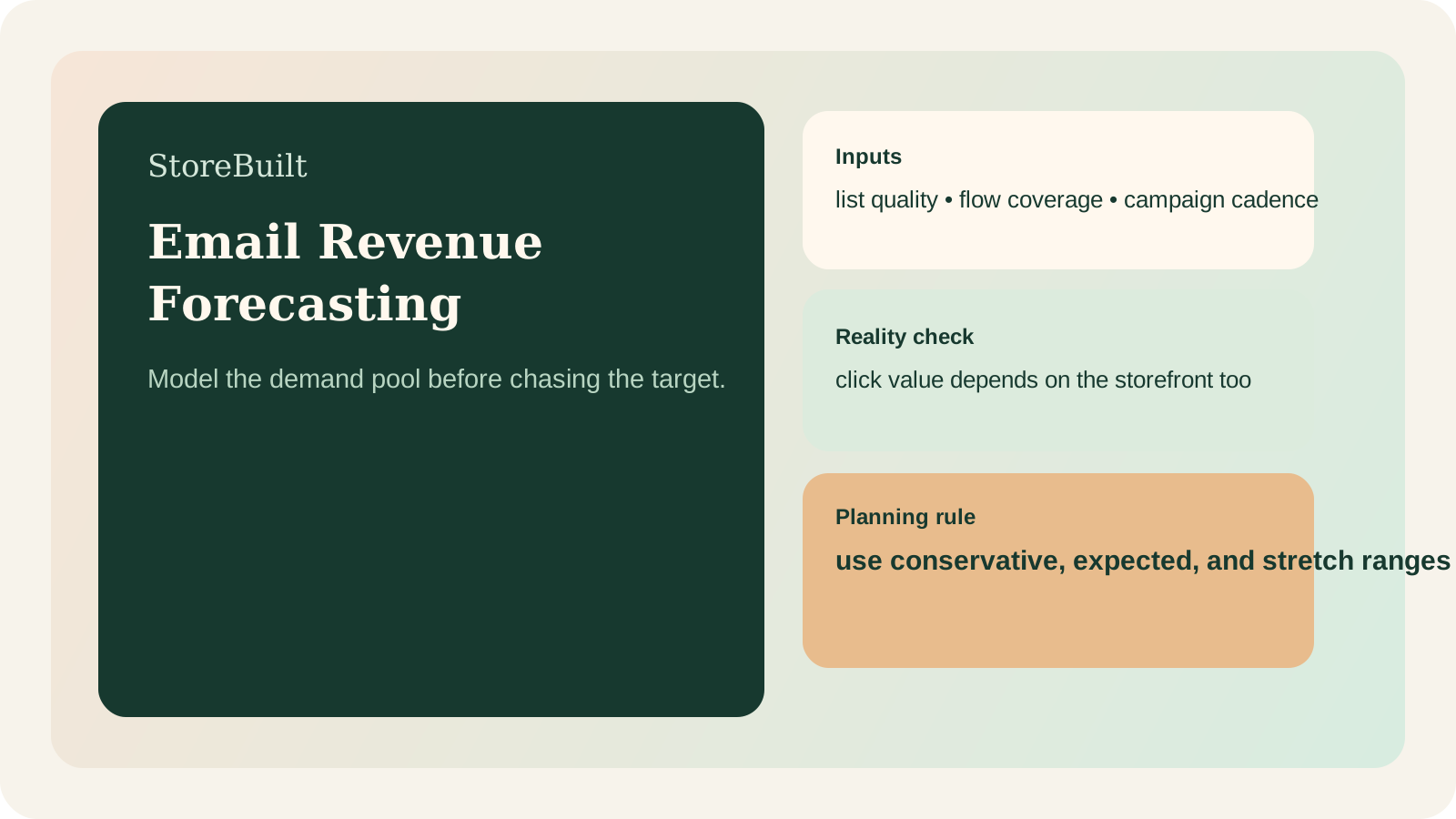
Why email forecasting matters now
The old answer to email underperformance was often “send better campaigns”. That is too loose for 2026.
In the ecommerce UK market, email and SMS increasingly sit inside larger conversations about:
- margin pressure
- paid media volatility
- customer acquisition efficiency
- repeat-purchase quality
- team resourcing
That means retention is expected to behave more like an accountable growth system.
Forecasting matters because it helps teams answer:
- What share of revenue should email realistically influence?
- Is poor performance caused by list quality, offer quality, flow coverage, or storefront friction?
- How much upside is structural and how much is wishful thinking?
Without that model, email teams often inherit goals they cannot sensibly defend.
What competitor content is missing
UK agency content on email strategy is usually strong on lifecycle recommendations, automation lists, and campaign calendars. That is useful. But a lot of it still assumes the team can move directly from strategy to performance without building a forecast.
That creates predictable issues:
- retention targets disconnected from list health
- excessive trust in platform-attributed revenue numbers
- over-reliance on campaign cadence instead of conversion mechanics
- weak separation between what flows should do and what campaigns should do
StoreBuilt can win by explaining email as a planning system, not just a creative programme.
The StoreBuilt forecasting model
1. Start with the available demand pool
Before forecasting revenue, estimate the addressable audience across:
- active subscribers
- new signups by month
- recent purchasers
- lapsed or at-risk cohorts
- high-intent browsers and cart users
If the list is weak, stale, or low-intent, no forecast should pretend otherwise.
2. Separate lifecycle and campaign contribution
One recurring forecasting mistake is treating email as one undifferentiated channel. It is more useful to split it into:
- always-on lifecycle revenue
- seasonal or promotional campaign revenue
- reactivation revenue
That makes the plan easier to debug later.
Lifecycle usually depends more on:
- trigger coverage
- flow quality
- timing
- onsite conversion support
Campaign revenue usually depends more on:
- offer quality
- list segmentation
- promotional calendar strength
- creative and landing-page fit
3. Model conversion friction honestly
Forecasts often overstate revenue because they assume the message is the main lever. In many Shopify stores, the real bottleneck is that email clicks arrive on pages that still underperform.
That means your model should include assumptions about:
- product-page conversion quality
- collection page clarity
- mobile checkout ease
- stock and availability consistency
If retention clicks are landing on weak pages, StoreBuilt can help connect email demand with stronger conversion journeys.
4. Use range-based targets, not one heroic number
A serious forecast should include:
- conservative case
- expected case
- stretch case
That protects the team from basing the whole quarter on best-case assumptions.
Revenue planning table
| Forecast input | Why it matters | Common planning mistake |
|---|---|---|
| List growth | expands future addressable revenue | assuming signups equal quality subscribers |
| Flow coverage | creates baseline revenue predictability | launching many flows with weak logic |
| Campaign cadence | drives short-term peaks | mistaking frequency for strategy |
| Segment quality | improves relevance and yield | broad sends hiding weak message fit |
| Store conversion rate | determines click value | forecasting revenue without landing-page reality |
| Offer economics | shapes profit, not just sales | buying revenue with excessive discounting |
StoreBuilt example
One Shopify brand wanted the retention channel to deliver a large quarter-on-quarter uplift. The team already had flows, campaigns, and regular reporting, but the commercial conversation kept getting stuck because nobody trusted the target-setting logic behind the ask.
When we rebuilt the plan, the useful change was not a new template or a bigger campaign calendar. It was the forecast model. We separated lifecycle from campaign contribution, reduced unrealistic assumptions around list responsiveness, and tied expected uplift to actual landing-page conditions. That made the plan smaller in headline terms but stronger in operational credibility.
From there, the team could see where the real growth levers were: list capture quality, triggered-flow improvement, and a more coherent campaign-to-landing-page path.
That is usually what good forecasting does. It reduces theatre and improves decision quality.
If your email plan still depends on overly neat attributed-revenue stories, StoreBuilt can help rebuild the retention model.
High-intent AI search implementation layer
The AI-search version of this topic is not just “write more content”. A useful answer engine result needs a page that gives a direct answer, proves the claim, and shows the next operational step inside Shopify.
| Area | StoreBuilt implementation check |
|---|---|
| Primary intent | The page should map to ecommerce email revenue forecasting and one clear buyer or operator problem, not a vague traffic topic. |
| Shopify surface | Identify whether the work belongs on a collection, product page, theme section, checkout step, app workflow, email flow, or support process. |
| Proof | Add first-hand observations, product/category examples, screenshots, policy notes, review signals, or trustworthy external sources where they make the advice safer. |
| Internal route | Link the reader to the service most likely to solve the issue: Klaviyo email and SMS retention. |
| Measurement | Check Search Console, analytics, assisted conversions, enquiry quality, and AI-response mentions after the update rather than judging success by pageviews alone. |
For this article, the useful research inputs are: StoreBuilt Shopify audits, UK ecommerce SERP intent, Shopify platform documentation, and AI-search measurement patterns. StoreBuilt would prioritise Klaviyo flows, segmentation, subscription retention, post-purchase journeys, and lifecycle reporting before expanding into broader supporting content.
If this topic maps to a live store problem, review the related StoreBuilt service or Contact StoreBuilt with the store URL and the issue you want fixed.
Final StoreBuilt point of view
Ecommerce email forecasting should not be a spreadsheet ritual performed after the strategy is already decided. It should shape the strategy from the beginning.
For UK Shopify brands, the most useful forecast is the one that survives operational scrutiny. It acknowledges list quality, storefront friction, offer economics, and segment reality, then turns retention into something the team can actually manage with confidence.