
What we have seen in platform workshops is this: teams search for best ecommerce platforms besides Shopify UK when they are frustrated with apps, fees, or theme limits — not because they have modelled total cost of ownership. Alternatives can be right; they are rarely cheaper once you count people and risk.
Migrations & replatforming or Contact StoreBuilt.
Table of contents
- Keyword decision and research inputs
- How to evaluate platforms besides Shopify
- WooCommerce for UK brands
- BigCommerce for UK brands
- Adobe Commerce for UK brands
- Squarespace and lighter platforms
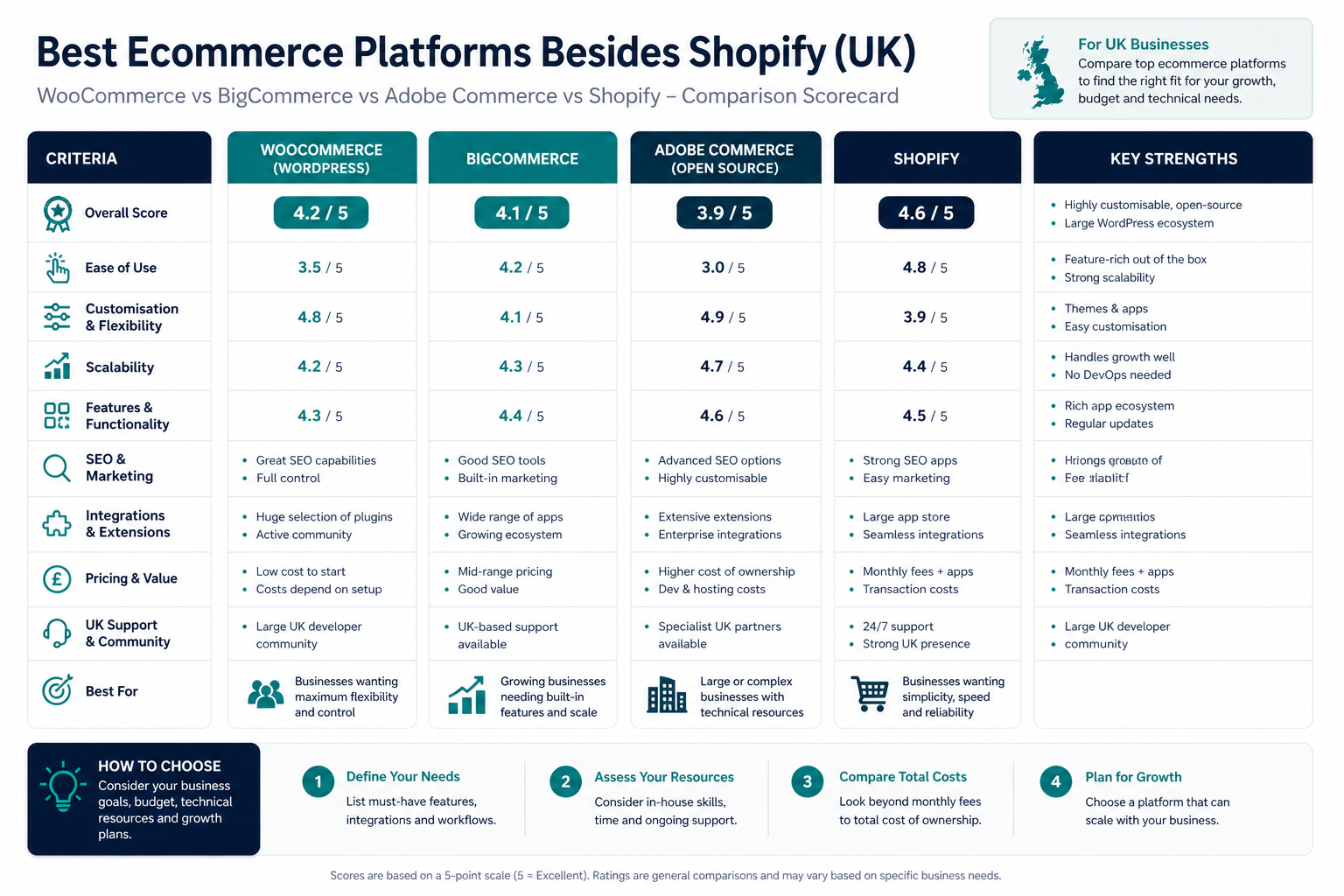
- Comparison scorecard
- When Shopify still wins
- StoreBuilt example
- Final StoreBuilt point of view
Keyword decision and research inputs
Primary keyword: best ecommerce platforms besides shopify UK
Secondary keywords: Shopify alternatives UK, UK ecommerce platform comparison 2026, WooCommerce vs Shopify UK.
Search intent: research and comparison. Funnel: upper-middle. Page type: buyer guide.
How to evaluate platforms besides Shopify
Score each option on:
- Time to revenue — how fast can merchandising ship changes?
- Integration tax — ERP, WMS, subscriptions, reviews, tax
- Team load — who owns hosting, security patches, plugin conflicts?
- Commercial flexibility — B2B, markets, wholesale, preorders
- Exit cost — data portability and redirect pain if you move again
WooCommerce for UK brands
Suits: WordPress-heavy content brands, agencies with in-house PHP, tight initial budget.
Watch-outs: Plugin conflicts, hosting performance, PCI scope, and the hidden cost of maintaining WordPress + Woo together.
UK fit: Strong when content SEO and editorial are core; weaker when ops wants predictable SaaS uptime.
BigCommerce for UK brands
Suits: Catalogues needing built-in multi-storefront features without full headless complexity.
Watch-outs: Theme flexibility vs Shopify OS 2.0; app ecosystem smaller for niche UK integrations.
UK fit: Solid for B2C catalogues with simpler retention stacks.
Adobe Commerce for UK brands
Suits: Enterprise complexity, deep B2B, custom catalog rules, existing Adobe investment.
Watch-outs: Implementation cost, partner dependency, and migration timelines measured in quarters not weeks.
UK fit: Justified at scale; overkill for most mid-market DTC brands.
Squarespace and lighter platforms
Suits: Early-stage makers, single-SKU launches, brochure-plus-shop models.
Watch-outs: Scale limits, weak B2B, integration ceilings.
Comparison scorecard
| Platform | Speed to launch | Ops overhead | App / integration depth | Typical UK sweet spot |
|---|---|---|---|---|
| Shopify | High | Low | Very high | DTC, multi-channel UK brands |
| WooCommerce | Medium | High | High (fragmented) | Content-led, dev-owned |
| BigCommerce | Medium–High | Medium | Medium–High | Structured catalogues |
| Adobe | Low | Very high | Very high | Enterprise B2B/B2C |
| Squarespace | High | Low | Low | Early-stage |
Related: platform migration guide UK and migration vs optimisation.
When Shopify still wins
Shopify remains the default for most UK growth brands when:
- merchandising velocity matters more than infinite customisation
- you need reliable checkout, Markets, and app coverage
- you cannot afford a permanent platform engineering team
StoreBuilt example
A UK craft supplies brand considered WooCommerce to “save fees.” Total cost modelling included two part-time developers, plugin renewals, and slower campaign launches. They stayed on Shopify, invested in collection SEO and subscription flows, and cut platform debate time to zero.
Final StoreBuilt point of view
Searching for platforms besides Shopify is healthy — switching without a scorecard is not. Model people, integrations, and exit cost first; then choose the platform that matches how your team actually operates.