
What we have seen in CRO programmes is this: teams rename button colours “A/B tests” without hypotheses, sample sizes, or a primary metric. A/B split testing on Shopify only works when experimentation is a discipline — not a monthly distraction.
CRO & UX or Contact StoreBuilt.
Table of contents
- Keyword decision and research inputs
- Split testing fundamentals
- When to test vs when to fix obvious bugs
- Shopify Rollouts vs third-party tools
- Hypothesis template
- Traffic, duration, and statistical hygiene
- What to test on UK Shopify stores
- Building an experimentation culture
- StoreBuilt example
- Final StoreBuilt point of view
Keyword decision and research inputs
Primary keyword: A/B split testing Shopify UK
Secondary keywords: Shopify experimentation guide, Shopify Rollouts UK, conversion rate testing ecommerce.
Search intent: learning and tool evaluation. Funnel: middle. Page type: complete guide.
Related: best A/B testing tools and Shopify Rollouts guide.
Split testing fundamentals
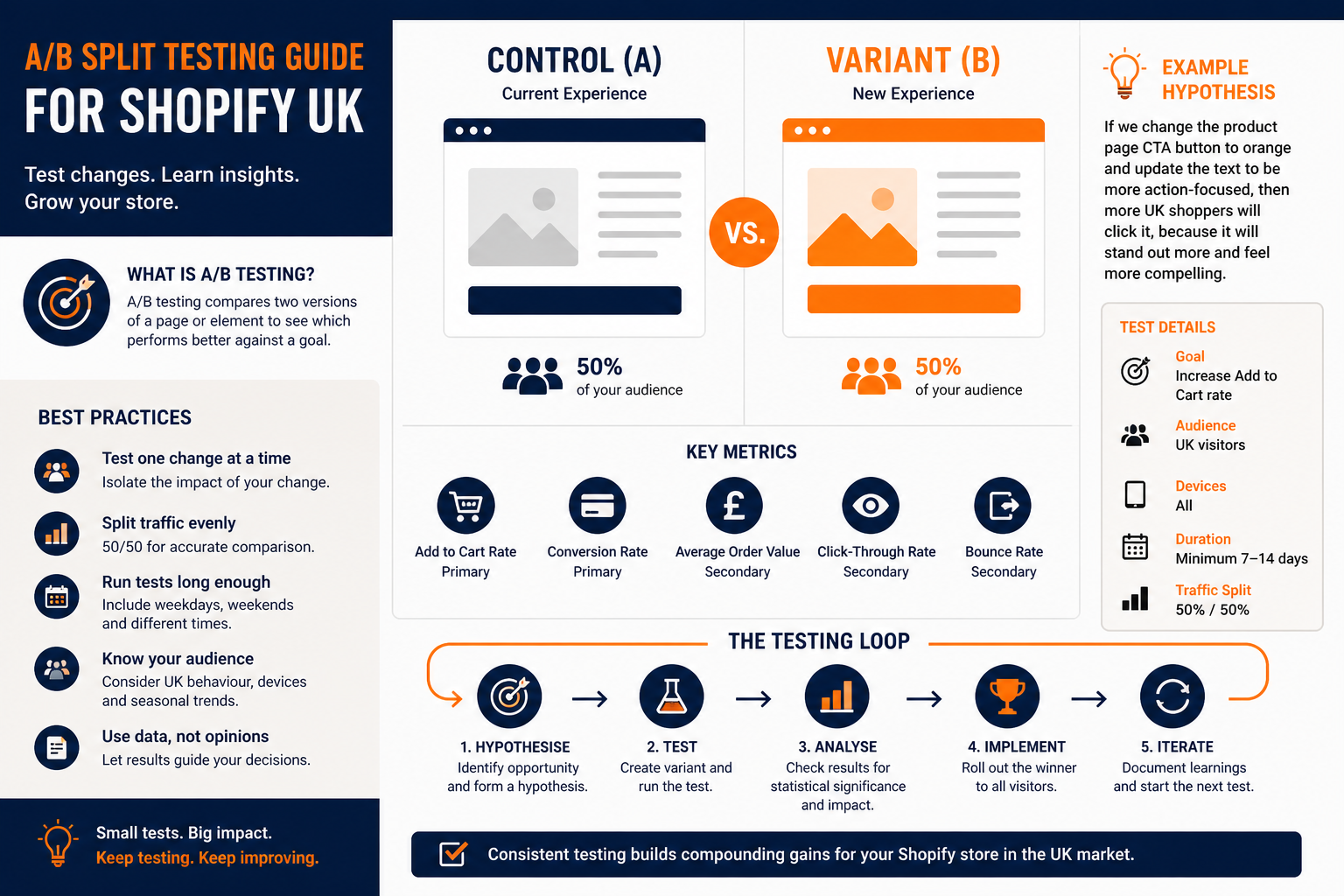
| Term | Meaning |
|---|---|
| Control | Current experience |
| Variant | Proposed change |
| Primary metric | One decision metric — usually conversion rate or revenue per session |
| Secondary metrics | Guardrails — AOV, bounce, speed, returns |
| Sample size | Visitors required before calling a winner |
When to test vs when to fix obvious bugs
Test when:
- Two credible approaches exist and the upside justifies traffic cost
- You can isolate the change and measure cleanly
Do not test when:
- Checkout is broken, shipping is wrong, or mobile layout fails basics
- Traffic is too low for months-long tests without sequential methods
See: low-traffic experimentation.
Shopify Rollouts vs third-party tools
| Approach | Best for |
|---|---|
| Shopify Rollouts | Theme sections, checkout extensibility within Shopify |
| Third-party CRO tools | Complex personalisation, multi-page funnels |
| Manual before/after | Major relaunches with holdout periods |
Pick one primary experimentation stack; tool sprawl kills learning velocity.
Hypothesis template
Because [insight/data], we believe [change] for [audience] will improve [primary metric] because [reason]. We will measure [metric + duration].
Document losers — they prevent repeated mistakes.
Traffic, duration, and statistical hygiene
- Pre-calculate minimum detectable effect
- Run full business cycles where seasonality matters
- Exclude bot traffic and internal staff sessions
- Do not peek daily and stop early on noise
What to test on UK Shopify stores
High leverage tests for UK DTC:
- Delivery cutoff clarity on PDP and cart
- Trust blocks near payment step
- Collection filter defaults for mobile
- Subscription vs one-off framing
- Free shipping threshold messaging
Low leverage: decorative hero rotations with no commerce hypothesis.
Building an experimentation culture
- Monthly experiment backlog prioritised by ICE or PIE score
- Shared results library accessible to merchandising and paid media
- Design and dev capacity reserved for tests, not only campaigns
- Leadership rewards learning, not only winners
StoreBuilt example
A UK supplements brand tested subscription framing on PDP — not button colour. Rollouts split traffic for three weeks with revenue per session as primary metric. Variant with explicit “skip or pause anytime” beat aggressive discount framing on contribution margin, not just conversion rate.
Final StoreBuilt point of view
A/B split testing is how UK Shopify teams stop debating taste and start debating evidence. Start with fix-the-obvious, then test one high-leverage hypothesis per month with documented guardrails.