
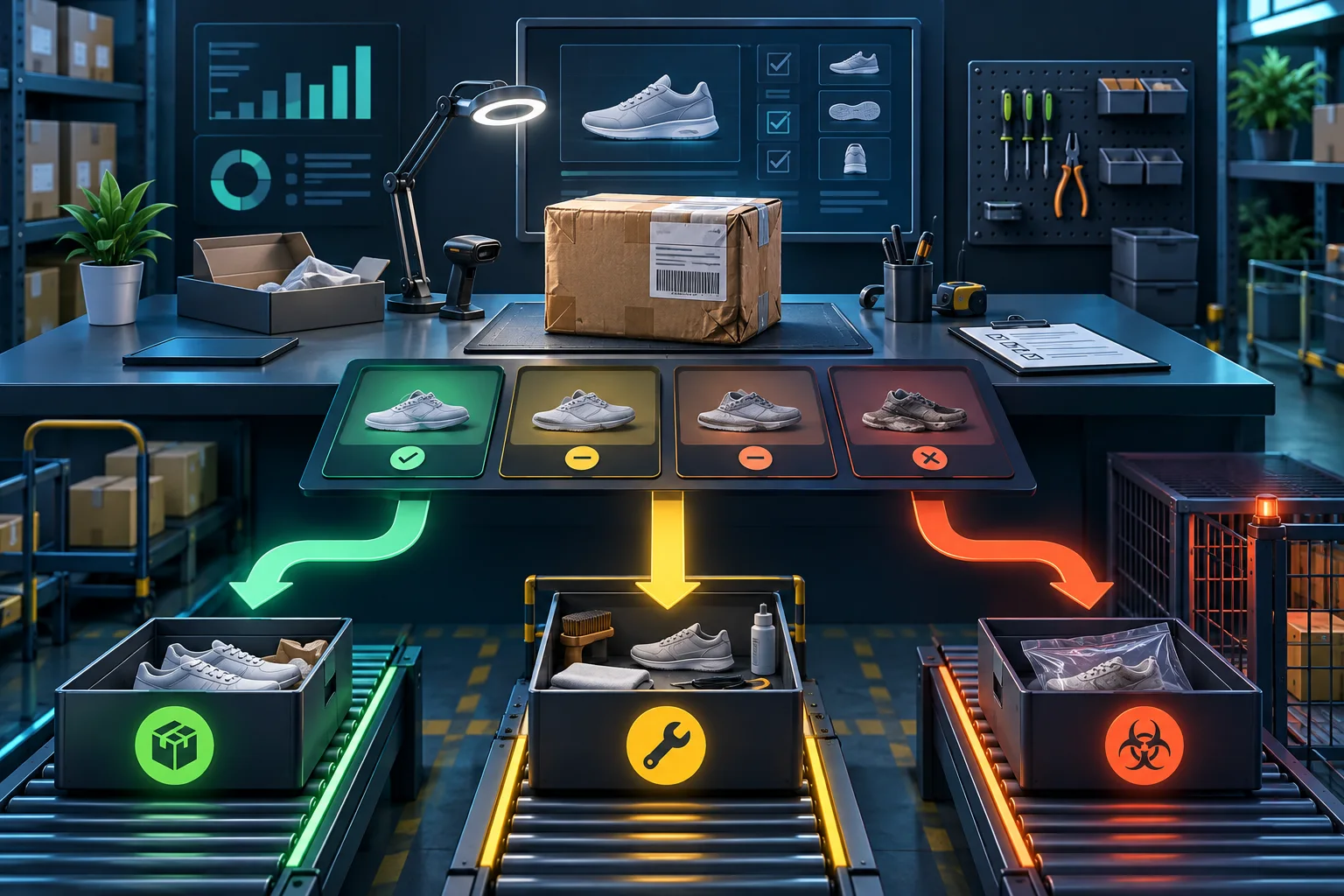
What we have seen in returns work is this: printing a label is the easy part. The commercial risk begins when an anonymous parcel arrives, the item condition is unclear and refund, replacement and inventory teams act from different evidence.
A Shopify RMA workflow creates a traceable bridge between the customer’s authorised return and the warehouse decision. This guide focuses on receiving, condition grading and disposition for UK ecommerce teams. It is operational guidance rather than legal advice; return rights and product-specific obligations need appropriate review.
Contact StoreBuilt if the workflow crosses Shopify, warehouse, payment or third-party systems.
Keyword decision
| Field | Decision |
|---|---|
| Primary keyword | Shopify RMA |
| Secondary intent | return merchandise authorisation Shopify, ecommerce returns receiving |
| Search intent | Operational guide |
| Funnel stage | Returns optimisation |
| Why StoreBuilt can help | Cover the neglected warehouse and stock-disposition half of the return journey |
Table of contents
- Create one traceable return identity
- Authorise with useful reason data
- Prepare the receiving station
- Grade condition consistently
- Separate refund from stock disposition
- Route every item to a named outcome
- Use returns data to prevent repeats
- StoreBuilt point of view
Create one traceable return identity
Assign an RMA or return reference that connects the order, customer, expected items, quantities, reason, requested outcome and label. Make it visible to support and receiving teams. Do not rely on the customer’s name written on a box or a carrier tracking number that covers only transport.
Define whether one authorisation can cover multiple parcels and whether multiple authorisations can exist against an order. Duplicate or reopened returns need a clear rule so the same item is not refunded twice.
Authorise with useful reason data
Use reason choices specific enough to guide action: wrong size, damaged in transit, faulty, not as described, changed mind, duplicate shipment or other. Pair a broad reason with optional notes or evidence where appropriate. Avoid forcing customers to diagnose technical faults they cannot see.
| Reason | Receiving focus | Follow-up owner |
|---|---|---|
| Damaged in transit | Packaging and carrier evidence | Operations |
| Faulty | Reproducible test and batch | Product/quality |
| Wrong item | Pick and pack trace | Fulfilment |
| Not as described | PDP and product match | Ecommerce |
| Changed mind | Condition and completeness | Returns team |
Prepare the receiving station
Give returns a defined location, tools and status. Staff need access to the expected RMA, order contents, product images, serial or batch information and grading rules. Provide safe handling for damaged, leaking, electrical, hygienic or otherwise controlled products.
Keep received returns separate from sellable stock until inspection is complete. A parcel scan proves arrival, not resale condition. Record the receiving time and person so customer-service expectations are based on the real queue.
Grade condition consistently
Create observable grades with examples: unopened and resale-ready; opened but complete; repairable; damaged or incomplete; quarantine for specialist review. Avoid subjective labels such as “fine”. Photograph exceptions where proportionate and permitted, and capture missing accessories or tamper seals.
An illustrative footwear team sees two identical “too small” returns. One is unworn and complete; the other has outdoor wear and a missing insert. The return reason is the same, but the inventory disposition is not. Consistent evidence protects both customer fairness and stock accuracy.
Separate refund from stock disposition
The customer resolution and the physical item decision can occur on different timelines. A refund may be approved while the item goes to repair or quarantine; an exchange may reserve new stock before the returned unit is assessed. Document who owns each decision and which status triggers customer communication.
Never restock merely because a refund was processed. Likewise, do not delay a customer outcome indefinitely because internal disposition is slow when policy or obligations require a prompt response.
Route every item to a named outcome
Use a small controlled set: restock as new, restock in a disclosed secondary condition, repair or refurbish, return to supplier, recycle or dispose, and quarantine. Each route needs inventory treatment, physical location and commercial owner. Regulated or safety-sensitive goods need specialist rules.
| Outcome | Inventory action | Evidence |
|---|---|---|
| Resale-ready | Add to eligible stock | Completed inspection |
| Secondary grade | Separate SKU/location if sold | Grade and disclosure |
| Repair | Move to unavailable repair stock | Fault and work order |
| Supplier claim | Keep out of availability | Claim reference |
| Quarantine | No sale or disposal | Review owner and deadline |
Use returns data to prevent repeats
Review reasons alongside SKU, variant, supplier, batch, fulfilment location and customer comments. Look for concentration rather than blaming a broad category. A size-related pattern may need measurements or fit guidance; “not as described” may reveal inconsistent images; transit damage may point to one package or carrier lane.
Track cycle time from request to receipt, receipt to decision and decision to customer resolution. Also track no-reference parcels, grading disagreement, items incorrectly restocked and repeat defect clusters. The goal is fewer preventable returns and faster fair handling, not simply a lower approval rate.
Build a return acceptance test
Rehearse an unopened return, worn item, missing accessory, wrong product, duplicate parcel, damaged-in-transit claim, unidentified parcel and an item requiring quarantine. Ask two trained colleagues to grade the same samples independently. Where they disagree, improve the rule or example rather than accepting personal judgement as normal.
Trace each scenario through customer message, refund or exchange, inventory adjustment and physical destination. Confirm reports distinguish received items from resale-ready stock. Test label failures and manual references too, because real returns will not all follow the ideal self-service route.
Set service and inventory controls
Publish internal targets for acknowledging requests, receiving parcels, completing inspection and resolving exceptions. Customer service should see enough status to answer accurately without entering the warehouse. Warehouse teams should see the promised customer outcome without accessing unnecessary personal information.
Reconcile return locations regularly. Count quarantine, repair and secondary-grade stock separately from new stock. Review aged items with a named commercial owner so products do not remain indefinitely unavailable and unaccounted for.
StoreBuilt point of view
Returns should be designed backwards from inventory truth and customer trust. StoreBuilt would not judge an RMA system by how quickly it prints labels. We would ask whether the parcel can be identified, the condition decision can be defended and the resulting product availability is accurate.
Read our returns reason analysis playbook and Shopify optimisation services, or Contact StoreBuilt for a returns workflow audit.
Sources reviewed
Current Shopify guidance frames RMA as the record connecting a customer return request to receiving and resolution, while Spring 2026 expands native return reasons and inventory handling. Sources were checked on 17 September 2026; no paid search-volume or client performance claim is used.