
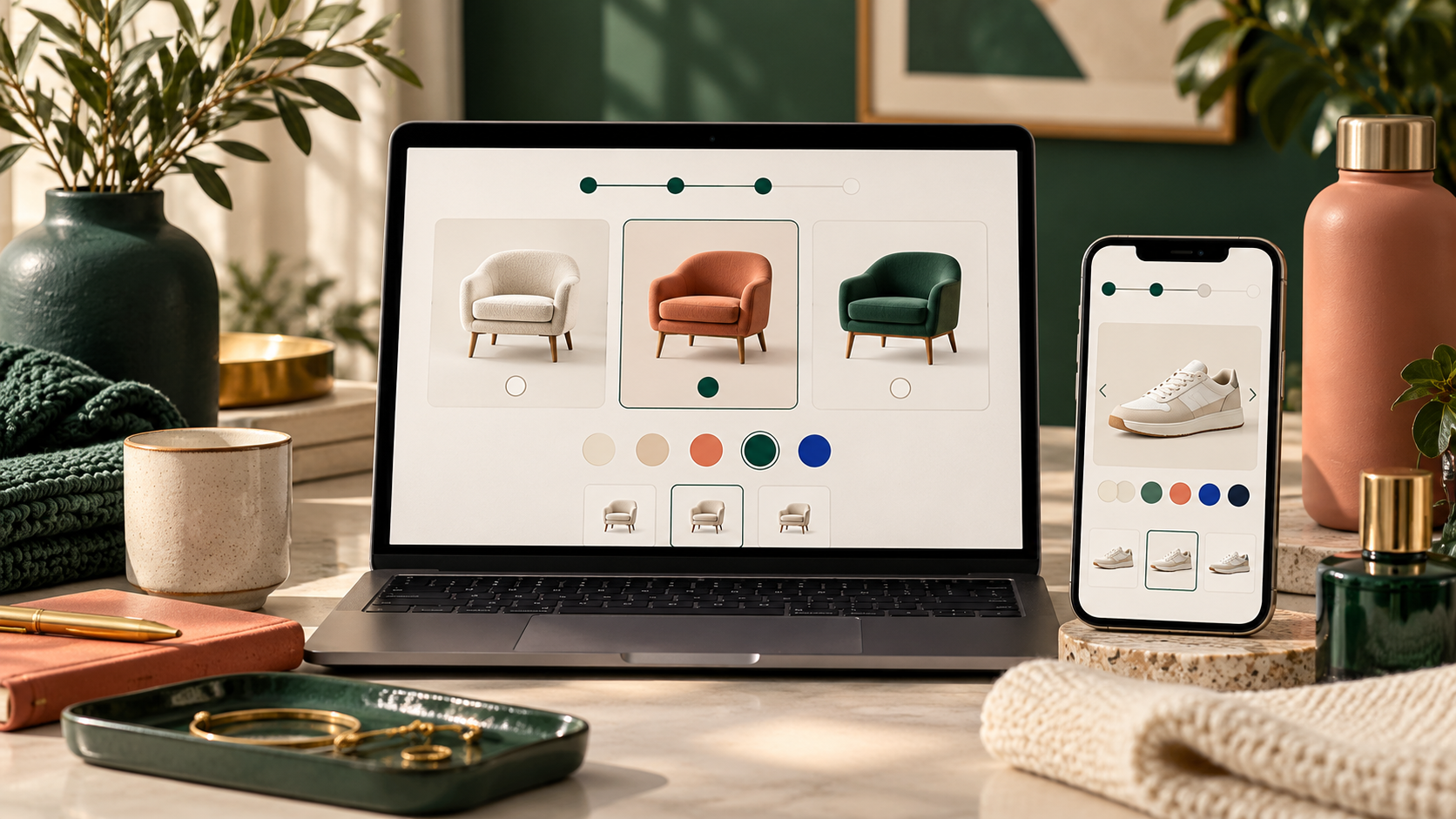
What we have seen is this: a product quiz can feel like sophisticated personalisation while quietly adding a detour before the buyer reaches a product. It earns its place only when it makes a difficult choice easier than a well-merchandised collection page would.
This guide is for teams researching a Shopify product quiz for a UK ecommerce store. It covers the commercial decision, not a particular vendor. If you collect personal data or make regulated claims, obtain the right privacy and legal guidance for your own implementation.
In this guide
- Start with the customer decision
- Write questions that change the result
- Make recommendations commercially useful
- Treat consent and data as product design
- Measure the right outcome
- StoreBuilt point of view
Start with the customer decision
A quiz is strongest where a buyer cannot easily translate their need into a product: a skincare routine, mattress firmness, coffee equipment, technical clothing fit, compatible parts, gift selection or a large furniture range. The quiz should clarify a choice the catalogue cannot explain quickly, not disguise weak filters or incomplete product information.
Write the decision in one sentence: “Help a first-time buyer select a compatible accessory,” or “help a gift buyer narrow a large range by recipient and occasion.” Then identify the evidence needed for a responsible recommendation. If the answer is already visible in one product attribute or collection filter, improve that surface first.
| Good quiz condition | Weak quiz condition |
|---|---|
| The buyer has a real, repeated decision problem | The quiz exists because competitors have one |
| Answers map to documented product attributes | Results are hand-written marketing copy |
| The outcome can explain why it fits | The result is a random-looking product card |
| The team can maintain logic and data | No one owns changes after launch |
Write questions that change the result
Every question should alter the recommendation, ranking, exclusion or explanation. Start from products and attributes, not from clever question wording. Map each answer to an outcome and test for contradictory or missing paths. Avoid asking for information because it is interesting to marketing if it does not improve the buyer’s result.
Use plain language. A shopper should understand why a question is relevant without reading a tooltip. Offer an “I’m not sure” option when uncertainty is legitimate. For sensitive areas such as health, body data or children, be especially careful not to imply diagnosis, suitability guarantees or professional advice.
| Question type | Useful purpose | Example guardrail |
|---|---|---|
| Use case | Narrows practical need | Do not promise outcomes the product cannot support |
| Compatibility | Excludes wrong products | Provide a route when the buyer lacks the identifier |
| Preference | Ranks style or experience | Make the selected preference visible in results |
| Budget | Keeps recommendations realistic | Do not hide a better option only to force price anchors |
An anonymised homeware example makes the distinction. A store asked seven lifestyle questions, but only two affected which product was returned. The shorter version used room size and primary use, displayed the relevant dimensions and linked to a comparison collection. Completion did not become the vanity metric; fewer pre-purchase size questions became the useful signal.
Contact StoreBuilt to turn a real buying decision into a focused Shopify discovery flow.
Make recommendations commercially useful
The result page is the product. It should show the recommendation, why it fits the answers, key attributes, price or range context, availability and a clear path to buy or compare. A “best match” should not hide alternatives where the decision is nuanced. Give buyers a way to edit an answer, browse the collection or talk to support.
Connect the recommendation to dependable product data. If the quiz says an item is right for a use case but the product page lacks the supporting specification, the customer loses trust at the moment of purchase. Review inventory and publication rules too: a strong result that lands on an unavailable SKU creates frustration rather than assisted conversion.
Product-card ordering, bundles and cross-sells should serve the stated recommendation. Do not turn the result into a generic upsell module. Our Shopify store design and development service can make the quiz journey feel native to the theme rather than a separate widget dropped into the page.
Treat consent and data as product design
Decide what information is necessary, where it is stored, who receives it and whether an email request is genuinely optional. Explain the value exchange in direct language. If a buyer gives an email to save results or receive useful follow-up, make the route and preferences clear. Do not block results just to manufacture a list unless the customer would reasonably expect that trade-off.
Review the quiz vendor’s scripts, performance, accessibility, data handling and removal path. Test loading states and failures. If the tool is unavailable, the store should still let someone browse and buy. Your privacy and legal teams should advise on the appropriate notices and consent approach; this article is not legal advice.
Measure the right outcome
Completion rate alone is a poor success definition. A short quiz with lower starts may produce more useful recommendations; a highly completed quiz can still send buyers to irrelevant pages. Establish a baseline for the relevant collection or product route, then compare with care by device, channel, returning versus new customer, product category and time period.
| Measure | What it can reveal | Caution |
|---|---|---|
| Start to completion | Friction or clarity in the flow | Does not prove purchase quality |
| Result click-through | Confidence in recommendation | Check whether result was in stock |
| Assisted add-to-cart | Whether the route helps selection | Segment by traffic source |
| Conversion and margin | Commercial outcome | Avoid claiming causation from a small sample |
| Support and returns reasons | Recommendation quality | Review qualitative comments too |
Run a controlled rollout when possible. Ensure tracking distinguishes a quiz view, answer progression, result, product click and purchase without collecting more data than necessary. Re-check mobile performance: many quizzes are designed in a desktop preview but used during an impatient mobile session.
StoreBuilt point of view
A product quiz is not an engagement toy. It is a merchandising interface that makes a recommendation and therefore inherits the responsibility to be clear, fast, accurate and maintainable. Use it where it removes genuine uncertainty; otherwise invest first in the collection, filter and product page that every shopper already uses.
Request a free Shopify audit to identify whether a quiz, better merchandising or product-page work is the right conversion priority.