
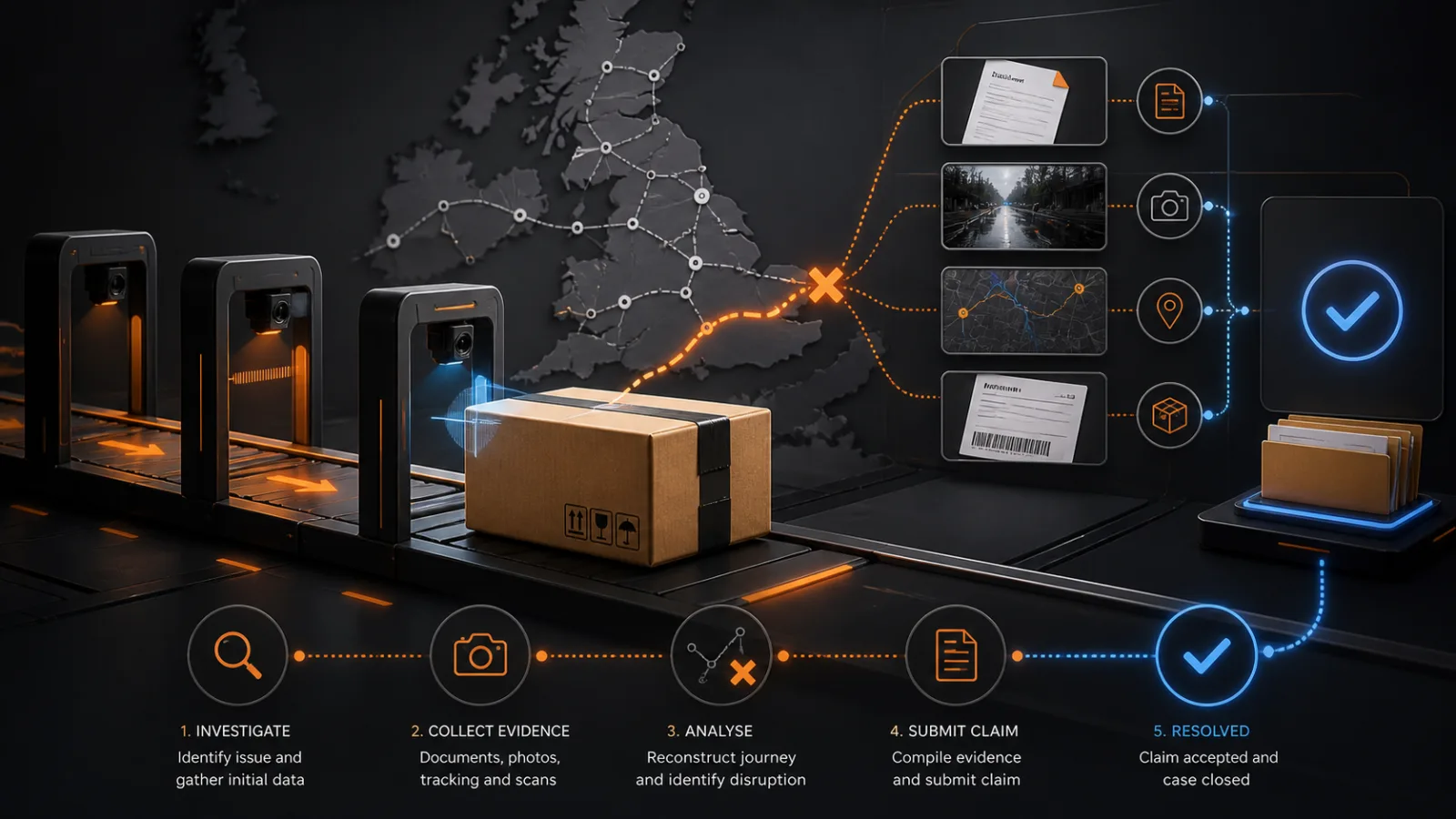
What we have seen in Shopify support and fulfilment reviews is this: missing-parcel cases become expensive when customer service, warehouse staff and finance each keep a different version of the event. The customer wants certainty; the carrier wants evidence; finance wants a recoverable ledger entry. One governed case must serve all three.
Contact StoreBuilt to connect Shopify orders, tracking events and support actions into one delivery-exception workflow.
Table of contents
- Keyword decision
- Define the lost-parcel trigger
- Separate customer resolution from recovery
- Build the evidence pack
- Automate without losing control
- Measure the real cost
- StoreBuilt point of view
Keyword decision
Primary keyword: Shopify lost parcel UK. Secondary intents include ecommerce carrier claims, missing parcel process and Shopify delivery investigation. Intent is operational-commercial, at the point where a merchant needs a repeatable system or integration. Competitor libraries tend to cover shipping apps broadly; StoreBuilt can realistically win the narrower implementation question by joining storefront evidence, helpdesk ownership, carrier deadlines and finance reconciliation.
Define the lost-parcel trigger
“The parcel has not arrived” is a customer report, not yet an operational status. Define when a delayed shipment becomes an investigation and when an investigation becomes presumed lost. The rule should use the promised delivery date, latest meaningful tracking event, carrier service, destination and any incident notice.
| Signal | Operational meaning | Next action |
|---|---|---|
| delivery promise missed | service failure may have started | check live tracking and carrier notice |
| no movement after collection | parcel may be stalled | open investigation timer |
| delivered scan disputed | proof needs validation | request delivery evidence |
| carrier confirms loss | recovery case is ready | resolve customer and file claim |
| parcel arrives after resolution | duplicate-value risk | follow late-arrival policy |
Do not use one threshold for every carrier and service. A next-day parcel with no acceptance scan needs a different response from an economy shipment moving through a known disruption. Record the rule version used so support can explain why a case was escalated.
Separate customer resolution from recovery
The customer should not become the retailer’s claims administrator. Create two linked tracks: a customer-resolution track with clear communication and an internal recovery track with carrier deadlines. The first decides whether to replace, refund or wait with consent; the second pursues compensation and diagnoses failure.
An anonymous home and lifestyle merchant handled missing parcels through a shared inbox. Agents repeatedly asked customers for information already present in Shopify, while carrier forms were filed only after refunds appeared in a finance report. A single exception record, opened from the fulfilment event and assigned a deadline, removed the hand-offs without changing the carrier.
| Decision | Customer factors | Operational factors |
|---|---|---|
| replace now | urgency, stock availability, preference | fraud signal, replacement route, cost |
| refund | customer preference, consumer policy | payment method, ledger treatment |
| continue investigation | customer agrees, parcel still moving | reliable next scan or carrier response |
| escalate | vulnerable customer, high value, repeated failure | manager approval and evidence review |
This article is practical implementation guidance, not legal advice. UK merchants should confirm their consumer obligations and policy wording with qualified advisers; a carrier’s internal claims timetable does not replace the retailer’s responsibilities to its customer.
Explore Shopify integration and automation support for tracking and helpdesk orchestration.
Build the evidence pack
Capture evidence before systems overwrite or hide it. Store the Shopify order and fulfilment IDs, order value, address used at dispatch, carrier and service, label and manifest references, acceptance scan, tracking timeline, promised date, parcel weight, packaging evidence and customer communications. For a disputed delivered scan, retain the carrier’s proof-of-delivery material and the customer’s concise non-receipt statement where required.
Create a checklist by carrier rather than one universal form. Claim windows, excluded goods, compensation bases and requested documents differ. Give every case a “file by” date earlier than the true deadline and make missing evidence visible.
Preserve the commercial outcome too: original item cost, outbound postage, replacement postage, refund, goodwill credit and recovered amount. A successful claim can still mask an unprofitable service if administration and repeat contacts consume the recovery.
Automate without losing control
Use carrier webhooks or scheduled tracking checks to flag silence, exception scans and disputed delivery. Shopify Flow or an integration can tag the order, create a helpdesk ticket, attach core fields and start timers. It should not automatically declare loss from one ambiguous scan.
Use idempotent actions: one order should create one active case, and retrying an integration must not issue a second refund. Restrict refund and replacement permissions, require a recorded reason, and close linked tasks when the resolution changes. If a replacement is sent, connect its fulfilment to the original case so another delay is visible.
Test partial fulfilments, split shipments, edited addresses, reshipments, subscription orders, click-and-collect handoffs and late-delivered parcels. Customer emails should describe the next decision and time, not expose internal carrier jargon.
Measure the real cost
Report cases per thousand shipments by carrier, service, warehouse and postcode band. Add median and 90th-percentile customer resolution time, time to claim submission, recovery rate, denial reason, repeat contacts and late-arrival duplicates.
| Pattern | Likely intervention |
|---|---|
| no first scan | warehouse manifest and handover control |
| loss concentrated on a service | carrier/service routing review |
| high claim denial | evidence completeness and deadline control |
| repeat contacts | clearer owner and promised update time |
| late arrival after refund | threshold or intercept policy review |
Review trends monthly and peak incidents daily. A low parcel-loss rate can still harm a high-value category disproportionately. Use contribution impact, not parcel count alone, to prioritise fixes.
Request a Shopify audit if delivery exceptions are being managed across disconnected exports and inboxes.
Run a lost-parcel tabletop test
Before peak, select representative orders and rehearse the whole case without issuing real money. Include a parcel with no first scan, disputed delivery, a partial fulfilment, a high-value item, an edited address and a replacement that later arrives. Ask support to identify the customer deadline, operations to assemble evidence and finance to show the expected recovery entry.
The test should expose missing fields and ambiguous ownership. Confirm that the original promise and tracking timeline remain available after a carrier status changes. Verify that an agent can see whether a refund or replacement already occurred and that a second action requires deliberate approval. Simulate an integration retry and confirm it creates neither a duplicate ticket nor a duplicate financial action.
Finally, sample the carrier submission itself. Check file formats, evidence limits, contractual deadline and claim-value basis against the merchant’s current service agreement. Record where a human must intervene. A playbook is only ready when an unfamiliar authorised colleague can follow the evidence, reach the next decision and explain the outcome to the customer without searching several private inboxes.
StoreBuilt point of view
StoreBuilt believes a lost parcel is not merely a carrier problem. It is a joined customer, data and finance workflow. Resolve the customer on a truthful timetable, preserve the evidence automatically and make recovery measurable; otherwise every missing box becomes an avoidable reinvention.