
What we have seen in StoreBuilt leadership workshops is this: Shopify reporting often answers marketing questions faster than finance questions. That creates delayed decisions on cash, margin, and inventory risk.
If your ecommerce leadership team needs a clearer commercial dashboard for Shopify decision-making, Contact StoreBuilt.
Table of contents
- Keyword decision and research inputs
- Why UK ecommerce teams need a CFO-grade Shopify view
- Core KPI framework for weekly decision-making
- How to connect channel metrics to contribution economics
- Dashboard governance model
- StoreBuilt example
- Final StoreBuilt point of view
Keyword decision and research inputs
Primary keyword: shopify cfo dashboard kpis
Secondary keywords:
- ecommerce UK market KPI dashboard
- Shopify finance reporting for ecommerce
- ecommerce profitability metrics UK
- contribution margin ecommerce dashboard
- Shopify executive reporting
Search intent: commercial implementation guidance for finance and ecommerce leadership teams.
Funnel stage: middle to bottom funnel.
Page type: strategic implementation guide.
Why StoreBuilt can realistically win this topic:
- We support teams where platform decisions need tighter finance alignment.
- We bridge operational metrics and executive decision criteria.
- We help convert broad KPI lists into usable weekly governance.
Research inputs used in angle selection:
- SERP intent review around Shopify KPI and ecommerce finance reporting topics.
- UK agency competitor content analysis for finance-oriented gaps.
- Keyword-style demand mapping from related query clusters.
Why UK ecommerce teams need a CFO-grade Shopify view
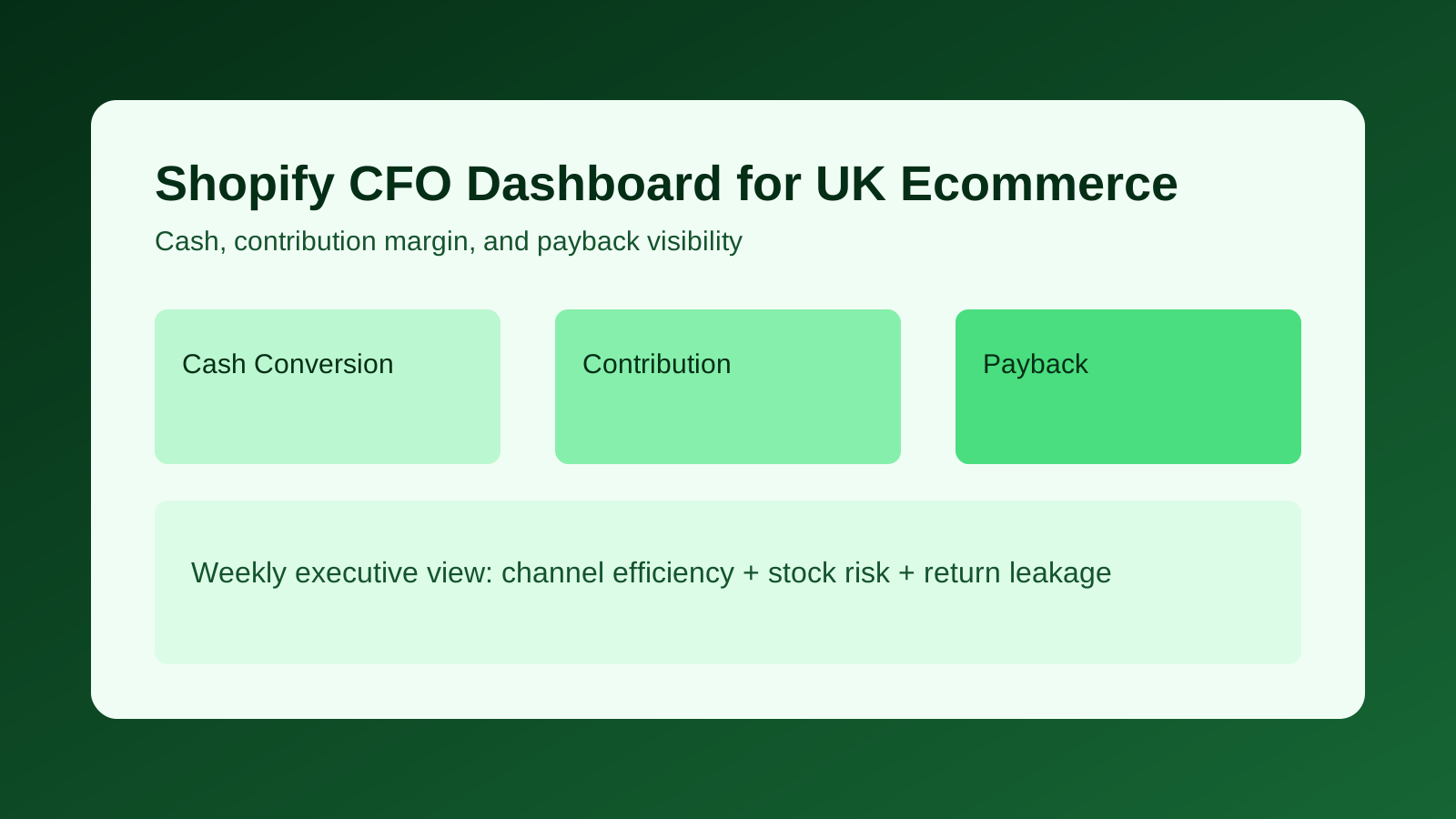
Many teams track ROAS, sessions, and conversion rates well. Fewer teams have a reliable weekly view of contribution, cash conversion, and return leakage by channel.
Without that view, growth can look healthy while economics weaken.
A CFO-grade dashboard should answer:
- Which channels are creating net profitable demand?
- Where are return patterns eroding contribution?
- Which stock decisions threaten cash and availability?
- How fast is marketing spend converting into recoverable cash?
Core KPI framework for weekly decision-making
Use a balanced KPI set that combines growth and resilience.
| KPI | Why it matters | Typical weekly trigger |
|---|---|---|
| Net revenue after returns | True top-line quality | Sharp deviation by channel or category |
| Contribution margin by channel | Real growth efficiency | Paid scale decision |
| Customer payback window | Cash discipline | Budget reallocation trigger |
| Inventory cover by priority categories | Stock-risk control | Reorder and promotion decisions |
| Return rate + reason profile | Margin protection | PDP and policy intervention |
| Blended CAC vs target bands | Acquisition control | Media pacing decisions |
Keep definitions fixed. Changing metric definitions too often destroys decision trust.
How to connect channel metrics to contribution economics
Do not report channels in isolation.
| Reporting layer | Example metric | Executive use |
|---|---|---|
| Demand | Sessions, new customer rate | Understand acquisition momentum |
| Conversion quality | Checkout completion, AOV | Evaluate conversion health |
| Economic quality | Net contribution, payback | Decide scale vs protect strategy |
| Operational risk | Return leakage, stockouts | Prevent false-positive growth |
A practical rule: no channel should be scaled only on blended ROAS if return-adjusted contribution is deteriorating.
For teams that need finance and ecommerce reporting aligned with platform execution, StoreBuilt can help build the operating model.
Dashboard governance model
A good dashboard without governance still fails.
| Cadence | Meeting outcome | Core attendees |
|---|---|---|
| Weekly performance council | Channel pacing and priority actions | Ecommerce, finance, growth, operations |
| Fortnightly risk review | Return and stock risk interventions | Operations, merchandising, finance |
| Monthly strategic review | Investment and roadmap shifts | Leadership team |
Each session should end with named owners, deadlines, and expected metric impact.
StoreBuilt example
A UK Shopify operator reported strong revenue growth but had recurring cash pressure and margin volatility. Channel reporting was detailed, but finance and ecommerce teams used different KPI definitions and decision cadences.
We helped align a shared metric dictionary, introduced return-adjusted contribution reporting, and established a weekly decision framework that linked media pacing to stock and margin realities. Execution improved because teams stopped debating data structure and started acting on one shared commercial view.
If your reporting is comprehensive but still not decision-useful, Contact StoreBuilt.
High-intent AI search implementation layer
The AI-search version of this topic is not just “write more content”. A useful answer engine result needs a page that gives a direct answer, proves the claim, and shows the next operational step inside Shopify.
| Area | StoreBuilt implementation check |
|---|---|
| Primary intent | The page should map to shopify cfo dashboard and one clear buyer or operator problem, not a vague traffic topic. |
| Shopify surface | Identify whether the work belongs on a collection, product page, theme section, checkout step, app workflow, email flow, or support process. |
| Proof | Add first-hand observations, product/category examples, screenshots, policy notes, review signals, or trustworthy external sources where they make the advice safer. |
| Internal route | Link the reader to the service most likely to solve the issue: Shopify store design and development. |
| Measurement | Check Search Console, analytics, assisted conversions, enquiry quality, and AI-response mentions after the update rather than judging success by pageviews alone. |
For this article, the useful research inputs are: Shopify Help documentation, StoreBuilt implementation patterns, UK ecommerce SERP intent, and common founder/operator questions. StoreBuilt would prioritise practical Shopify setup, theme structure, page hierarchy, product data, and launch-ready implementation before expanding into broader supporting content.
If this topic maps to a live store problem, review the related StoreBuilt service or Contact StoreBuilt with the store URL and the issue you want fixed.
Final StoreBuilt point of view
In the ecommerce UK market, the strongest Shopify leadership teams treat KPI architecture as a commercial control system, not a reporting exercise. Clarity on contribution, cash, and operational risk usually matters more than adding more dashboards.
If you want StoreBuilt to help design a CFO-grade Shopify KPI framework your team can run every week, Contact StoreBuilt.