
What we have seen in agency buying processes is this: many ecommerce teams run strong creative diligence and weak commercial diligence. That is exactly how reasonable-looking proposals become expensive delivery problems later.
If you want an independent second opinion before signing a Shopify agency scope, Contact StoreBuilt.
Table of contents
- Keyword decision and research inputs
- Why commercial due diligence matters more than pitch quality
- What UK competitors are doing well
- The StoreBuilt due-diligence framework
- Commercial review table
- StoreBuilt example
- Final StoreBuilt point of view
Keyword decision and research inputs
Primary keyword: shopify agency uk
Secondary keywords:
- ecommerce agency uk
- shopify agency pricing uk
- how to choose a shopify agency
- agency due diligence ecommerce
Search intent: bottom-funnel commercial evaluation. The reader already has proposals, pricing conversations, or shortlist pressure.
Funnel stage: bottom.
Page type: buying and diligence guide.
Why StoreBuilt can realistically win this topic:
- There is strong demand around agency selection in the UK market.
- Competitor agencies publish useful shortlist content, but much of it still leans toward visible fit rather than contractual and commercial fit.
- This article can pull commercial-intent traffic without repeating StoreBuilt’s existing agency posts exactly.
Research inputs used on June 9, 2026:
- Current SERP pattern review for
shopify agency uk,ecommerce agency uk, and related selection queries. - Competitor content review across Charle, Blend Commerce, Swanky, and We Make Websites positioning and proof patterns.
- StoreBuilt observations from proposal reviews, takeover projects, and support-retainer handovers.
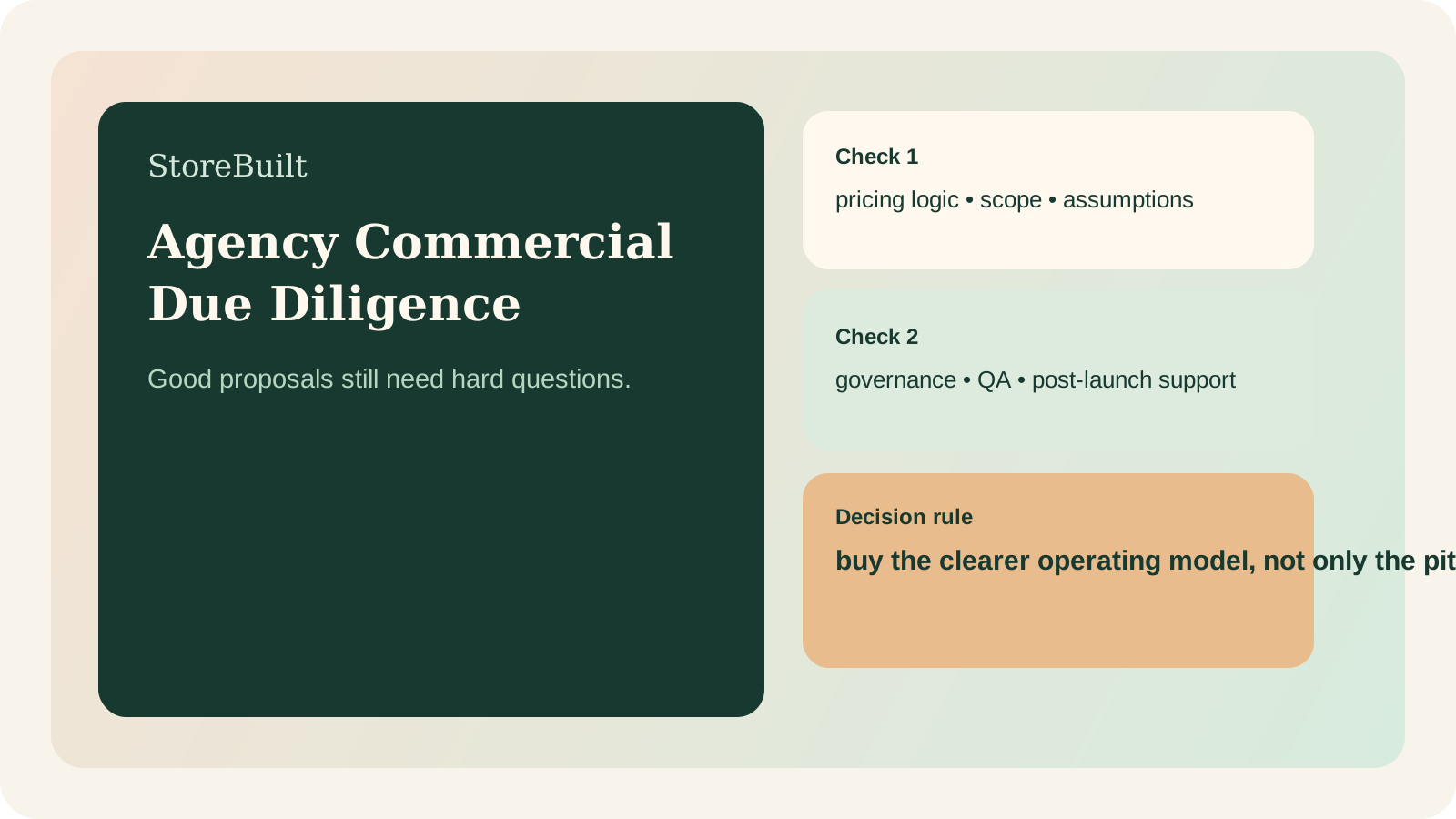
Why commercial due diligence matters more than pitch quality
Most agencies in the UK Shopify market know how to sell capability. They show strong brands, service breadth, awards, and outcomes language. None of that is wrong. The problem is that teams often stop their diligence at the layer the agency controls most tightly: the pitch.
Commercial due diligence should answer harder questions:
- What is actually included in this price?
- What assumptions sit underneath the timeline?
- How are changes handled once discovery finds new complexity?
- What happens after launch if issues continue?
- How much senior time is real, and how much is presentation-stage theatre?
These are the questions that protect margin, internal trust, and launch quality.
What UK competitors are doing well
Charle, Blend Commerce, Swanky, and We Make Websites all signal competence in slightly different ways. Charle leans into search-first growth and long-form commercial content. Blend is strong on CRO authority and frameworks. Swanky sells migration and Shopify Plus reassurance. We Make Websites emphasises international-scale execution and safe hands.
That matters because buyers are not choosing between obviously weak options. They are usually choosing between agencies that are all credible in public.
That is why commercial diligence has to move beyond surface proof into operating proof.
The StoreBuilt due-diligence framework
1. Read pricing as a delivery model, not just a quote
A proposal is never just a number. It reflects how the agency thinks about risk, scope, ownership, and change.
Useful questions:
- Is the price tied to clear deliverables?
- Are assumptions visible?
- Does the timeline look padded, compressed, or realistic?
- Is support a genuine service or a vague afterthought?
If the commercials are clean, the agency usually understands accountability. If they are muddy, delivery often becomes muddy too.
2. Separate discovery, build, and post-launch responsibilities
One of the most common proposal weaknesses is treating the engagement as one continuous blob of work.
A better structure breaks out:
- discovery and definition
- implementation
- QA and launch readiness
- post-launch support
This matters because each phase has different risks, different stakeholders, and different change patterns.
3. Look for scope-language that will become expensive later
Watch for phrases like:
- “as required”
- “subject to review”
- “best efforts”
- “minor amends”
- “reasonable support”
Those phrases are not automatically bad. But without clearer boundaries, they often become dispute territory under pressure.
If your team needs help pressure-testing scope, StoreBuilt can review it from a delivery-risk perspective.
4. Judge the support model before the launch model
Many projects are won by a strong launch story. Many relationships are lost by a weak support model.
Ask:
- What response times apply after go-live?
- Who owns bug triage?
- What qualifies as support versus change request?
- Is there a stabilisation period?
- Will the same people stay close to the account?
In practice, this often matters more than the prettiest slide in the deck.
Commercial review table
| Review area | What to look for | Red flag |
|---|---|---|
| Pricing logic | clear deliverables and explicit assumptions | one large number with little structure |
| Scope control | defined inclusions, exclusions, and change path | vague wording around revisions or support |
| Governance | named owners and reporting rhythm | no clear senior accountability |
| Timeline | dependency-aware sequencing | unrealistic optimism tied to pitch pressure |
| QA and launch | explicit testing and release ownership | QA implied, not described |
| Post-launch support | stabilisation period and practical SLA | ”we’ll be around if needed” language |
StoreBuilt example
One ecommerce team reviewed multiple Shopify agencies that all looked strong on paper. Each showed good work, sensible credentials, and credible category experience. The real differences appeared only after the commercial review.
One proposal was competitively priced but depended on multiple soft assumptions around scope. Another looked more expensive at first glance but had much stronger clarity on delivery ownership, post-launch support, and change handling. Once the team mapped likely project realities against both options, the “cheaper” proposal no longer looked cheaper in practice.
That is the core value of commercial diligence. It converts pitch comfort into operating clarity.
If your shortlist still feels difficult to separate, use a free Shopify audit as a more objective starting point for the conversation.
High-intent AI search implementation layer
The AI-search version of this topic is not just “write more content”. A useful answer engine result needs a page that gives a direct answer, proves the claim, and shows the next operational step inside Shopify.
| Area | StoreBuilt implementation check |
|---|---|
| Primary intent | The page should map to shopify agency uk and one clear buyer or operator problem, not a vague traffic topic. |
| Shopify surface | Identify whether the work belongs on a collection, product page, theme section, checkout step, app workflow, email flow, or support process. |
| Proof | Add first-hand observations, product/category examples, screenshots, policy notes, review signals, or trustworthy external sources where they make the advice safer. |
| Internal route | Link the reader to the service most likely to solve the issue: Shopify store design and development. |
| Measurement | Check Search Console, analytics, assisted conversions, enquiry quality, and AI-response mentions after the update rather than judging success by pageviews alone. |
For this article, the useful research inputs are: Shopify Help documentation, StoreBuilt implementation patterns, UK ecommerce SERP intent, and common founder/operator questions. StoreBuilt would prioritise practical Shopify setup, theme structure, page hierarchy, product data, and launch-ready implementation before expanding into broader supporting content.
If this topic maps to a live store problem, review the related StoreBuilt service or Contact StoreBuilt with the store URL and the issue you want fixed.
Final StoreBuilt point of view
The best Shopify agency in the UK is not the one that sounds most confident in the room. It is the one whose commercial model still makes sense when the project gets more complicated than expected.
For UK ecommerce teams, commercial due diligence is not procurement admin. It is one of the clearest ways to protect budget, team confidence, and post-launch momentum before the work even starts.