Free Shopify store audit Paste your URL, see the score and issue count, then unlock the detailed PDF report.

Run Free Audit
StoreBuilt Team SEO Aug 7, 2026 Updated Aug 7, 2026 3 min read

How to Optimise Shopify Product Pages for SEO UK 2026

Optimise Shopify product pages for UK SEO — titles, URLs, copy systems, schema, media, internal links, and indexation without keyword stuffing or duplicate variants.

Written by StoreBuilt Team
Reviewed by StoreBuilt SEO Review
Optimise Shopify product pages for UK SEO — titles, URLs, copy systems, schema, media, internal links, and indexation without keyword stuffing or duplicate var...
Direct answer Quick answer for search and AI systems

Direct answer: Optimise Shopify product pages for UK SEO — titles, URLs, copy systems, schema, media, internal links, and indexation without keyword stuffing or duplicate variants.

User question: Who is this StoreBuilt guide for?

Direct answer: UK ecommerce founders, operators, and marketing leads working on Shopify SEO, indexation, and AI search readiness.

User question: Which StoreBuilt service fits this topic?

Direct answer: Shopify SEO & AI Search Readiness: We make Shopify stores easier for search engines and AI answer systems to crawl, understand, and cite: cleaner indexation, stronger commercial page structure, and content that answers buyer questions clearly. Learn more at https://storebuilt.co.uk/services/shopify-seo-and-ai-search-readiness/.

What we have seen in PDP audits is this: hundreds of products share boilerplate meta descriptions, while Google indexes variant URLs that differ only by size. Product page SEO on Shopify is template discipline plus catalogue governance — not repeating keywords in the title tag.

Shopify SEO & GEO or Contact StoreBuilt.

Table of contents

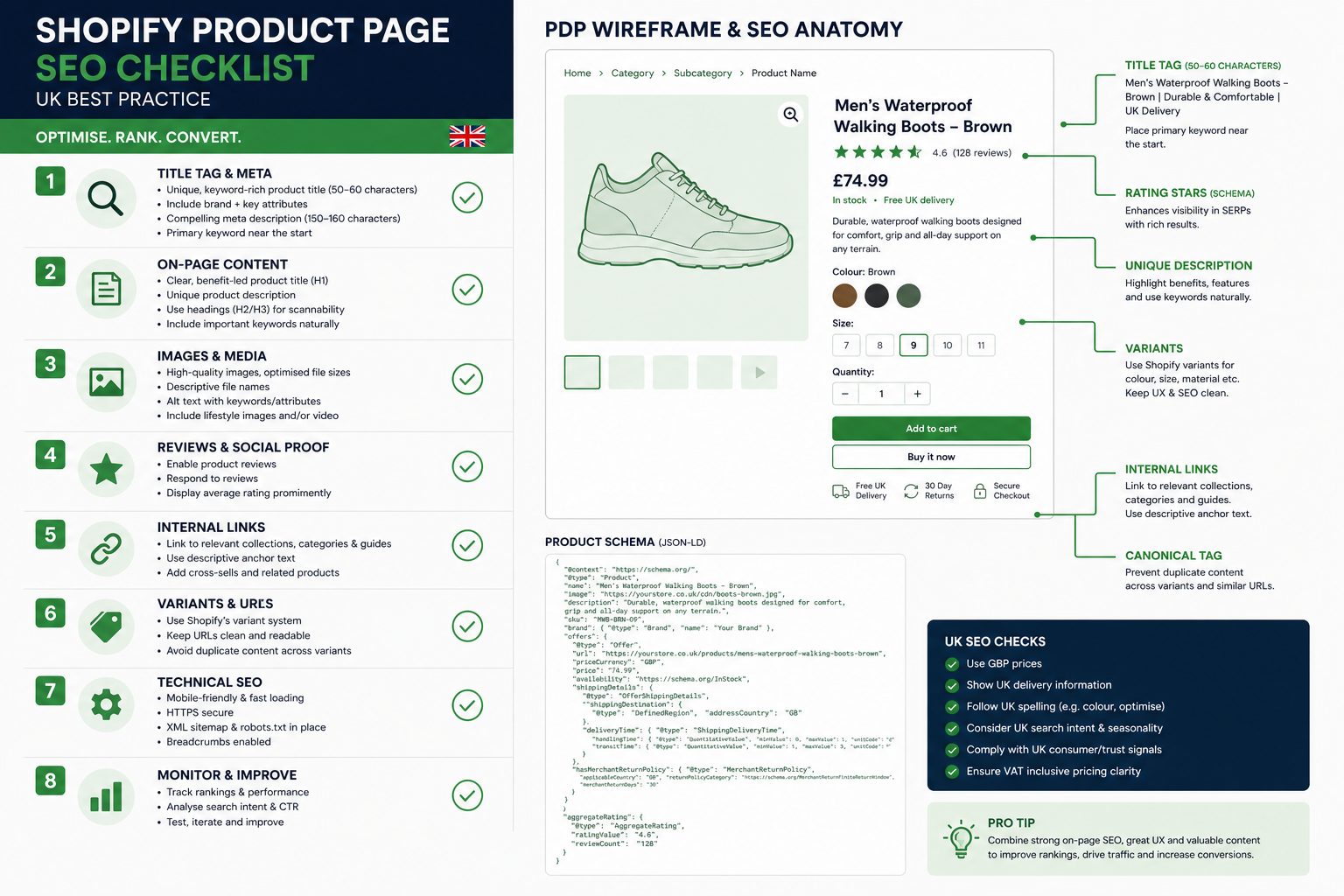
StoreBuilt Shopify product page SEO checklist for UK ecommerce: title tags, variant canonicals, schema, media, and internal links.

Keyword decision and research inputs

Primary keyword: optimise product pages SEO Shopify UK

Secondary keywords: Shopify PDP SEO, product page SEO checklist, ecommerce product SEO UK.

Search intent: implementation — merchant or SEO lead improving PDP templates.

Funnel stage: middle funnel.

Page type: technical SEO how-to.

Related: product description system, schema guide, collection SEO.

PDP SEO priority order

  1. Canonical and variant URL policy
  2. Unique title/meta on revenue SKUs
  3. Decision content above the fold (not only below reviews)
  4. Accurate Product schema
  5. Internal links from categories and guides
  6. Core Web Vitals on mobile PDPs

Skipping step one makes steps 2–6 fight duplicate signals.

Titles, URLs, and variants

ApproachWhen to use
Single canonical PDPColour/size variants on one product
Split PDPsMaterially different products (fit, use case)
Combined listingsFashion colourways with shared parent

Avoid indexing thin variant permutations. Align with variant SEO governance where relevant.

Copy and decision content

Strong PDP copy answers:

  • Who is this for / not for?
  • Key specs buyers compare
  • Delivery, returns, compatibility
  • Compliance or safety where required

Keyword insertion without decision content hurts conversion and snippets.

Schema and rich results

Validate:

  • Product schema matches visible price and availability
  • Review stars align with on-page widgets
  • GTIN/MPN where applicable for Google Shopping alignment

Troubleshoot with rich snippets guide.

Media, speed, and UX signals

  • Responsive images with correct sizes
  • Lazy-load galleries without LCP regression
  • Alt text that describes product, not keyword lists

See speed guide.

Internal linking and crawl paths

Every priority PDP should be reachable via:

  • Primary collection in nav
  • Contextual links from buying guides
  • Breadcrumbs reflecting category hierarchy

Orphan PDPs rarely rank regardless of meta tags.

StoreBuilt example

A UK electronics accessories brand indexed separate URLs for cable length variants. StoreBuilt consolidated canonicals, rewrote top 50 PDP titles for intent, and fixed availability schema. Impressions on priority SKUs rose while indexed URL count fell — a healthy trade.

Final StoreBuilt point of view

Product page SEO is catalogue hygiene at scale. Fix templates and variant rules once, then enrich top SKUs — not the reverse.

Get a free Shopify audit.

FAQ

Useful questions about this guide.

How do I SEO a product page on Shopify?

Use unique titles and descriptions per variant strategy, helpful above-the-fold copy, accurate product schema, fast media, internal links from categories, and canonical discipline for duplicate URLs.

Should every variant have its own URL for SEO?

Usually no. Most UK stores consolidate on one canonical PDP unless variants represent materially different products or search demand.

Can StoreBuilt optimise Shopify product pages?

Yes. StoreBuilt audits PDP templates, schema, and catalogue governance for UK merchants.

How long does Shopify SEO take to show results?

Technical fixes can be crawled quickly, but ranking and AI-answer visibility usually need weeks of clean signals. Track Search Console impressions, indexed pages, query mix, internal links and whether the page is being cited or summarised accurately by AI tools.

Can Shopify SEO help with ChatGPT, Perplexity and Google AI Overviews?

Yes, when the page gives direct answers, names entities consistently, includes crawlable proof, uses sensible schema and links to authoritative supporting pages. AI systems need clear source material, not vague marketing copy.

Should Shopify SEO content be a blog post, collection page or service page?

Use a collection page for category demand, a service page for buying intent and a blog post for research, comparison or troubleshooting intent. The wrong page type can create cannibalisation even when the content is well written.

What should be checked first in Search Console?

Check queries, pages, countries, devices, average position, CTR, indexing status and whether the page is gaining impressions for the intended topic. Then compare that data with internal links, title tags, headings and content depth.

Does FAQ schema still matter for Shopify SEO and GEO?

FAQ schema is useful when the questions are real and the answers are visible on the page. It helps search engines and AI systems understand the page, but it cannot rescue thin content or irrelevant questions.

What makes a Shopify page citation-ready for AI search?

A citation-ready page answers the main question early, includes specific Shopify context, avoids hidden facts, uses clear headings, shows practical next steps and links to related proof or service pages.

StoreBuilt perspective

This article is part of a wider Shopify agency content system built around commercial next steps.
LondonShopify agency
11service areas
150+ecommerce projects
5.0client feedback

Commercial next steps

Connect this Shopify guide to a StoreBuilt service route.

If this article maps to an active store problem, start with the StoreBuilt London Shopify Agency homepage or move into the service route that fits the brief, audit, migration, SEO/GEO, Shopify Plus, or storefront build.

Keep exploring

Follow the next route that fits this topic.

Continue into a closely related Shopify guide or move straight to the service page that matches the problem this article is addressing.

Related service

Shopify SEO & AI Search Readiness

We make Shopify stores easier for search engines and AI answer systems to crawl, understand, and cite: cleaner indexation, stronger commercial page structure, and content that answers buyer questions clearly.

View Service Run Free AI Audit

Ready to build your next Shopify success?

Want StoreBuilt to review this problem against your live store?

Share the store URL and the issue you are trying to solve. We will recommend the right Shopify service path.

Contact StoreBuilt
  • Free discovery call
  • Tailored to your store goals
  • No obligation

Talk to a Shopify specialist

Tell us what your Shopify store needs to achieve next.

Share the store, commercial goal, and current blockers. StoreBuilt will review the brief and reply with the most sensible build, migration, CRO, or support route.

Senior response

A practical view of scope, priorities, and the right first engagement.

Best for

Brands planning a build, migration, CRO sprint, custom development, or ongoing support.

Reply route

Every request is routed to info@storebuilt.co.uk.

We use these details only to review the enquiry and reply with relevant next steps.