
What we have seen in retention audits is this: UK Shopify brands pay for Klaviyo, launch two flows, then blast campaigns because nobody owns flow logic. Klaviyo flows should be a governed system — not a template gallery you never maintain.
Klaviyo email & SMS or Contact StoreBuilt.
Table of contents
- Keyword decision and research inputs
- Flow architecture principles
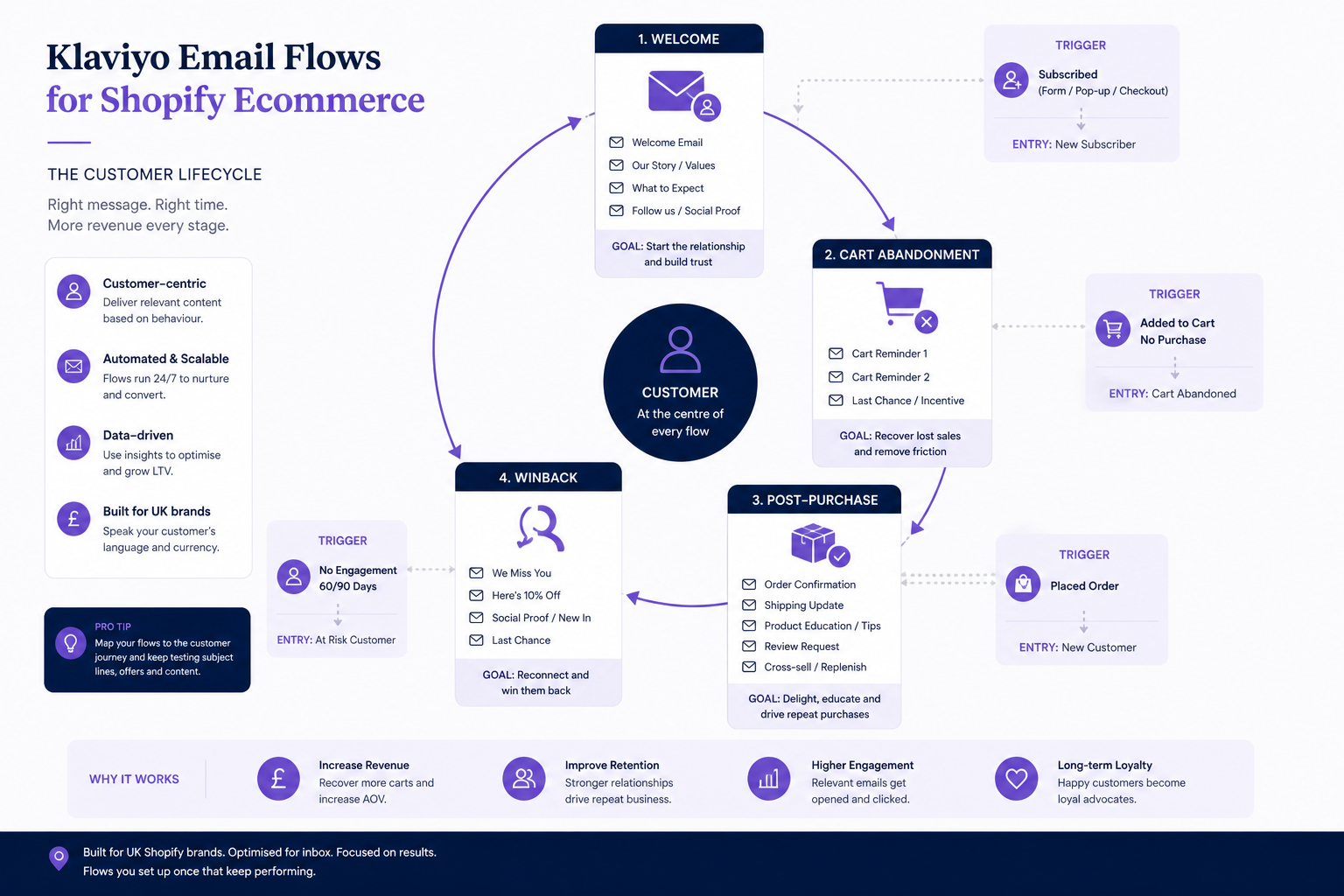
- Core flows every UK Shopify store needs
- Segmentation and suppression rules
- SMS coordination and consent
- Measurement that finance trusts
- Common flow mistakes
- StoreBuilt example
- Final StoreBuilt point of view
Keyword decision and research inputs
Primary keyword: Klaviyo flows Shopify UK
Secondary keywords: Shopify email automation UK, lifecycle email ecommerce UK, Klaviyo automation playbook.
Search intent: implementation. Funnel: middle. Page type: playbook.
Related: marketing automation playbook and customer retention strategies.
Flow architecture principles
| Principle | Why it matters |
|---|---|
| One entry rule per intent | Prevents duplicate emails and list fatigue |
| Suppression before send | Active subscribers, recent purchasers, support cases |
| Dynamic product blocks | Relevance beats generic hero banners |
| Test subject lines in flows | Small gains compound at flow scale |
| Document owners | Merchandising, CRM, and ops must know who edits what |
Core flows every UK Shopify store needs
Welcome series
Introduce brand proof, bestsellers, and delivery/returns clarity. Delay second email if first purchase happens within 24 hours.
Browse abandonment
Trigger on high-intent product views with stock and variant accuracy. Exclude out-of-stock SKUs.
Cart abandonment
Separate from browse abandon. Show line items, shipping threshold, and trust signals — not discount codes by default.
Post-purchase
Set delivery expectations, cross-sell complementary SKUs, request reviews after fulfilment — not at checkout.
Replenishment
For consumables: timing based on SKU repurchase intervals, not arbitrary 30-day delays.
Winback
Target lapsed buyers with newness or category entry offers; suppress if they reactivated via another channel.
Segmentation and suppression rules
- Split VIP, first-time, and subscription cohorts
- Exclude B2B trade accounts from DTC promo tone
- Respect marketing consent and soft opt-in rules for UK email
- Pause flows during site outages or checkout incidents
SMS coordination and consent
Pair high-intent SMS (cart, dispatch) with email — never duplicate the same offer in both channels within hours. Capture SMS consent explicitly; document opt-out handling.
See: SMS marketing governance.
Measurement that finance trusts
Track flow-attributed revenue, but also:
- Unsubscribe and spam complaint rates per flow
- Cannibalisation vs paid media on promo flows
- Incrementality on discount-led recovery flows
Common flow mistakes
| Mistake | Symptom |
|---|---|
| Discount-first cart recovery | Margin erosion, trained waiters |
| No stock check in product blocks | Emails for unavailable SKUs |
| Stale flow copy after rebrand | Trust drop, brand inconsistency |
| Campaigns replacing flow maintenance | Revenue spikes then decay |
StoreBuilt example
A UK skincare brand had twelve Klaviyo flows, half conflicting. StoreBuilt consolidated to seven governed flows, fixed browse/cart overlap, and added replenishment by SKU interval. Email revenue share rose without increasing send volume — because relevance improved.
Final StoreBuilt point of view
Klaviyo flows are operating infrastructure, not a launch-week checkbox. UK Shopify teams that treat flows like product features — owned, tested, suppressed, measured — beat teams that only run Black Friday campaigns.