
What we have seen in creator-led ecommerce growth is this: brands often think Shopify Collabs is a discovery shortcut, when the bigger issue is usually the lack of a clear creator operating model.
The tool can help, but it does not remove the need for positioning, offer design, margin discipline, and measurement.
If your brand wants to turn creator partnerships into a more accountable Shopify growth channel, Contact StoreBuilt.
Table of contents
- Keyword decision and research inputs
- What Shopify Collabs is best used for
- When it fits UK ecommerce brands
- Collabs operating model and decision table
- How to design offers without hurting margin
- StoreBuilt example
- 60-day Collabs launch plan
- Final StoreBuilt point of view
Keyword decision and research inputs
Primary keyword: shopify collabs
Secondary keywords:
- how to use Shopify Collabs
- Shopify affiliate marketing
- creator marketing Shopify
- influencer affiliate Shopify
- ecommerce creator partnerships UK
Search intent: educational and solution-aware with channel setup intent.
Funnel stage: middle funnel.
Page type: tactical channel guide.
Why StoreBuilt can realistically win this topic:
- We can explain Collabs as part of a wider commercial system rather than a creator trend.
- UK ecommerce teams need help deciding whether the channel fits their economics and team model.
- Competitor content often focuses on setup basics, not offer governance or attribution quality.
Research inputs used in angle selection:
- Current SERP review around
shopify collabs, creator affiliate terms, and Shopify growth-channel queries. - Charle-style informational guide patterns and adjacent UK ecommerce agency content.
- Public Shopify channel guidance and creator-commerce best practice discussion.
What Shopify Collabs is best used for
Shopify Collabs is best used as a structured creator and affiliate layer for brands that want a cleaner way to recruit, manage, and measure creator partnerships tied to store performance.
That sounds simple, but the difference between useful and wasteful use is significant.
Collabs tends to be most helpful when the business wants to:
- recruit creators with a clearer workflow
- manage codes or affiliate relationships more consistently
- centralise a channel that was previously ad hoc
- connect creator activity more directly to Shopify trading data
It is less useful when the brand still lacks:
- a defined creator proposition
- a margin-aware offer structure
- someone responsible for channel quality
- a clear sense of what “good” creator performance looks like
The tool is not the strategy. It is an operating layer.
When it fits UK ecommerce brands
It tends to fit brands with visually communicative products, repeatable creator hooks, and a team that can actively manage the channel.
That often includes:
- beauty and skincare
- fashion and accessories
- home, lifestyle, and gifting
- specialist wellness or enthusiast categories
The channel is stronger when the proposition is easy for creators to explain and the product can earn repeat content, not just one-off discount promotion.
| Brand condition | Collabs fit | Why |
|---|---|---|
| strong visual product and creator angle | high | easier to recruit and brief relevant partners |
| clear repeat-purchase or gifting logic | high | creator economics become more sustainable |
| thin margin with heavy discount reliance | lower | channel can become expensive quickly |
| weak internal ownership | lower | creator quality and reporting will drift |
| established retention flows | higher | creator traffic has a better post-click path |
This matters because creator channels often look cheaper than paid media in theory, while hiding workload in relationship management and attribution clean-up.
Collabs operating model and decision table
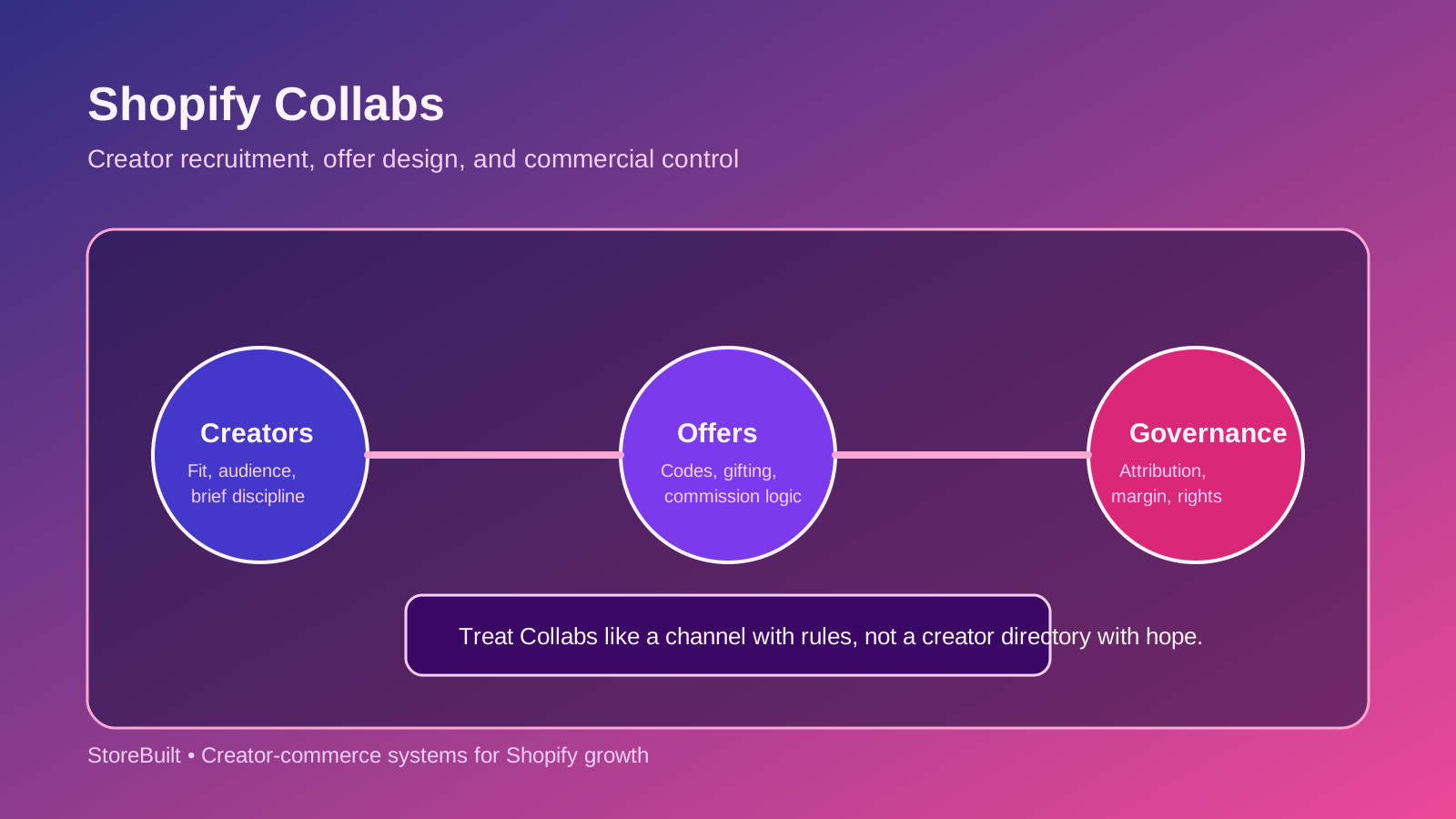
The brands that use Collabs well usually run it like a channel with rules.
That means clear thinking across four areas:
- creator fit
- offer design
- landing experience
- attribution and review
| Area | Good practice | Common mistake |
|---|---|---|
| Creator recruitment | target creators with audience and brand-fit logic | approving too many generic applicants |
| Offer structure | align codes or commission to margin reality | using one blunt discount for everyone |
| Landing flow | give creator traffic a consistent post-click path | sending all traffic to the homepage |
| Measurement | review quality, not only volume | judging success on vanity reach |
One strong pattern we have seen is that ecommerce teams over-focus on recruitment and under-focus on the landing experience. Creator traffic still needs a convincing Shopify journey.
If the product page, offer copy, and checkout trust are weak, Collabs becomes a top-of-funnel amplifier for a weak storefront.
For brands that need the channel connected to stronger onsite conversion, StoreBuilt CRO and UX optimisation should sit close to the programme.
How to design offers without hurting margin
This is where many creator programmes become commercially sloppy.
A stronger Collabs setup usually starts with different offer types for different creator tiers or intents.
For example:
- gifting-first relationships for testing fit
- commission-led partnerships for proven creators
- launch-specific codes for campaign bursts
- content-led collaborations where rights or reuse matter
Questions worth asking before launch:
- Does the commission model still work after returns and discounts?
- Are codes being used to create a real channel or just cheaper sales?
- What is the difference between creator-driven new customer demand and existing-customer discount capture?
- Are creators getting a brief that reflects the product truthfully?
| Offer model | Strong fit | Watch-out |
|---|---|---|
| product gifting | early fit testing | weak if no follow-up process exists |
| fixed creator discount code | simple activation | can train customers to wait for codes |
| commission on attributed sales | scalable if margins allow | reporting and returns need review |
| campaign-specific creator landing page | stronger story control | more setup work but higher quality |
Good creator-commerce systems protect margin as seriously as they pursue reach.
StoreBuilt example
One ecommerce brand wanted to use creator partnerships more seriously after seeing inconsistent results from gifting and informal discount-code sharing. Their belief was that a dedicated platform would make the channel perform better by itself.
The review showed the bigger issue was structure. Creator selection was broad, landing pages were inconsistent, and performance was judged too quickly without clear benchmarks for quality traffic or assisted value.
Once the team clarified who the ideal creator was, aligned offers to margin, and tightened the post-click experience, the channel became easier to evaluate and easier to scale. That is usually the turning point. Better governance makes the tool useful.
60-day Collabs launch plan
Treat it like a channel build, not a plug-in.
| Timeline | Focus | Output |
|---|---|---|
| Days 1-10 | define creator fit, product angle, and offer rules | creator-channel brief |
| Days 11-25 | prepare landing paths, codes, and performance tracking | launch-ready setup |
| Days 26-45 | recruit and test a controlled first cohort | early signal set |
| Days 46-60 | review quality, margin, and repeatability | scale or refine decision |
Metrics worth reviewing:
- creator application quality
- traffic quality by creator
- conversion and AOV by offer type
- code usage concentration
- new customer share
- content reuse value where applicable
If the team is mainly looking at clicks and discount-code activity, it is not measuring the channel deeply enough.
For brands that want a more complete Shopify growth system around creator traffic, retention, and content, StoreBuilt Klaviyo email and SMS retention support can help capture more of the value after the first visit.
High-intent AI search implementation layer
The AI-search version of this topic is not just “write more content”. A useful answer engine result needs a page that gives a direct answer, proves the claim, and shows the next operational step inside Shopify.
| Area | StoreBuilt implementation check |
|---|---|
| Primary intent | The page should map to shopify collabs and one clear buyer or operator problem, not a vague traffic topic. |
| Shopify surface | Identify whether the work belongs on a collection, product page, theme section, checkout step, app workflow, email flow, or support process. |
| Proof | Add first-hand observations, product/category examples, screenshots, policy notes, review signals, or trustworthy external sources where they make the advice safer. |
| Internal route | Link the reader to the service most likely to solve the issue: International expansion and localisation. |
| Measurement | Check Search Console, analytics, assisted conversions, enquiry quality, and AI-response mentions after the update rather than judging success by pageviews alone. |
For this article, the useful research inputs are: StoreBuilt Shopify audits, UK ecommerce SERP intent, Shopify platform documentation, and AI-search measurement patterns. StoreBuilt would prioritise Markets setup, localisation, hreflang, currencies, duties, content adaptation, and operational checks before expanding into broader supporting content.
If this topic maps to a live store problem, review the related StoreBuilt service or Contact StoreBuilt with the store URL and the issue you want fixed.
Final StoreBuilt point of view
Shopify Collabs is useful when a brand is ready to operate creator partnerships as a real growth channel with rules, measurement, and commercial discipline.
It is not a shortcut around channel strategy. The brands that win with it know who they want, what offer they can afford, and what the customer should do after the click. That is what turns creator activity into actual ecommerce growth.