
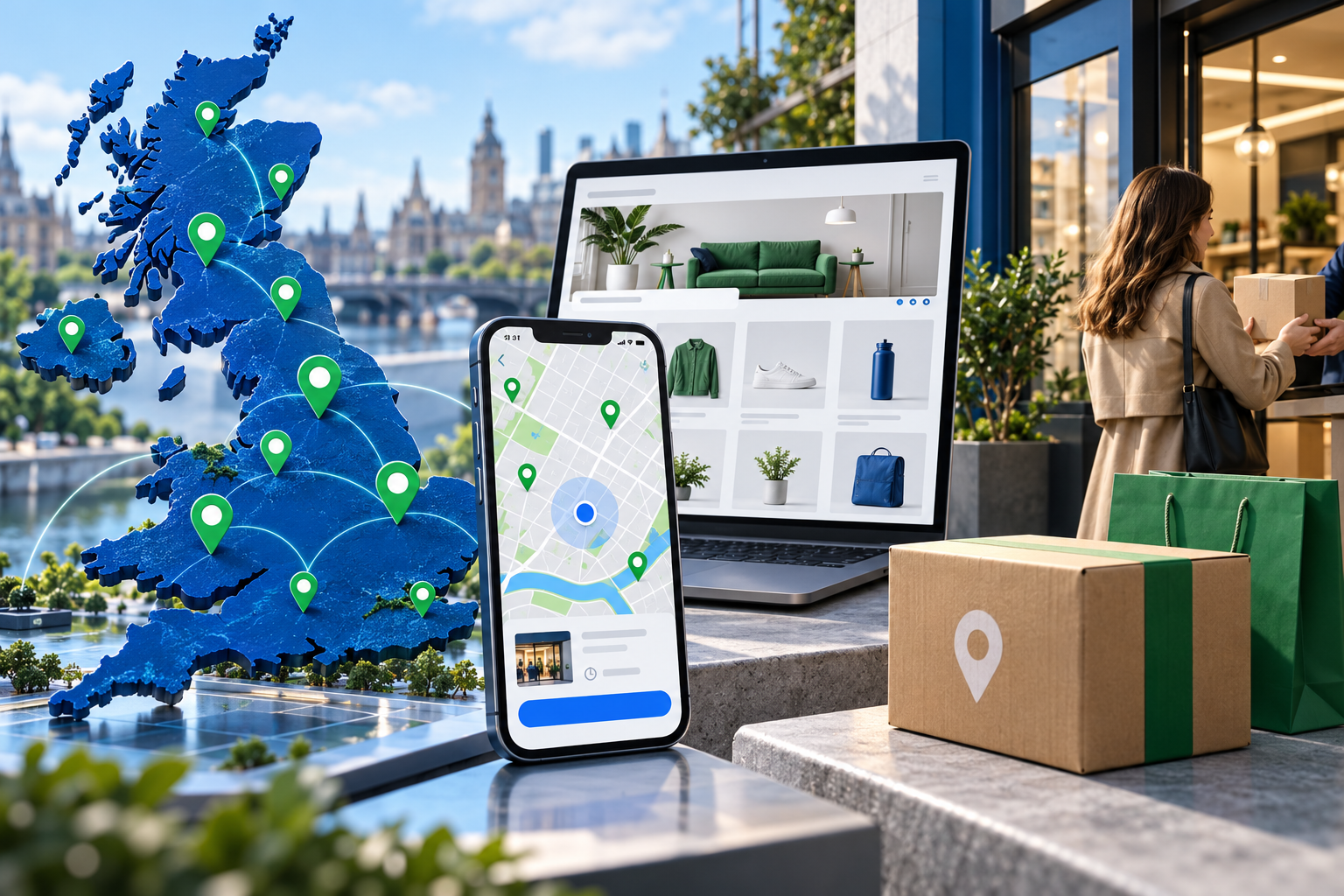
What we have seen is this: Shopify work becomes harder when a customer-facing promise is designed separately from the people and systems that must deliver it. This guide gives UK ecommerce teams a practical way to handle Shopify store locator UK without relying on a vague app recommendation or a generic checklist.
In this guide
- Decide what a shopper needs at the decision moment
- Set a source of truth for location data
- Separate location truth from stock promises
- Connect local discovery to commerce
- Run an exception routine
- StoreBuilt point of view
Keyword decision: Primary keyword: Shopify store locator UK. Supporting terms: local ecommerce SEO, UK retail. Search intent is local commerce implementation and optimisation. The page is a focused implementation guide, not a replacement for StoreBuilt’s agency service pages. Charle’s live Articles hub was used as a UK Shopify editorial-intent signal only; no copy or visual treatment was reproduced. Official Shopify documentation and Google Search Central ecommerce guidance inform the platform and crawlability context. StoreBuilt can add value through the practical hand-offs between merchandising, operations, customer experience and implementation.
Decide what a shopper needs at the decision moment
Customers use a store locator to answer practical questions: where is the nearest store, when is it open, can they collect, who can help and is the journey worthwhile? Start with these answers rather than a map pin. A location page that is attractive but stale creates the kind of lost trip that harms both conversion and trust.
An anonymised StoreBuilt audit found a retailer directing shoppers to a location that had changed its Saturday hours. The underlying map was correct; the operating ownership was not. A named retail approver and seasonal review cadence addressed the real issue.
Set a source of truth for location data
Define who owns names, addresses, phone numbers, opening times, seasonal exceptions, accessibility notes, services, collection instructions and local contact routes. If the ecommerce team and retail team update separate lists, the locator will eventually disagree with reality. Give changes a clear request path and review date.
| Field | Customer reason | Review trigger |
|---|---|---|
| Address and map | Plans the trip | Relocation or access change |
| Opening hours | Avoids a wasted visit | Bank holiday and rota change |
| Collection guidance | Sets fulfilment expectation | Process or carrier change |
| Services | Chooses the right branch | Local capability change |
Separate location truth from stock promises
A store can be open without carrying a product, and a product may be available to collect only after a particular hand-off. Do not imply real-time local stock unless the data path can support it. Use precise copy such as collection availability or contact guidance where certainty is limited.
Contact StoreBuilt to map this workflow around your actual Shopify setup.
Connect local discovery to commerce
Add useful location links from relevant product, delivery and contact routes. Ensure each location page has a distinct explanation of services and practical details—not thin duplicated pages. Structured, crawlable location information can support discovery, but it must first be genuinely helpful to the person choosing where to shop.
Run an exception routine
Bank holidays, relocations, temporary closures and changed collection arrangements create most customer pain. Build an exception checklist, set a reminder before seasonal peaks and make emergency updates possible without a development release.
StoreBuilt point of view
Local ecommerce succeeds when it is specific about what the customer can do next. A reliable store locator is therefore a service-design asset as much as an SEO asset.
Make local information easy to maintain
Location information often becomes inaccurate because changing it is harder than publishing it. Give branch teams a lightweight way to flag a closure, service change or temporary collection constraint, while keeping final publishing approval with the person accountable for customer-facing accuracy. Record the effective date and, where relevant, a review date so a temporary Christmas or refurbishment message does not become permanent by accident.
Use the same approved facts wherever a customer can make a decision: the store locator, location page, delivery or collection help, contact route, campaign landing page and any local social or paid activity. The point is not to duplicate content mechanically; it is to prevent a shopper receiving contradictory instructions after moving from discovery to purchase. A small source-of-truth table is often more valuable than a feature-heavy map.
For local SEO, resist the temptation to create pages with only a place name swapped in. Give each page the details that make that specific visit possible: access, services, collection arrangements and practical local contact information. Review the page as a customer would before treating it as search content. Useful local pages are easier for search engines to understand because they answer real local questions clearly.
Location-data QA checklist
For every branch, test the exact details a visitor needs before leaving home: map destination, postal address, phone contact, normal opening hours, exception hours, accessibility or parking information where relevant, services and collection instructions. Compare the published entry to an approved retail source rather than trusting a prior web page. When there is a discrepancy, fix the source and record who confirmed it.
Test the route from a product that offers local collection to the location information that explains collection. It should be obvious whether the displayed branch can actually support the service, how a customer will hear that an order is ready and what identification or timing applies. Where the stock signal is not live, use wording that avoids implying a guarantee. Careful language here prevents wasted journeys and avoidable contacts.
Track location-page searches, direction clicks, contact clicks, collection-related tickets and complaints about inaccurate information. These signals show whether the locator is solving the expected job. If a retailer uses several systems, agree a periodic reconciliation rather than waiting for a customer to report an old opening time. Data maintenance is recurring operational work, so it deserves a recurring operating habit.
Request a free Shopify audit for a focused review of the affected customer journey, data and hand-offs.
For a scoped implementation plan, Contact StoreBuilt.