
What we have seen in B2B Shopify builds is this: finance asks for Shopify reverse charge VAT setup for EU customers while checkout still treats every order as B2C. UK merchants need a configuration path that matches accountant-approved rules — implemented in Shopify, not guessed in the admin.
Shopify B2B & Plus or Contact StoreBuilt.
This article is practical Shopify implementation guidance, not tax or legal advice. Confirm all rules with your UK accountant.
Table of contents
- Keyword decision and research inputs
- What reverse charge means for UK Shopify merchants
- Prerequisites before Shopify configuration
- Shopify admin setup steps
- Customer VAT validation workflow
- Invoices, checkout messaging, and proof
- Common misconfiguration patterns
- StoreBuilt example
- Final StoreBuilt point of view
Keyword decision and research inputs
Primary keyword: shopify reverse charge vat setup EU customers
Secondary keywords: Shopify B2B VAT UK EU, reverse charge VAT ecommerce UK, Shopify tax settings EU B2B.
Search intent: implementation. Funnel: middle. Page type: technical ops guide.
What reverse charge means for UK Shopify merchants
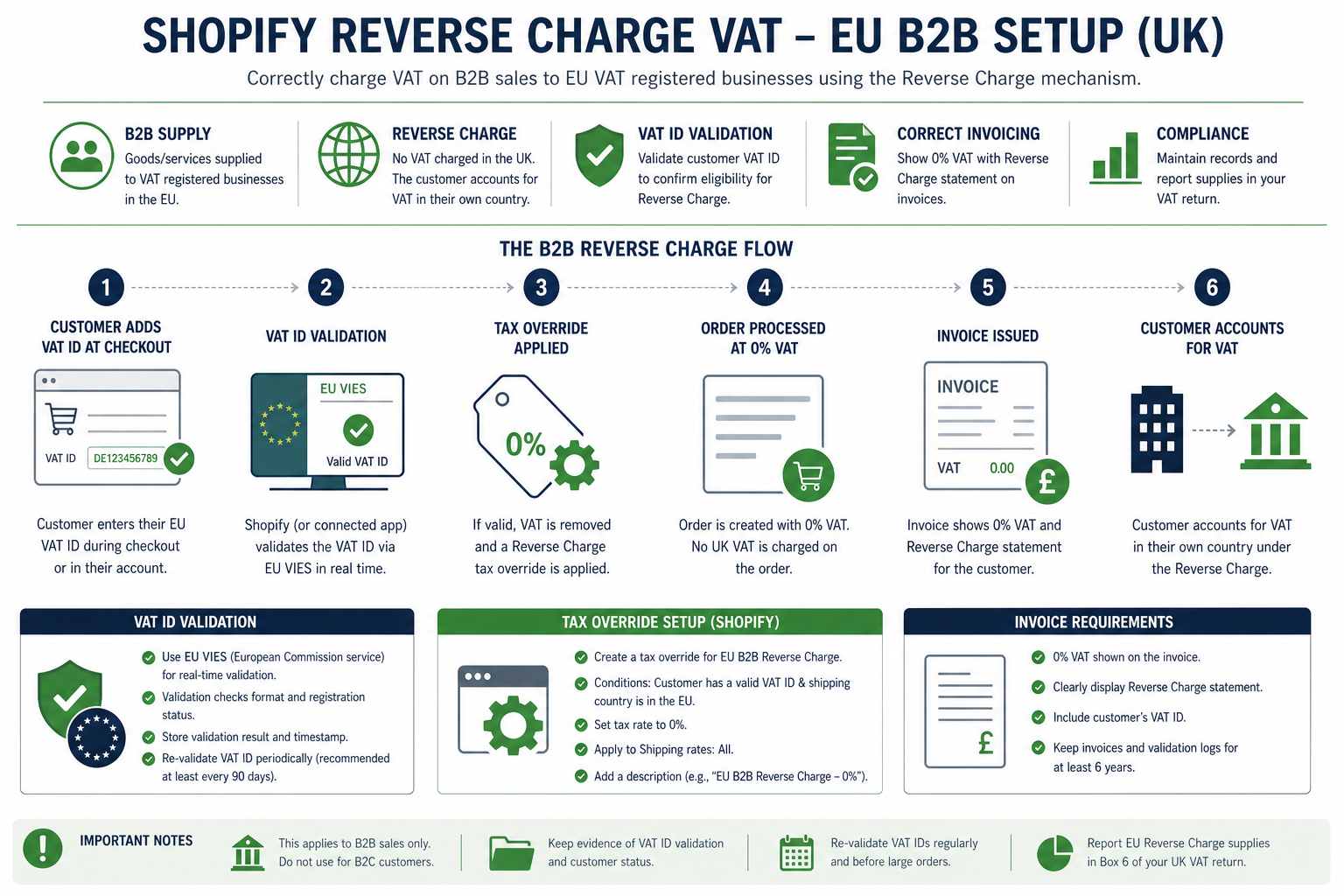
For qualifying B2B cross-border EU sales, VAT liability may shift to the buyer under reverse charge rules — but eligibility depends on customer status, product type, and registration. Shopify does not replace professional tax advice; it executes rules you define.
See also: Shopify VAT and B2B tax setup UK and EU.
Prerequisites before Shopify configuration
- Written rules from your accountant for EU B2B vs B2C
- VAT OSS / IOSS / registration status documented
- List of EU countries you sell to and product tax categories
- Decision on Shopify B2B vs standard customer accounts with metafields
Shopify admin setup steps
| Step | Action |
|---|---|
| 1 | Configure Markets for EU countries you serve |
| 2 | Set tax regions and product tax categories |
| 3 | Enable customer tax exemptions for valid VAT IDs where applicable |
| 4 | Test B2B checkout with EU VAT number in staging |
| 5 | Verify order tax lines match accountant expectations |
Use Shopify Tax or approved tax apps if native rules are insufficient for your stack.
Customer VAT validation workflow
- Collect VAT ID at registration or checkout
- Validate format; consider VIES-style checks where appropriate
- Store VAT status on customer record (metafield or B2B company profile)
- Block reverse charge until validation passes
Invoices, checkout messaging, and proof
Checkout and invoice templates should show reverse charge wording only when your accountant approves exact text. Keep audit trail: customer VAT ID, validation timestamp, order tax lines.
Common misconfiguration patterns
| Mistake | Symptom |
|---|---|
| Reverse charge applied to B2C EU buyers | Customer complaints, compliance risk |
| No VAT ID gate | Incorrect zero-rated orders |
| Mixed Markets and legacy tax settings | Random tax on same SKU |
| Theme hides tax breakdown | Finance cannot reconcile |
Related: Shopify UK EU VAT customs compliance for cross-border ops context.
StoreBuilt example
A UK industrial supplies merchant selling to EU trade accounts had Shopify charging UK VAT on every export order. StoreBuilt implemented B2B company profiles, VAT ID capture, and accountant-signed tax overrides. Finance reconciliation time dropped because order tax lines matched their ERP expectations.
Final StoreBuilt point of view
Reverse charge VAT on Shopify is an implementation exercise bounded by professional tax advice. Get rules on paper first, then configure Markets, customer validation, and checkout proof — and test with real EU B2B scenarios before launch.