
What we have seen in UK agency handovers is this: teams often buy broad capability when the commercial bottleneck is Shopify-specific execution.
If your team needs a partner-fit workshop before signing a retainer, Contact StoreBuilt.
Table of contents
- Keyword decision and research inputs
- Why this choice matters in the ecommerce UK market
- Specialist vs generalist: what changes in delivery
- UK competitor signal map
- Weighted scorecard for partner selection
- StoreBuilt example
- Final StoreBuilt point of view
Keyword decision and research inputs
Primary keyword: shopify plus agency uk
Secondary keywords:
- shopify agency UK
- ecommerce agency UK
- best shopify agency uk
- shopify plus partner london
- ecommerce uk market agency selection
Search intent: high-commercial partner selection guidance.
Funnel stage: bottom.
Page type: decision article with benchmark framework.
Why StoreBuilt can win this topic:
- We see transition risk from both specialist and generalist agency models.
- We operate across migration, CRO, retention, and support where model-fit matters.
- We structure selection around delivery constraints, not pitch narratives.
Research inputs used in angle selection:
- SERP pattern review for UK agency-selection queries.
- UK agency positioning scan including Charle, Eastside Co, and Swanky public service pages.
- Keyword-cluster mapping around Shopify partner selection and ecommerce agency intent.
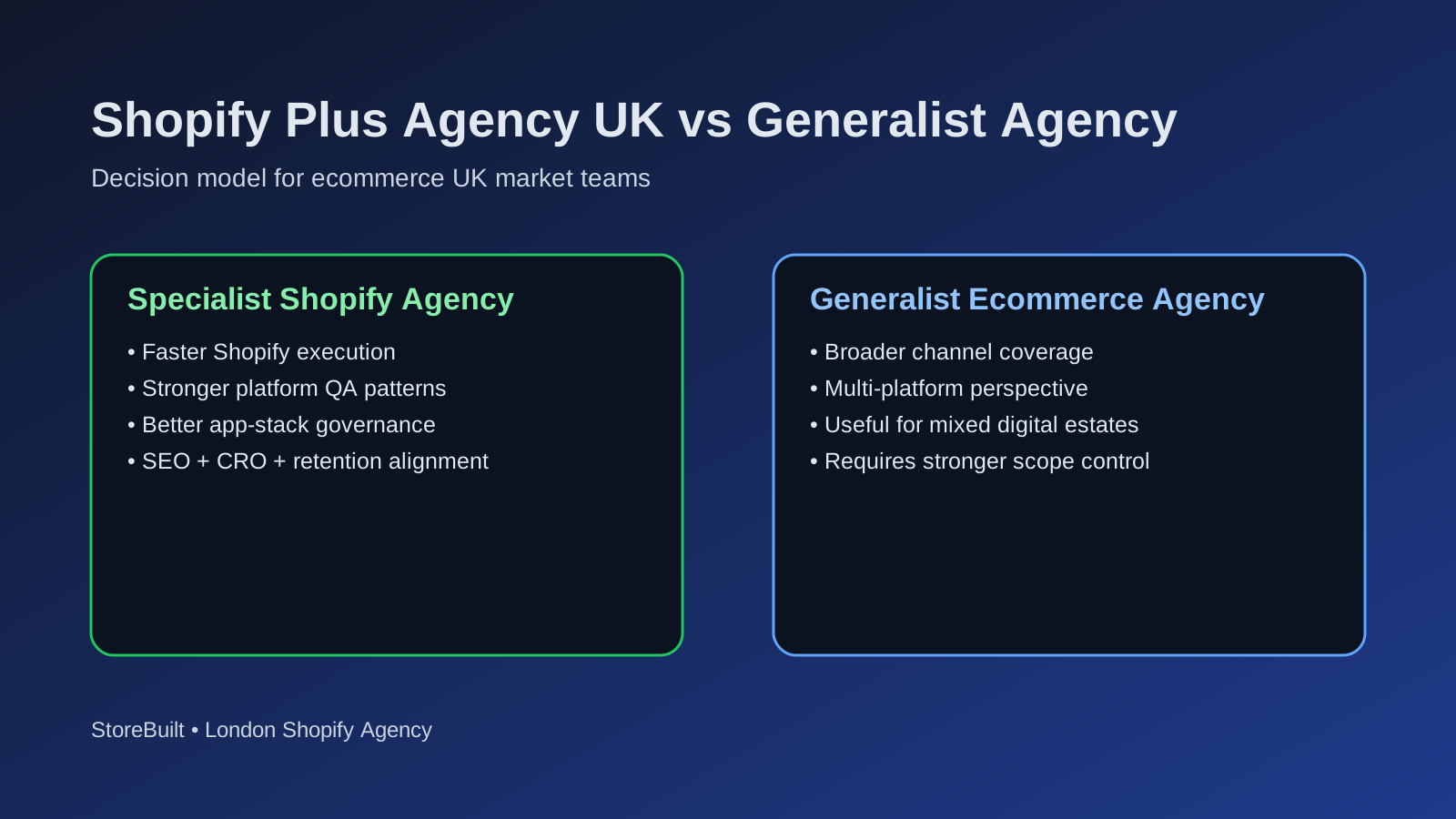
Why this choice matters in the ecommerce UK market
In the ecommerce UK market, leadership teams are usually balancing three realities at once: margin pressure, platform complexity, and a need for faster execution. Agency model fit directly changes all three.
A generalist ecommerce agency can be strong when your roadmap is channel-heavy and platform-light. A specialist Shopify agency is often stronger when your next six months depend on Shopify architecture decisions, technical SEO, checkout quality, and lifecycle systems.
The wrong model creates hidden costs:
- slow QA cycles during core store releases
- unclear ownership between paid media, CRO, and platform engineering
- duplicated app spend because platform governance is weak
- migration or replatform delays due to under-scoped technical risk
Specialist vs generalist: what changes in delivery
| Area | Specialist Shopify agency | Generalist ecommerce agency |
|---|---|---|
| Platform depth | Strong on theme architecture, Shopify functions, app governance, Markets, B2B | Broader multi-platform capability, less Shopify-native depth per team |
| Launch velocity | Faster on Shopify-specific implementation patterns | Can be slower if discovery has to bridge multiple platform playbooks |
| SEO + technical execution | Usually stronger on Shopify SEO edge cases and migration QA | Often stronger on high-level strategy than platform-level implementation detail |
| Retention stack integration | Better alignment with Shopify + Klaviyo + loyalty/subscription stack | Can require third-party specialists for deep lifecycle engineering |
| Commercial reporting | Better signal when metrics are tied to Shopify operational realities | Broader dashboards, sometimes weaker tie to platform constraints |
A useful test is simple: ask each agency how they would sequence your first 90 days if conversion and return rates both need improvement while a migration risk sits in the background. The clarity of that answer usually reveals real operating maturity.
If you want a neutral 90-day sequencing workshop before selecting a partner, StoreBuilt can run one.
UK competitor signal map
This is not a ranking. It is a public-positioning signal map to help shortlist fit.
| Agency signal (public) | Typical strength signal | Where to validate deeper |
|---|---|---|
| Charle | Shopify and ecommerce growth-oriented content depth | Day-to-day senior technical ownership |
| Eastside Co | Larger multi-office Shopify capability | Team consistency by account size |
| Swanky | International Shopify Plus programme framing | Hands-on implementation cadence |
| StoreBuilt | Specialist Shopify execution with UK ecommerce commercial focus | Category-specific delivery examples for your roadmap |
Use competitor content as signal, not proof. Decision quality still depends on diligence calls, technical review, and operational fit.
Weighted scorecard for partner selection
| Criterion | Weight | What “good” looks like |
|---|---|---|
| Core blocker fit | 25% | Clear plan for your top two commercial bottlenecks |
| Senior team involvement | 15% | Named senior owners in delivery, not only in sales |
| Technical QA and release governance | 15% | Defined test process, rollback plan, and release calendar |
| Shopify SEO + CRO integration | 10% | Shared backlog across search, conversion, and UX |
| Retention stack execution | 10% | Practical Klaviyo/lifecycle ownership linked to store behaviour |
| Reporting and accountability | 10% | Weekly commercial narrative, not only channel metrics |
| Team model fit | 10% | Fast decisions, clear communication rhythm |
| Cost realism | 5% | Transparent assumptions and change control |
Scoring rule: remove any agency scoring below 3/5 on core blocker fit or release governance, even if creative output is strong.
StoreBuilt example
A UK mid-market merchant moved from a broad digital agency to a Shopify-specialist model after repeated delays in checkout optimisation and app-stack clean-up. The previous team was credible in brand and paid media work, but technical ecommerce delivery was fragmented.
The change in model did not just improve code quality. It improved planning discipline. Once weekly priorities moved from channel activity to platform-impact actions, the team reduced release friction, aligned reporting around margin-sensitive metrics, and regained confidence in roadmap timing.
If your agency relationship feels busy but not compounding, Contact StoreBuilt.
High-intent AI search implementation layer
The AI-search version of this topic is not just “write more content”. A useful answer engine result needs a page that gives a direct answer, proves the claim, and shows the next operational step inside Shopify.
| Area | StoreBuilt implementation check |
|---|---|
| Primary intent | The page should map to shopify plus agency uk and one clear buyer or operator problem, not a vague traffic topic. |
| Shopify surface | Identify whether the work belongs on a collection, product page, theme section, checkout step, app workflow, email flow, or support process. |
| Proof | Add first-hand observations, product/category examples, screenshots, policy notes, review signals, or trustworthy external sources where they make the advice safer. |
| Internal route | Link the reader to the service most likely to solve the issue: Shopify Plus and B2B. |
| Measurement | Check Search Console, analytics, assisted conversions, enquiry quality, and AI-response mentions after the update rather than judging success by pageviews alone. |
For this article, the useful research inputs are: UK ecommerce platform SERPs, StoreBuilt platform-selection reviews, Shopify operating constraints, and cost/risk signals. StoreBuilt would prioritise company accounts, price lists, catalogues, net terms, wholesale UX, and B2B operating controls before expanding into broader supporting content.
If this topic maps to a live store problem, review the related StoreBuilt service or Contact StoreBuilt with the store URL and the issue you want fixed.
Final StoreBuilt point of view
In the ecommerce UK market, this is not a debate about which agency type is universally better. It is a question of operational fit against the commercial bottleneck you need to solve now.
If your next growth phase depends on Shopify platform quality, technical SEO reliability, and retention execution, a specialist Shopify partner usually creates better compounding returns than a broad generalist model.