
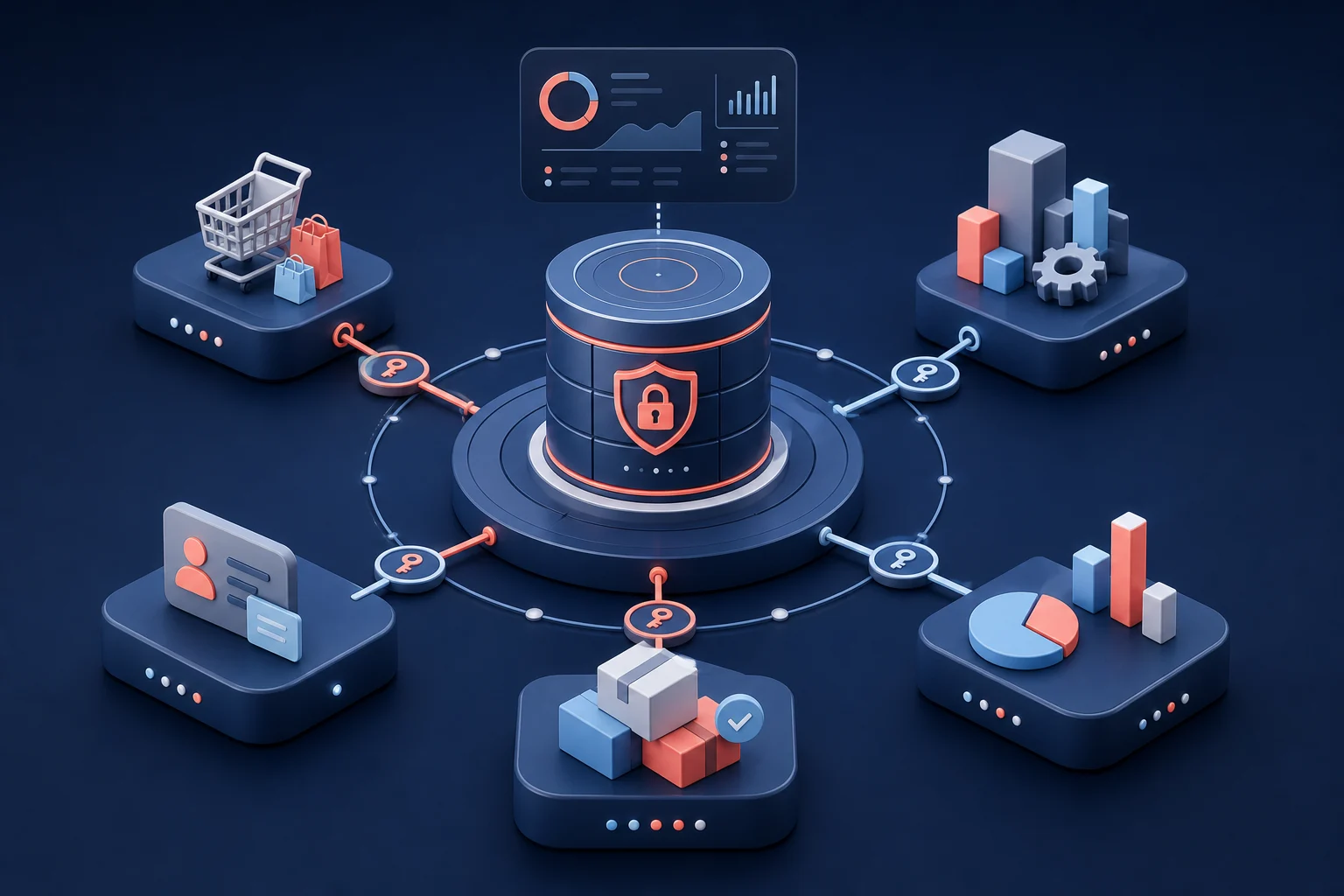
What we have seen in troubled integrations is this: the connector is blamed first, but the deeper issue is often that two systems are both allowed to be “right”. A dependable Shopify integration agency UK brief begins with ownership.
Explore Shopify support and audits.
Table of contents
- Keyword decision
- Build the ownership matrix
- Design for disagreement
- Monitoring that operations can use
- Migration and vendor safeguards
- A practical discovery plan
- StoreBuilt point of view
Keyword decision
Primary keyword: Shopify integration agency UK with secondary intents Shopify ERP integration, ecommerce data ownership and Shopify systems architecture. Agency pages dominate buying intent; this supporting guide targets the operational question buyers ask during discovery and routes qualified readers to Shopify support, maintenance and audits.
Build the ownership matrix
List every business-critical object and field. “Product data comes from the PIM” is too vague if merchandising updates copy in Shopify while ERP overwrites price.
| Data | Likely owner | Questions to resolve |
|---|---|---|
| Product copy | PIM or Shopify | Who can publish and approve? |
| Price | ERP or commerce | How are scheduled promotions handled? |
| Inventory | ERP/WMS | Is availability physical, available-to-promise or buffered? |
| Order | Shopify | Which downstream system may change status? |
| Fulfilment | WMS/3PL | How are partials and cancellations returned? |
| Customer | CRM/Shopify | Which fields may merge? |
| Consent | Consent source | Is provenance and timestamp preserved? |
| Finance | ERP/accounting | What is the reconciliation boundary? |
For each row define system owner, business owner, update direction, frequency, permitted transformation and failure response.
Design for disagreement
Integrations fail in ordinary ways: a SKU is missing, an address exceeds a field limit, credentials expire or a downstream API slows. The design should answer whether to retry, quarantine, reject or continue with a fallback.
Use idempotency so retrying does not create duplicate orders or refunds. Preserve stable external identifiers. Keep a traceable log of transformations. Establish reconciliation jobs rather than assuming “no alert” means accuracy.
An anonymous UK retailer had orders flowing successfully while a subset of stock updates silently failed because a new location code was unmapped. The improvement combined mapping validation, freshness alerts and daily reconciliation. A dashboard alone would not have corrected the ownership gap.
Monitoring that operations can use
Technical uptime is insufficient. Monitor:
- Age of the last successful update
- Failed and quarantined records
- Queue depth and processing delay
- Inventory or financial reconciliation difference
- Orders stuck in an intermediate state
- Authentication and API-version risk
Create severity definitions. A single delayed marketing attribute is not equivalent to checkout orders failing to reach fulfilment. Route alerts to people with authority to act and keep a support runbook.
Migration and vendor safeguards
Before replacing an app, ERP or agency, confirm access to source code where applicable, credentials, mapping documentation, environments, logs and exportable history. Record third-party account ownership in the client’s organisation rather than a contractor’s personal account.
Avoid a migration that changes platform, data model, warehouse workflow and reporting simultaneously without staged validation. Use comparison reports and a rollback or containment plan.
A practical discovery plan
- Interview commerce, operations, finance and CX separately.
- Map current systems and data flows.
- Identify authoritative fields and conflicting edits.
- Rank failures by revenue, customer and compliance impact.
- Define monitoring and reconciliation acceptance criteria.
- Prototype the riskiest journey.
- Test partial, duplicate, delayed and invalid records.
Include data-protection review where personal data moves between processors. This guide is technical guidance, not legal advice.
StoreBuilt point of view
The integration diagram is not the deliverable. Reliable ownership is. StoreBuilt would rather see a small, observable flow with clear reconciliation than a sprawling stack whose success depends on nobody noticing the errors.