
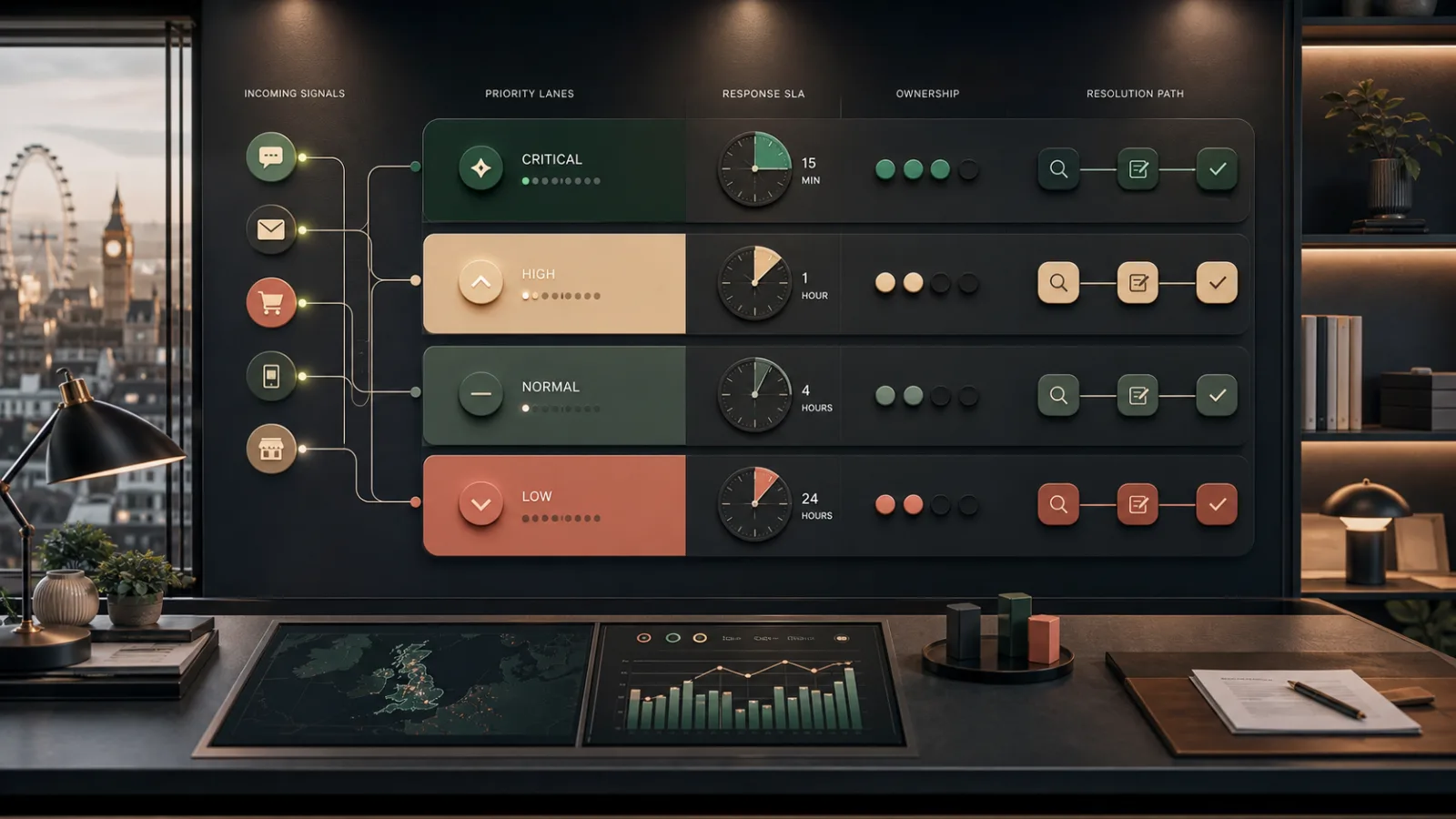
What we have seen is this: a fast automatic reply can coexist with a slow customer outcome. Ecommerce teams improve service when they design promises around risk, ownership and resolution—not when they chase one average response-time number.
Contact StoreBuilt to connect Shopify order context with a workable support process.
Table of contents
- Keyword decision
- Separate acknowledgement from resolution
- Build priority rules
- Define the SLA clock
- Give agents the right Shopify context
- Measure customer outcomes
- StoreBuilt point of view
Keyword decision
Primary keyword: Shopify customer support SLA. Secondary intents include ecommerce customer service SLA UK, Shopify support workflow and ecommerce response time. Intent is middle-funnel operational design. UK agency results tend to explain Shopify support services or list helpdesk tools; this article targets the merchant-side operating model, connecting order data, urgency and escalation.
Separate acknowledgement from resolution
Use at least four clocks: acknowledgement, meaningful first response, next update and resolution. An automated receipt can reassure the customer, but it should not be reported as the same thing as an agent solving the issue.
| Measure | What it proves | What it can hide |
|---|---|---|
| acknowledgement | message arrived | no investigation started |
| meaningful first response | useful action or question | ownership may still be unclear |
| next-update target | customer is not left guessing | case may remain blocked |
| resolution | outcome completed | poor quality or repeat contact |
An anonymous UK brand celebrated a low first-response time while customers contacted it repeatedly about address changes. Bots answered instantly, but the warehouse cut-off passed before a person acted. A risk-based cancellation and address lane mattered more than the global average.
Build priority rules
Priority should come from impact and time sensitivity, not customer volume alone. A social complaint may be visible, but a captured payment with no reliable order, possible account compromise or allergy concern can carry greater risk.
| Priority | Example | Handling principle |
|---|---|---|
| Critical | safety issue, account compromise, systemic checkout failure | immediate ownership and leadership path |
| High | cancellation before dispatch, payment/order mismatch, failed delivery today | act within the operational window |
| Normal | return request, product advice, invoice copy | queue by target and customer context |
| Low | general feedback, non-urgent account tidy-up | resolve efficiently without displacing risk |
Define vulnerable-customer and accessibility adjustments. Give agents discretion to raise priority when the standard channel or response format creates a barrier.
See StoreBuilt Shopify support, maintenance, and audit services for ongoing implementation work.
Define the SLA clock
State the time zone, business hours, public-holiday treatment and channel coverage. Decide when the clock begins, pauses and resumes. “Waiting on customer” may pause resolution, but “waiting on our warehouse” should normally remain owned internally.
Set targets from capacity and risk. Email, live chat and social messaging do not need identical promises. Avoid advertising 24/7 support if only an autoresponder is always on. For peak periods, publish a temporary service plan and add capacity before extending every deadline.
Escalation should occur before breach. At 50% of the target, check ownership; near the deadline, route to a senior queue; on breach, capture cause and issue a customer update. Silent reassignment merely moves the ageing ticket.
Give agents the right Shopify context
Support should see customer identity, order and payment state, fulfilment location, tracking, refund history, tags, relevant subscription status and prior contact without copying sensitive data into uncontrolled notes. Deep links are safer than repeated exports.
Create approved actions and guardrails:
| Action | Required context | Control |
|---|---|---|
| cancel order | fulfilment and warehouse state | cut-off and confirmation |
| change address | dispatch state and fraud risk | revalidation and audit note |
| refund | payment, return and policy | threshold or approval |
| resend item | stock and claim evidence | duplicate-check |
| issue goodwill | customer history and reason | capped permission |
Automation should classify and enrich, not invent certainty. Use order number extraction, sentiment or intent hints and status lookup to reduce handling time. Keep human review for ambiguous refunds, fraud, safety and exceptions.
Measure customer outcomes
Track median and 90th-percentile response and resolution, SLA attainment by priority, reopen rate, repeat contact, backlog age, transfer count and customer outcome. Average time alone allows a small number of very old cases to disappear.
Connect service demand to root causes. Tag contacts caused by delivery promise, theme confusion, discount rules, failed payment, product content or app incidents. A support programme creates more value when it removes the storefront issue producing tickets.
Review breached cases weekly. Separate demand spikes, poor routing, missing permissions, external dependency and product defects. Assign an owner and prevention action. If a warehouse repeatedly blocks cancellations, change the order-to-warehouse workflow rather than training agents to apologise faster.
Start a Shopify audit to find customer-service demand created by store friction.
Staff the promise and manage dependencies
An SLA is only credible when capacity planning supports it. Forecast contact volume from orders, campaign calendar, delivery incidents, launches and return peaks. Translate that demand into staffed hours by channel and skill. A team that can answer product questions may not have permission to resolve payment, fraud or warehouse exceptions, so raw headcount is not the same as usable capacity.
Build handovers for work that crosses shifts or suppliers. The record should show current customer impact, completed checks, next action, dependency owner and next update time. Do not make the customer restate the history because an outsourced team, warehouse or developer entered the case.
External dependencies still belong in the service design. Set an internal response expectation for the 3PL, carrier, payment provider and development partner. When their target is slower than the customer promise, create an escalation route or change the promise. “Waiting on a third party” explains the blockage internally; it does not remove the need to update the customer.
Quality assurance should sample resolved and reopened cases across every priority. Check whether the agent verified identity, understood the order state, used an approved remedy, recorded the reason and communicated a clear outcome. Fast responses that create a second contact should count as avoidable work.
Create a major-incident mode for widespread checkout, payment, fulfilment or delivery disruption. Consolidate duplicate contacts, publish one approved status, protect high-risk cases and update storefront messaging where appropriate. Individual agents should not compose conflicting explanations while the underlying incident changes.
Finally, review the promise quarterly. Product mix, international expansion, warehouse cut-offs and channel volume change. An SLA inherited from a smaller operation can become either impossible or unnecessarily slow. Keep the public promise stable where possible, but adjust routing, capacity and escalation as the business changes.
StoreBuilt point of view
StoreBuilt believes a support SLA is a decision system, not a stopwatch. The best model protects short operational windows, equips the owner with order truth and measures whether the customer actually needed to contact you again.